Blog

  • Jesus Born in a Bethlehem Manger: Significance & Meaning

    Jesus Born in a Bethlehem Manger: Significance & Meaning

    Christmas means “Christ-mass” or to worship Christ. The actual date of Jesus’ birth, the decorations, or the gifts are not the true meaning of Christmas. Christmas is about the spirit of worship of Jesus Christ. When you get a glimpse of Jesus, it stirs up true worship and releases God’s peace and blessing.

    Christmas is the celebration of God’s passionate pursuit of mankind. God is breaking into the brokenness of this world with His love and power. The birth of Jesus in Bethlehem’s manger reveals how God works to bring about His purposes in the world.

    Christmas means different things to different people. There can be beautiful memories and traditions around Christmas. But what does the Bible say about Jesus’ birth? Why was Jesus born in Bethlehem? Why was He placed in a manger? The Bible’s answers to these questions unlock the true meaning of Christmas.

    Jesus placed in a manger in Bethlehem is not just a sentimental scene. It’s the way God’s Kingdom operates. From the manger to the cross, God’s way is displayed.

    Will we learn Jesus’ ways so that our weariness and heaven burdens will be lifted? God is in control. He even uses a burdensome governmental edict and census to bring about the fulfillment of His promises of a Savior.
    Jesus Born in a Bethlehem Manger: Significance & Meaning

    Why was Jesus born in Bethlehem?

    Jesus was born in Bethlehem because of a 700 year old prophecy.

    Jesus’ birth in the town of King David’s birth reveals that God is in control. God even allows a government mandated census to bring about the fulfillment of His promises of a Savior.

    The Bible records in Luke 2:4-7 that Jesus Christ was born in Bethlehem. Bethlehem is in the country of Israel, on the continent of Asia, in the region referred to now as the Middle East.

    Micah prophesied 700 years before Jesus was born, that the Messiah would be born in Bethlehem. Bethlehem was the city where David, the second king of Israel, was born.

    But you, O Bethlehem Ephrathah,

        who are too little to be among the clans of Judah,

    from you shall come forth for me

        one who is to be ruler in Israel,

    whose coming forth is from of old,

        from ancient days.

    Micah 5:2 (ESV)

    The timing was terrible for Mary and Joseph as they were preparing for Mary to give birth. They were displaced from their home. The circumstances seemed unjust. Yet it was what God allowed. 

    Nazareth was Mary and Joseph’s hometown, in the Northern Israel region called Galilee. A government census forced them to leave the comfort of their home and travel about 90 miles south to Bethlehem. It was the time for Mary to give birth, so Jesus was born in Bethlehem and not in their hometown of Nazareth.

    The Shepherd’s Valley in Modern Day Bethlehem - Photo by David Kim
    The Shepherd’s Valley in Modern Day Bethlehem – Photo by David Kim

    God sometimes allows things for a purpose much greater than our temporary comfort. He is maturing His people to rule and reign with Him in His Kingdom. Jesus’ birth in Bethlehem reveals how God brings about His Kingdom on the earth.

    Jesus was born in Bethlehem because there was a government mandated census. The census required everyone to return to their hometown (Luke 2:1-3). Joseph was from the lineage of David, so he had to go to Bethlehem.

    In those days a decree went out from Caesar Augustus that all the world should be registered. This was the first registration when Quirinius was governor of Syria. And all went to be registered, each to his own town. And Joseph also went up from Galilee, from the town of Nazareth, to Judea, to the city of David, which is called Bethlehem, because he was of the house and lineage of David, to be registered with Mary, his betrothed, who was with child. And while they were there, the time came for her to give birth. And she gave birth to her firstborn son and wrapped him in swaddling cloths and laid him in a manger, because there was no place for them in the inn.

    Luke 2:1-7 (ESV)

    Jesus would come to the Earth as Emmanuel, which means “God with us.” The circumstances of the entry of God’s Kingdom into the world would seemingly rest on man’s unjust government.

    Jesus’ birth in Bethlehem reveals that God is in control. He is on the throne in heaven. God uses the good and even the bad things that happen in the world to bring about His eternal, good purposes. Nothing can stop God’s ultimate purposes.

    There will be no end to the increase of God’s government and peace. When Jesus returns, He will fully bring God’s Kingdom, including His justice.

    For to us a child is born,
    to us a son is given;
    and the government shall be upon his shoulder,
    and his name shall be called
    Wonderful Counselor, Mighty God,
    Everlasting Father, Prince of Peace.
    Of the increase of his government and of peace
    there will be no end,
    on the throne of David and over his kingdom,
    to establish it and to uphold it
    with justice and with righteousness
    from this time forth and forevermore.
    The zeal of the Lord of hosts will do this.

    Isaiah 9:6-7 (ESV)

    Not only does this fulfill the prophecy that the Savior would be born in Bethlehem, but there is much more:

    How does God raise up His Ruler? In the context of weakness and government oppression.

    God uses an ungodly decree on Earth to accomplish His eternal purposes to bring about a Savior born in Bethlehem.

    This is the way God’s works in the world. He uses the weak to shame the seemingly wise and powerful.

    Jesus’ birth in Bethlehem also reveals that it was always in God’s plan to save His people. He did not leave a world in brokenness. He planned to do this before the foundation of the world (Rev. 13:8). In God’s perfect time, Jesus, the Son of God, was born.

    Why was Jesus born in a manger?

    Many depictions of Jesus’ birth, or nativity, show Him in a stable or barn. But the Bible does not say that Jesus was born in a stable or a barn. It’s true that Mary wrapped the baby with swaddling cloths and laid him in a manger.

    A manger is a feeding trough for animals. A manger is not the same as a stable or a barn where animals are kept. A manger, or feeding trough, is often found in a stable or barn, so Jesus could have been born in a stable. But the Bible does not say that.

    Jesus was not born in a manger, but He was laid in a manger, a feeding trough for animals, after He was born.

    Was Jesus born in a cave? An ancient tradition from a second century document says that Mary gave birth to baby Jesus in a cave, or grotto, in Bethlehem.

    In Bethlehem today, there is a structure called the Church of the Nativity. It was commissioned in 327 A.D. and built over the grotto, or cave, which marks the traditional spot where Jesus was thought to be born. A 14-pointed silver star marks the spot. The inscription in Latin reads: Here of the Virgin Mary Jesus Christ was born.

    The grotto, the cave, where Jesus was thought to be born - Photo by David Kim
    The grotto, the cave, where Jesus was thought to be born – Photo by David Kim

    Luke 2:7 tells us that Mary laid Jesus in a manger because there was no room for them in the inn. Perhaps this was because the city was overwhelmed by out-of-town people because of the census.

    Why is it significant that Jesus was born in a manger? The manger draws attention to the challenging and humble circumstances around Jesus’ birth. Many cultures wrap babies in swaddling cloths to help the baby calm down. Some say that it mimics the mother’s womb and soothes the baby. But it is unusual to place a baby in a manger. 

    Whether it was a cave, a stable, or somewhere else, Luke tells us that Mary laid Jesus in a manger (Luke 2:7).  It was not a hospital with white linens. It wasn’t in a comfy, cute story-book basket or a soft crib with sanitized, matching bed sheets.

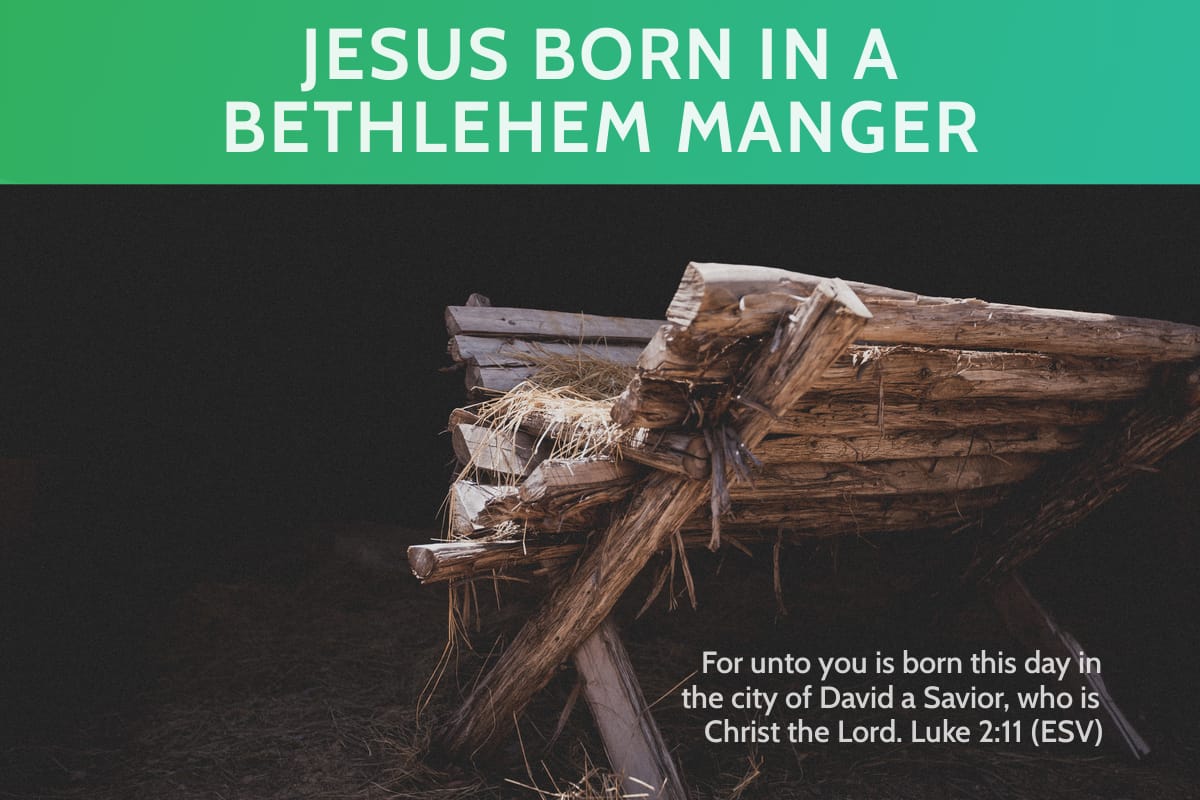
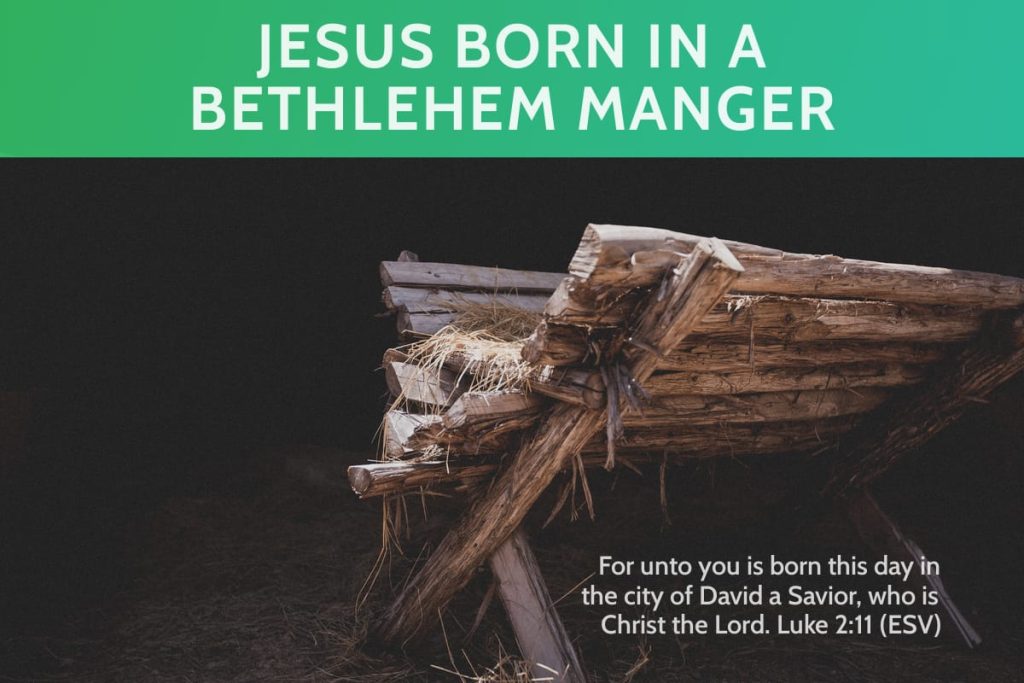
    A manger is a feeding trough for animals.
    A manger is a feeding trough for animals.

    Why was Jesus born and laid in a manger? To teach us that it’s into those very places of brokenness, the manger scenes of our lives, that God sends His Son.

    The manger where Christ was laid represents life improvised. It’s not plan A, it’s not plan B. It was never something anyone would have ever chosen. But it’s what life is right now.  It’s what’s available because the other options have fallen through. We pick up the pieces of our lives and try to move on. It can be in relationships, jobs, health issues, disappointments, trials, the pain.

    It’s what makes people ask: “If God were working in my life, surely, THIS couldn’t be happening… If God exists, why is there so much evil in this world? And in MY life?”

    Our lives are not always the picture-perfect Christmas card. It’s into the reality of brokenness in our world that the hope of God and the light of the world begins to reveal His life. There is a baby lying in a manger, He is Christ, the Lord.

    It’s into those very places of brokenness, the manger scenes of our lives, that God sends His Son.

    Oftentimes, we want God to wave His magic wand over our lives and make all the problems go away. We want God to remove all our weaknesses and problems. Sometimes, God says: That’s where I want to reveal myself. That’s where My strength is made perfect, even in your weakness.

    Jesus Christ did not come as some would have imagined in His first coming. In His Second Coming, He will return as the King and Judge. But God first came to us as a Baby in the Manger and eventually, as the Lamb of God who would lay down His life on the cross.

    Jesus placed in a manger in Bethlehem is not just a sentimental scene. It’s the way that God’s Kingdom operates.

    Jesus was not born in a King’s place, but placed in a manger. He came as a humble servant, as the Lamb of God, to ultimately lay down His life as a sacrifice for sin.

    From the manger to the cross, God’s ways are displayed. Will we learn Jesus’ ways so that our weariness and heaven burdens will be lifted? Will we truly be able to experience as the popular Christmas song “O Holy Night” say: A weary world rejoices?

    Jesus invites you to learn His ways and bring your burdens to Him. All who are burdened and heavy laden can come to Him.

    Come to me, all who labor and are heavy laden, and I will give you rest. Take my yoke upon you, and learn from me, for I am gentle and lowly in heart, and you will find rest for your souls. For my yoke is easy, and my burden is light.”

    Matthew 11:28-30 (ESV)

    Come and Behold Him!

    Christmas is an invitation to come and behold the glory of God in the face of Jesus Christ.

    Let the lights of Christmas draw you to behold Jesus, the light of the world, Whose light shines in the darkness (John 8:12)

    Let the music of Christmas open your ears to the declaration of heaven and the hosts of angels who appeared to the shepherds and announced: “Glory to God in the highest, and on earth peace among those with whom he is pleased!” (Luke 2:14)

    Let the candy canes of Christmas remind you of the Great Shepherd who will lead and guide His people like a shepherd with the shepherd’s staff (Psalm 23).

    Let the Christmas tree and the gifts under the tree remind you that God so loved the world, He gave His Jesus, who died on the cross, a tree (1 Peter 2:24). Let it stir true joy and celebration in your heart, that God gave the best He had, His only Son (John 3:16)

    For unto you is born this day in the city of David a Savior, who is Christ the Lord.

    Luke 2:11 (ESV)


    Subscribe to my newsletter for updates and encouraging content.


    Here are others articles that you might find helpful:

    What Is Worship According to the Bible? Definitions & Foundations

    How to Get to Heaven According to the Bible: It’s NOT by Being Good

    One Bible Study resource that I highly recommend is: Unlocking the Bible: A Unique Overview of the Whole Bible (You can check out the reviews on this link to Amazon). It has a chapter on every book of the Bible, is very clear, and has great insights. Be sure to get the book and not the one that has just diagrams, charts, and images. The covers look very similar.

    Scripture quotations are from the ESV® Bible (The Holy Bible, English Standard Version®), copyright © 2001 by Crossway, a publishing ministry of Good News Publishers. Used by permission. All rights reserved. May not copy or download more than 500 consecutive verses of the ESV Bible or more than one half of any book of the ESV Bible.


    Read the Christmas Bible Story

    26 In the sixth month the angel Gabriel was sent from God to a city of Galilee named Nazareth, 27 to a virgin betrothed to a man whose name was Joseph, of the house of David. And the virgin’s name was Mary. 28 And he came to her and said, “Greetings, O favored one, the Lord is with you!” 29 But she was greatly troubled at the saying, and tried to discern what sort of greeting this might be. 30 And the angel said to her, “Do not be afraid, Mary, for you have found favor with God. 31 And behold, you will conceive in your womb and bear a son, and you shall call his name Jesus. 32 He will be great and will be called the Son of the Most High. And the Lord God will give to him the throne of his father David, 33 and he will reign over the house of Jacob forever, and of his kingdom there will be no end.”

    34 And Mary said to the angel, “How will this be, since I am a virgin?”

    35 And the angel answered her, “The Holy Spirit will come upon you, and the power of the Most High will overshadow you; therefore the child to be born will be called holy—the Son of God. 36 And behold, your relative Elizabeth in her old age has also conceived a son, and this is the sixth month with her who was called barren. 37 For nothing will be impossible with God.” 38 And Mary said, “Behold, I am the servant of the Lord; let it be to me according to your word.” And the angel departed from her.

    Luke 1:26-38 (ESV)

    18 Now the birth of Jesus Christ took place in this way. When his mother Mary had been betrothed to Joseph, before they came together she was found to be with child from the Holy Spirit. 19 And her husband Joseph, being a just man and unwilling to put her to shame, resolved to divorce her quietly. 20 But as he considered these things, behold, an angel of the Lord appeared to him in a dream, saying, “Joseph, son of David, do not fear to take Mary as your wife, for that which is conceived in her is from the Holy Spirit. 21 She will bear a son, and you shall call his name Jesus, for he will save his people from their sins.” 22 All this took place to fulfill what the Lord had spoken by the prophet:

    23 “Behold, the virgin shall conceive and bear a son,
    and they shall call his name Immanuel”

    (which means, God with us). 24 When Joseph woke from sleep, he did as the angel of the Lord commanded him: he took his wife, 25 but knew her not until she had given birth to a son. And he called his name Jesus.

    Matthew 1:18-25 (ESV)

    In those days a decree went out from Caesar Augustus that all the world should be registered. 2 This was the first registration when Quirinius was governor of Syria. 3 And all went to be registered, each to his own town. 4 And Joseph also went up from Galilee, from the town of Nazareth, to Judea, to the city of David, which is called Bethlehem, because he was of the house and lineage of David, 5 to be registered with Mary, his betrothed, who was with child. 6 And while they were there, the time came for her to give birth. 7 And she gave birth to her firstborn son and wrapped him in swaddling cloths and laid him in a manger, because there was no place for them in the inn.

    8 And in the same region there were shepherds out in the field, keeping watch over their flock by night. 9 And an angel of the Lord appeared to them, and the glory of the Lord shone around them, and they were filled with great fear. 10 And the angel said to them, “Fear not, for behold, I bring you good news of great joy that will be for all the people. 11 For unto you is born this day in the city of David a Savior, who is Christ the Lord. 12 And this will be a sign for you: you will find a baby wrapped in swaddling cloths and lying in a manger.” 13 And suddenly there was with the angel a multitude of the heavenly host praising God and saying,

    14 “Glory to God in the highest,
    and on earth peace among those with whom he is pleased!”

    15 When the angels went away from them into heaven, the shepherds said to one another, “Let us go over to Bethlehem and see this thing that has happened, which the Lord has made known to us.” 16 And they went with haste and found Mary and Joseph, and the baby lying in a manger. 17 And when they saw it, they made known the saying that had been told them concerning this child. 18 And all who heard it wondered at what the shepherds told them. 19 But Mary treasured up all these things, pondering them in her heart. 20 And the shepherds returned, glorifying and praising God for all they had heard and seen, as it had been told them.

    21 And at the end of eight days, when he was circumcised, he was called Jesus, the name given by the angel before he was conceived in the womb.

    Luke 2:1-21 (ESV)

    Now after Jesus was born in Bethlehem of Judea in the days of Herod the king, behold, wise men from the east came to Jerusalem, 2 saying, “Where is he who has been born king of the Jews? For we saw his star when it rose and have come to worship him.” 3 When Herod the king heard this, he was troubled, and all Jerusalem with him; 4 and assembling all the chief priests and scribes of the people, he inquired of them where the Christ was to be born. 5 They told him, “In Bethlehem of Judea, for so it is written by the prophet:

    6 “‘And you, O Bethlehem, in the land of Judah,
    are by no means least among the rulers of Judah;
    for from you shall come a ruler
    who will shepherd my people Israel.’”

    7 Then Herod summoned the wise men secretly and ascertained from them what time the star had appeared. 8 And he sent them to Bethlehem, saying, “Go and search diligently for the child, and when you have found him, bring me word, that I too may come and worship him.” 9 After listening to the king, they went on their way. And behold, the star that they had seen when it rose went before them until it came to rest over the place where the child was. 10 When they saw the star, they rejoiced exceedingly with great joy. 11 And going into the house, they saw the child with Mary his mother, and they fell down and worshiped him. Then, opening their treasures, they offered him gifts, gold and frankincense and myrrh. 12 And being warned in a dream not to return to Herod, they departed to their own country by another way.

    Matthew 2:1-12 (ESV)
  • Book of James: Summary, Meaning & Application

    Book of James: Summary, Meaning & Application

    The Book of James is an important book in the Bible. Throughout history, people have had different opinions on what it means. A few have even said that it is not helpful for Christians to study! Because of this, James has sometimes been misunderstood, misused, and neglected.

    In this article, we will examine what the Epistle of James is about and summarize its teaching so we can apply it to our lives.

    The Book of James explains how to receive wisdom from God’s Word. Wisdom from God results in a life that is fruitful even in the face of hardships. James applies the teachings of Jesus, especially the Sermon on the Mount, to everyday life. It explains what a life of obedience to Christ looks like.

    One of the keys to understanding the book of James is that it is an application of the Sermon on the Mount that Jesus taught.

    James Summary

    James is not just about trying to get to heaven when you die. The biblical Gospel is living as people of God’s Kingdom now, not just in the future. Grace release power to live everyday as people of God’s Kingdom.

    James and sermon on Mount is not a call to try to live a better life. It describes God’s Kingdom, not man’s wisdom. It’s not a band-aid for a broken and hurting world. It’s an entirely different way of looking at the world. It requires repentance: to see God, yourself, and the world differently.

    The goal of the book of James is nothing less than our full spiritual maturity as Jesus’ disciples

    The Sermon on the Mount in Matthew 5-7 is not just a good set of morals that you can try to live by. It’s impossible because the Kingdom of God cannot be entered into by man’s efforts.

    Here are some of the ways that James refers to his brother, Jesus’ teaching in the book of James:

    References to the Sermon on the Mount in the Book Of James

    Book of JamesSermon on the MountThemes
    James 1:2Matthew 5:10-12Blessing in facing trials
    James 1:4Matthew 5:48The goal of the Gospel: be perfect, complete
    James 1:6Matthew 7:7Asking in faith
    James 1:20Matthew 5:22The limits of man’s anger
    James 1:22Matthew 7:24-27Doing the word of God
    James 3:18Matthew 5:9Pursuing peace
    James 5:2Matthew 6:19Moth and rust of earthly riches
    James 5:3Matthew 6:21Storing up treasures reveals the heart
    James 5:10Matthew 5:12Example of prophets’ suffering
    James 5:12Matthew 5:34Not taking oaths

    The goal of both the book of James and the Sermon on the Mount is the same: to be perfect and complete as the Father in heaven is perfect. 

    You therefore must be perfect, as your heavenly Father is perfect.

    Matthew 5:48 (ESV)

    And let steadfastness have its full effect, that you may be perfect and complete, lacking in nothing.

    James 1:4 (ESV)

    To be perfect doesn’t mean that you never sin (1 John 1:8-10). It means that you will be complete in Christ. The goal is not to become spiritual child, but to be fully mature in Christ.

    The call of the Gospel is so much higher and the grace of God so much greater than we can ever imagine. The good news is not only that you can go to heaven when you die if you believe in Jesus. The Good News gets even better.

    The Gospel is an invitation into a life in God that is impossible by man’s efforts or works. But God gives us His grace. Grace is not an excuse to live however you want. Grace is the empowerment on your heart to live out the Good News that Jesus preached. It’s a glorious Gospel.

    James describes God’s vision for your life: to go from drifting and being tossed to and fro by the wind and the waves to receiving God’s true wisdom. This is God’s vision for your life and it will bring you into the fullness of Christ.

    James is a call to perfection, or completeness, in Christ. It’s a call to action, to obedience to Christ out of love and to patient endurance unto fruitfulness.

    The Gospel is sometimes understood in its very limited sense of believing in Jesus so your sins can be forgiven and you can go to heaven. The Gospel is much more than that.

    The Gospel is not trying harder to live for Christ. It’s nothing less than a new spiritual birth (John 3:3) until you are transformed into the image of Christ. It can never be entered in through trying to live a better life in your own strength. This can only be received through repentance and faith in Christ. 

    The Gospel of Jesus Christ results in a righteousness that is way beyond the surface of what is often understand as religion. It’s a true relationship with the living God.
    Following Christ is not trying to improve your life or to try to live by a set of moral standards. The Christian life is to count your life as crucified with Christ. It’s to live in the newness of life of who Jesus is.

    The deep things of God are not complex philosophies, doctrines or spiritual experiences but simple acts of obedience to God out of love.

    James doesn’t allow for a Christianity that is lukewarm. It brings a much needed balance and understanding to the Gospel.

    The Benefits of Studying the Book of James in the Bible

    1. The Book of James explains how people get stuck in life and how to move on to spiritual maturity.
    2. James provides pieces that are vital to the Gospel of the Kingdom of God.
    3. James protects us from becoming content with a fruitless form of godliness.

    The key verses in James are James 1:21b-22. These 2 verses summarize the entire teaching of James.

    Therefore put away all filthiness and rampant wickedness and receive with meekness the implanted word, which is able to save your souls. But be doers of the word, and not hearers only, deceiving yourselves.

    James 1:21b-22 (ESV)

    James explains, as Jesus did, that the seed is the Word of God (Luke 8:11). The commands of Christ need to be received with meekness. This means that the Word of God needs to be received as God’s Word and joyful obedience will be the result.

    The book of James is not a random collection of wisdom sayings in the New Testament. Sometimes James is compared to the book of Proverbs in the Old Testament. There are several themes and topics that James focuses on and returns to throughout his epistle.

    The 5 Major Themes of James:

    1. Understanding the place of trials in the Christian life.
    2. Having a proper view of wealth and riches
    3. Receiving God’s Word rightly in order to see fruit.
    4. Emphasizing importance of doing and obeying the word of God out of faith.
    5. Submitting the tongue, our speech, to God.

    We’ll look at some of these themes in the summary of each chapter below. But first, let’s consider: Who is the author of the Book of James? Understanding who James is will give us insight into the letter that James wrote.

  • Who Wrote the Book of James?
  • Book of James Summary
  • Summary of James Chapter 1
  • Summary of James Chapter 2
  • Summary of James Chapter 3
  • Summary of James Chapter 4
  • Summary of James Chapter 5
  • James and Spiritual Warfare

Who Wrote the Book of James?

There are several people named James in the Bible, so which James wrote the book of James?

In general, the early church affirmed that James, the brother of Jesus, wrote the book of James. This is affirmed in the writings of early church historians like Josephus in his Antiquities of the Jews.

The letter of James is written by James, the half-brother of Jesus, to the twelve tribes in the Dispersion (James 1:1). The Jewish people had been scattered throughout the region while living under the rule of the Roman empire. They had move beyond Jerusalem and Israel and James was writing to these Jewish followers of Jesus Christ.

James was one of 4 brothers born to Mary and Joseph (Matt 13:55): James, Joses, Simon, and Judas. They also had sisters . Although James’ name in Greek is actually the name Jacob, which has Hebrew roots, it came to be translated as James in English.

What’s fascinating about James and his brothers is that they did not believe in Jesus during His ministry. It seems like they even mocked Him as recorded in John 7:3-5. It wasn’t until after Jesus’ death, burial and resurrection that they came to believe in Him (Acts 1:14).

At first, James didn’t believe in Jesus’ claims to be the Christ. But after he saw the resurrected Lord, he was willing to lay down his life for His Lord.

To call his half-brother “Master” and “Lord,” James had to be fully convinced.

James does not identify Himself as Jesus’ brother in the book of James. This is one of the reasons that some modern scholars question whether it was actually James, the brother of Jesus, who wrote the book. James simply doesn’t boast that he is Jesus’ brother.

James refers to himself as “a servant of God and of the Lord Jesus Christ” (James 1:1). James actually refers to Jesus Christ as “Lord” several times in the book (James 2:1; 5:7, 8).

If there was anyone who knew Jesus closely, it would have been his brothers. Yet, they came to believe that their brother was the Son of God and to refer to Him as the Lord. What happened? 1 Corinthians 15:7 mentions that Jesus appeared to James after His resurrection.

How did James and Jude come to believe to their half-brother as the Lord? 1 Corinthians 15:7 mentions that Jesus appeared to James after His resurrection.

Brothers might know things that even their mothers don’t. James would have seen Jesus’ life close-up. There would be no secrets. If there were any family secrets, hidden sins, he would have known it all. It was a great testimony for James to acknowledge that Jesus is the Christ, the Son of God.

At one point, Jesus’ family came to visit Him. Great crowds of people came around Him to be healed and to hear Him. Jesus explained that whoever does the will of God is His brother, sister, and mother.

James was not just a biological brother of Jesus but a spiritual brother, one who does the will of God.

James became one who was willing to lay down his life for His Lord and to obey the will of God.

James simply introduces himself as James in the letter, without any other introduction. He must have been well known and expected the readers of his letter to know who he was. James writes with authority and wisdom. He doesn’t explain his credentials and assumes that the readers would know who it is.

James was one of the pillars of the church in Jerusalem (Gal. 2:9; 1:19) so he probably only needed to refer to himself simply as James.

Jude, who is one of James’ brothers, also doesn’t refer to Jesus directly as his brother. Jude, who wrote the New Testament book of Jude, refers to himself in Jude 1:1 as “Jude, a servant of Jesus Christ, and brother of James.” Then in Jude 1:4, 17, and 21, he refers to their brother as the Lord Jesus Christ.

According to Josephus, the historian, James was martyred for his faith in AD 62. James didn’t die out of family loyalty to his older brother, Jesus. Rather, James laid down his life in allegiance to His Lord, Jesus Christ.
James was often referred to as James the Just and some historians consider him to be a Nazarite. That mean he would have taken a vow of devotion and didn’t eat meat,cut his hair, nor drink wine. Such was his devotion to his Lord, Jesus Christ.

Book of James Summary

What is the main message of James? The book of James is an exhortation to live out Jesus’ message of the Gospel of the Kingdom. James shows what it looks like to live out the Sermon on the Mount (Matthew 5-7).

James references the Sermon on the Mount (Matthew 5-7) many times, so without understanding this connection, the teaching of James can be misunderstood and misapplied. (See the table in the introduction section of this article) Some people throughout history have even doubted the usefulness of James in the Bible because this connection was not fully understood.

To apply the book of James is to respond to Jesus’ message of the Gospel. The response that Jesus is looking for is repentance and faith. In Matthew’s Gospel, repent is the first word that Jesus speaks in His public ministry.

From that time Jesus began to preach and to say, “Repent, for the kingdom of heaven is at hand.”

Matt. 4:17 (ESV)

The primary word for repent in the New Testament means “to think differently afterwards.” To repent means to change your mind about God, yourself, and the world around you. To repent is to reconsider, to come to a new way of thinking, see from a new perspective. 

To repent is not just feeling sorry for your sin. Repentance makes you see everything differently, and that includes how you view your sin.

To repent is to change your mind about how you think about God, the world, and yourself.

There is a distinctly Kingdom perspective on life that Jesus brings. It’s a distinctly heavenly wisdom that Jesus declares.

In the Beatitudes, the beginning of the Sermon on the Mount (Matt. 5:3-12),  Jesus presents a view of the world that is radically different from the way people see the world. Jesus presents heaven’s perspective and He calls people to change their mind – to see from this new perspective, and to receive the Good News of this Kingdom coming to earth through the King, Jesus.

Jesus calls people to Himself as one who came from the Father.

Jesus said to him, “I am the way, the truth, and the life. No one comes to the Father except through Me.

John 14:6

The book of James applies this perspective. It’s a life that responds to the Gospel of the Kingdom. 

Let’s now look at how James applies this to several major things in our lives: our speech, how to live in God’s wisdom, how to think about wealth and money.  These themes are related and overlap. The book of James deals with these from different perspectives and brings these topics up at them at different points in the book.

The Book of James

Summary of James Chapter 1

The main point of James chapter 1 is to introduce the major themes that will be explained in more detail in the rest of the letter of James: A perspective on trials in life (James 1:2-8; 12-18), a view of wealth (vs. 9-11), receiving God’s Word (vs. 21), obeying out of faith (vs. 22-25), controlling the tongue (vs. 19-20, 26).

The main theme of the book of James is receiving wisdom from God’s Word. Wisdom from God results in a life that bears fruit. 

Wisdom from God’s Word that affects every area of life and results in a life the is fruitful and thrives even in the face of trials.

James echoes what Jesus taught in the Sermon on the Mount:

You therefore must be perfect, as your heavenly Father is perfect.

Matt. 5:48 (ESV)

James explains how you can live with great joy in being transformed into the image of Christ.

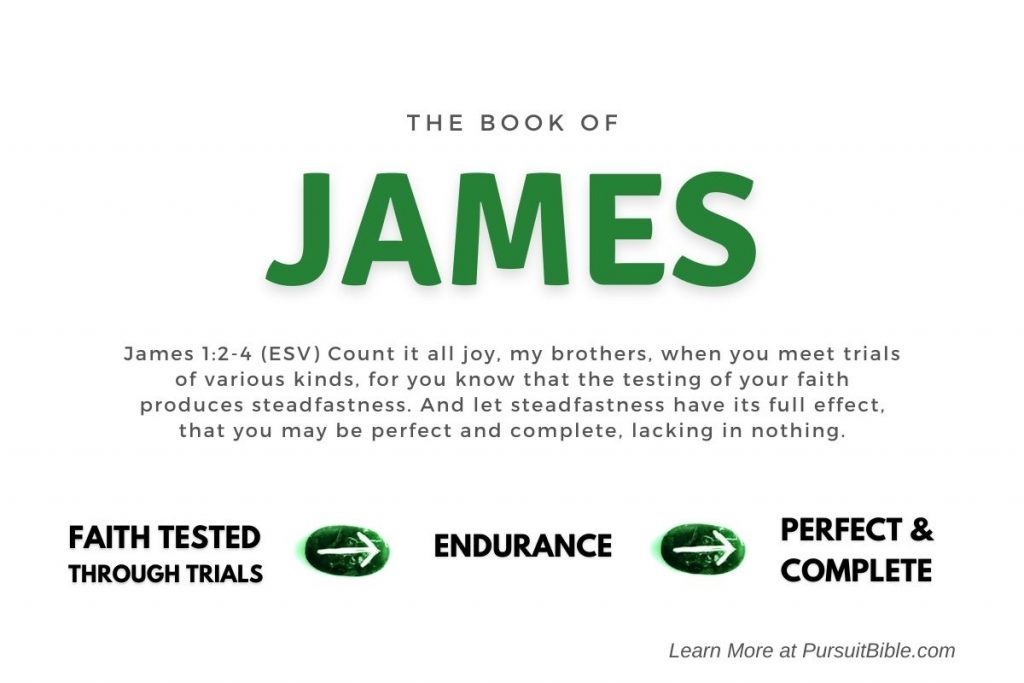
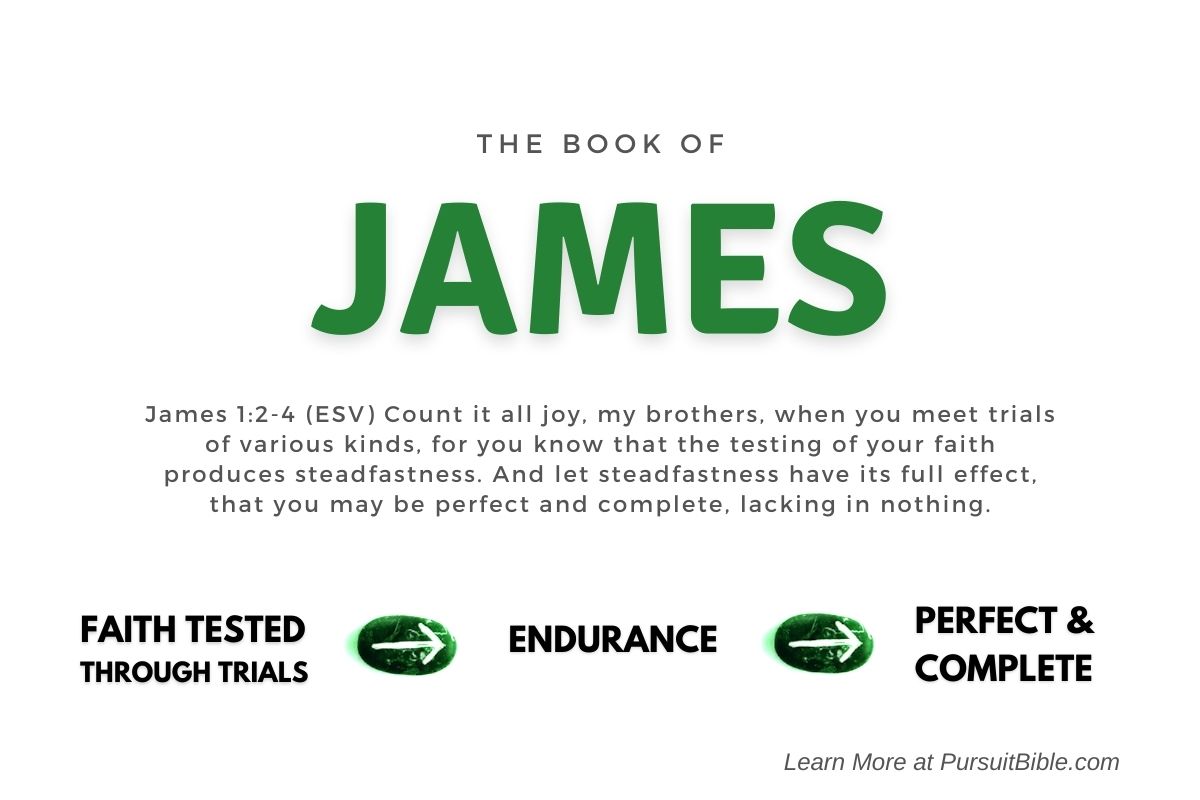
Count it all joy, my brothers, when you meet trials of various kinds, for you know that the testing of your faith produces steadfastness. And let steadfastness have its full effect, that you may be perfect and complete, lacking in nothing.

James 1:2-4 (ESV)

The goal of the Christian life is that you would be complete, and to be transformed into the image of Christ. The goal is that you would be perfect, whole, not lacking anything, and fully mature in Christ. This will take full surrender and receiving God’s Word with meekness.

Much of our energy in life is spent trying to avoid testing trial and temptation. James sees this from a completely different perspective. James is an invitation into the life of Christ in all things. 

The view on life that James presents is very different from religion in the way most people think about it.

Christianity is not trying to get God to bless you, like you, or accept you. It’s an invitation to live a radically different life as a citizen in God’s Kingdom because you have already been blessed in Christ. You can endure anything, even death, with the hope of God’s Kingdom that Jesus proclaimed.

This requires repentance and faith, and seeing God, the world, and yourself differently.

James 1:27 explains that there is pure and undefiled religion that goes way beyond the surface of what is often understood as religion. It’s acknowledging that anything mankind does cannot measure up to God’s standards. It requires surrendering fully to Jesus Christ. As the Word of God is received with meekness, it will result in pure works that care for people in the world.

Religion only makes sense if it is a life that is responding to the Word of God bearing fruit in one’s life. All the major religions in the world require people to live a better life. The Bible calls people to live out of something much deeper.

The Gospel of Jesus Christ results in a righteousness that is way beyond the surface of what is often understand as religion. It’s a true relationship with the living God that results in a transformed life from the inside out.

James is a book that helps when you’re stuck in life. James shows you how you got there and how to get out. Rather than looking for shortcuts when you experience trials in life, James goes to the root of experiencing God’s life-transforming power.

James 1:1-14-15 explains that sin will mature if we don’t bring it to the cross. It starts with being enticed by desire, then desire is conceived, sin is birthed, and when sin is fully growth, death results.

James protects us from a fruitless form of godliness. It calls us to simple obedience to Christ, to be wholly surrender to Him, not being double minded.

Summary of James Chapter 2

The main theme of James 2 is that showing partiality is sin and that faith must be accompanied by works.

James 2 Explains that Partiality is Sin

Favoritism in the Bible is showing partiality or judging people by outward appearances. You are not to judge people by their wealth, influence, social standing, eloquence, education, gender, age, or popularity.

My brothers, show no partiality as you hold the faith in our Lord Jesus Christ, the Lord of glory. 

James 2:1 (ESV)

Showing partiality is a sin in light of the glory of the Lord Jesus (James. 2:9). When you treat people differently based on outward appearances, it is sin.

God does not show partiality (Romans 2:11). God does not judge by the surface. To judge is to make distinction and have discernment. God looks at the heart and the obedience that flows out of faith and love. That’s why God choose David, the  shepherd boy, to be king over Israel (1 Samuel 13:14).

We are to see people through God’s eyes. This does not mean to excuse sin or to accept violence, wickedness, or evil. We are to relate rightly and judge with righteous judgment (John 7:24). 

It takes God to open our eyes to see the riches of His glorious inheritance in the saints (Eph. 1:18).

When we try to achieve justice in this world apart from God, it results in a judgemental and sometimes hateful spirit. Without God, human attempts do not achieve His righteousness. Only the Gospel of Jesus Christ can bring true answers to the root cause of sin in the heart of mankind that leads to partiality.

Many of the problems we face in modern life are the same old things, maybe with new names and labels. The Gospel of Jesus Christ alone answers the issues of the heart at the core.

James 2 Explains that Faith Without Works is Dead

James 2 revisits the theme that was introduced in James 1:22.

But be doers of the word, and not hearers only, deceiving yourselves.

James 1:22 (ESV)

James explains that faith without works is useless, or dead.

So also faith by itself, if it does not have works, is dead.

James 2:17 (ESV)

You believe that God is one; you do well. Even the demons believe—and shudder! Do you want to be shown, you foolish person, that faith apart from works is useless?

James 2:19-20 (ESV)

If the seed of the Word of God is planted in your hearts, it will bear fruit if you have received it with meekness. True faith will always result in fruit.

James is a call to be doers of the Word and not just hearers only. Jesus describes this important connection of the Word of God and obedience in John 15:2.

Whoever has my commandments and keeps them, he it is who loves me. And he who loves me will be loved by my Father, and I will love him and manifest myself to him.

(John 15:21 ESV)

When you encounter God’s love, you will love Him back and obey Jesus.

The book of James in the Bible explains the kind of life that will survive and thrive in the storms that are coming on the horizon. 

The Sermon on the Mount ends with Jesus’ exhortation to not just hear but do the Word of God (Matt. 7:24-27). It’s the true wisdom of God and fruitfulness that will result in a life that stands in the face of the storms that are ahead. James emphasis the same in the book of James.

The Book of James highlights things that are easily missed from the understanding of the Gospel of the Kingdom. These are vital pieces without which we have an incomplete Gospel. James highlights this Spirit of Wisdom when he calls attention to the need to be doers of the Word and not just hearers only.

The Gospel of the Kingdom that Jesus proclaimed is the only foundation upon which the Church can be built into the fullness of Christ. It’s the only message that will empower our hearts with true hope to endure until the end. It’s the call of Jesus for His church to arise to the fullness of Christ.

You can’t know God in a vacuum. It has to be lived out in your everyday life.

If anyone says, “I love God,” and hates his brother, he is a liar; for he who does not love his brother whom he has seen cannot love God whom he has not seen.

1 John 4:20 (ESV)

The letter of James provides an important perspective on the Christian life. It presents several parts that are vital to the full understanding of Gospel of the Kingdom that Jesus proclaimed.

Summary of James Chapter 3

The main them in James 3 is the importance of the tongue, our speech, and receiving wisdom from heaven.

For we all stumble in many ways. And if anyone does not stumble in what he says, he is a perfect man, able also to bridle his whole body. 

James 3:2 (ESV)

James 3 is an expansion of the theme of our speech, that was introduced earlier in James 1.

Know this, my beloved brothers: let every person be quick to hear, slow to speak, slow to anger; for the anger of man does not produce the righteousness of God. Therefore put away all filthiness and rampant wickedness and receive with meekness the implanted word, which is able to save your souls.

James 1:19-21 (ESV)

Words or speech express what is in the heart. James echoes what Jesus taught in Matthew 15:18-20. Words that flow from a heart ruled by the flesh reveal anger and things that do not express or result in the righteousness of God.

When God’s Word is implanted in the heart, it transforms the heart and in turn, the words that flow from it.

God’s implanted Word affects your words.

What do your words say about you?

It can be helpful to ask:

James 3 also contrasts worldly wisdom and the wisdom that comes from heaven. Wisdom from God is expressed in your lifestyle and through “works in the meekness of wisdom” (James 3:13).

Wisdom from heaven is not man’s wisdom. It’s based on resting in God and expresses itself in meekness of a heart fully submitted to Him.

Summary of James Chapter 4

James 4 explains why people fight and quarrel.

What causes quarrels and what causes fights among you? Is it not this, that your passions are at war within you? You desire and do not have, so you murder. You covet and cannot obtain, so you fight and quarrel. You do not have, because you do not ask. You ask and do not receive, because you ask wrongly, to spend it on your passions.

James 4:1-3

Fights and quarrels come from desires for pleasure, or passions, that are at war within the heart. Rage in the heart from passions result in war and conflict in relationships. This can be applied to every level of relationships where 2 or more people are involved: families, friends, churches, nations.

Lust and passions in the heart manifests as fights and quarrels. These things come to be expressed in lust, murder, and wanting what others have.

James 4, in verses 11-12, also revisits the topic of the tongue, or speech. This time, particularly the aspect of judging others, which is related to the previous topic of the reason for  fights and quarrels.

James 4 ends in verses 13-17 with a warning about the evil nature of boasting in arrogance. Boasting in arrogance is evil compared to receiving God’s Word in meekness and allowing it to transform your heart and in turn, your words and actions.

Summary of James Chapter 5

James 5 gives a warning against rich oppressors. It’s a development on the themes of riches and money that were touched on earlier in the Book of James.

James gives a sobering call to the rich who have stored up treasure while oppressing others (James 5:3). James echoes Jesus’ teaching that where you store your treasure reveals the condition of your heart.

For where your treasure is, there your heart will be also.

Matt. 6:21 (ESV)

James 5:7-11 gives a call to patient endurance until the coming of the Lord. The Word of God will bear fruit that will endure. The Kingdom of God operates as a seed, the Word, that will bear fruit with patient endurance. In light of the hope of Jesus’ Second Coming, you can live with confidence and joy regardless of whatever you face in this life.

James 5:13-20 gives a call to the prayer of faith. Prayer involves confessing of sin to one another. The prayer of faith leads to healing and the heavens being opened as in the example of Elijah.

James ends with an exhortation to stay true to God’s wisdom and to restore others who have wandered from it. God’s power is available to save and to overcome sin.

James and Spiritual Warfare

As with all Scripture, the book of James must be approached in full dependence on the Holy Spirit and in view of the full counsels of God, the teaching of all of the Bible. It is a vital book to understanding the Gospel that Jesus preached.

There is tension and spiritual warfare around the book of James. It confronts the enemy’s last stronghold against the Kingdom of God. Many people will have passion, knowledge, spiritual experiences and power. The Enemy will even allow all of these if it will end without simple obedience to Christ. But when a disciple of Jesus begins to obey Christ out of love, the Gospel of the Kingdom advances – one heart at a time. This causes spiritual conflict.

Submit yourselves therefore to God. Resist the devil, and he will flee from you. 

James 4:7 (ESV)

We’re all building something with our lives. Will it endure through the storms of this life? Will it endure at the end of the age, when you stand before Jesus, the King and Judge? Will you bear fruit that God is looking for?

My prayer for you is that you would experience the blessing of the Gospel of the Kingdom of God as expressed in the book of James: May the seed of the Word of God, planted in the soil of a heart fully yielded to God, produces a supernatural harvest of fruitfulness to His glory!

Subscribe to my newsletter for updates and encouraging content.

If you found this Bible Study on the Book of James to be helpful, here are a few others that I’d recommend:

Summary of Ephesians: Meaning, Outline & Application. The book of Ephesians gives another important perspective on the Gospel of the Kingdom. It shows how the raw power of the Gospel transforms individuals and regions as the church comes to the fullness of Christ.

11 Ways to Study the Bible: Methods, Techniques & Tips. In this article, I share different methods of Bible Study, including how to study a book of the Bible. My studies in James combined a few of the methods in the article. Try some of the different methods and see which one works the best for you.

One resource that I highly recommend is: Unlocking the Bible: A Unique Overview of the Whole Bible (You can check out the reviews on this link to Amazon). It has a chapter on every book of the Bible, is very clear, and has great insights. Be sure to get the book and not the one that has just diagrams, charts, and images. The covers look very similar.

Scripture quotations are from the ESV® Bible (The Holy Bible, English Standard Version®), copyright © 2001 by Crossway, a publishing ministry of Good News Publishers. Used by permission. All rights reserved. May not copy or download more than 500 consecutive verses of the ESV Bible or more than one half of any book of the ESV Bible.

Photo by Noah Buscher on Unsplash

  • In All Things Give Thanks: Biblical Meaning & Power of Thanksgiving

    In All Things Give Thanks: Biblical Meaning & Power of Thanksgiving

    Giving thanks is a foundational response to God in the Bible.  When you grow in the knowledge of God and your focus is on Him, you can, as the Scripture says, “in all things give thanks.”

    Give thanks in all circumstances; for this is the will of God in Christ Jesus for you.

    1 Thessalonians 5:18 (ESV)

    Give thanks to the Lord, for he is good,
    for his steadfast love endures forever.

    Psalm 136:1 (ESV)

    What does the Bible say about giving thanks in all things? 

    You can give thanks in all things because thanksgiving is a response to the goodness and grace of God. God’s nature does not change based on outward circumstances.

    It’s difficult to be thankful when you are:

    • Not trusting fully in God’s faithfulness
    • Not fully yielded to God as the good King
    • Proud or arrogant
    • Discontented
    • Anxious
    • Focused only on the negative
    • Jealous or envious of others
    • Holding on to anger or bitterness
    Give thanks in all circumstances

    Thankfulness is one of the ways to measure your spiritual health. It’s an indicator of how much you know God. It can reveal how much you are trusting in Him.

    When you are growing in the knowledge of God, you can give thanks in every circumstance. It doesn’t matter whether you have plenty or are in need. You can have a spirit of thanksgiving that carries you into God’s heart for your life.

    In this world, it’s easy to take things for granted. We need to remember to give thanks in every circumstance.

    God made the world to work in such a way that people can see His character and faithfulness in the world (Rom. 1:20).

    • The air we breathe every time we take a breath
    • The sun that gives light, warmth, and life to plants and all living things
    • The intricate way our bodies work
    • The laws of nature that keep our universe in order
    • The beautiful things of the human spirit like love, kindness, wisdom, and compassion.
    • And the list goes on…

    We have an endless list of things that are common grace everyone experiences. We also have the greatest display of God’s goodness and faithfulness to the world, His special grace.

    God’s steadfast love is fully displayed through Jesus Christ. He laid down His life on the cross to die for the sins of the world. He did this all out of love.

    This takes our thanksgiving to a whole other level. 

    When we give thanks, it aligns us with God’s goodness, opens us up to receive more from Him, and frees us from anxiety and worry. It carries us through any struggle and hardship in life. It even carries us through persecution and the valley of the shadow of death.

    Giving thanks is meant to bring encouragement and strength no matter what you’re going through. Let’s take a closer look at what the Bible says about thankfulness, why it’s important and powerful, and how you can give thanks in everything. 

    The Meaning of Thanksgiving in the Bible

    What is the meaning of thanksgiving in the Bible?

    Thanksgiving in the Bible means to respond to God’s goodness and grace with gratitude. The word for giving thanks in the Old Testament means to raise hands to God in gratitude. The New Testament word for thanks has the root idea of grace. 

    The biblical definition of thanks is very rich and meaningful. It’s a different way of looking at life and how God works in the world. It’s based on God’s goodness towards mankind and involves responding to Him with our whole being.

    In the New Testament, the word for thanks means to be “thankful for God’s grace.” The root word in Greek actually has the word grace in it.

    When you give thanks, you’re responding to God’s goodness and graciousness. Everything in the Christian life is by God’s grace, and so requires faith on our part.

    Give thanks to the Lord, for he is good,

        for his steadfast love endures forever.

    Psa. 136:1 (ESV)

    In the Old Testament, the main words for thanks come from the root word which means to lift up hands. Many English translations translate the word as thanks or sometimes, praise.

    What does giving thanks have to do with lifting up hands? To open and lift your hands is one response when you’ve been shown grace and kindness. It’s a way of expressing openness to the person who gave the gift and a way of acknowledging their graciousness.

    Thanksgiving is a response to the revelation of God. As God opens your eyes to see Him as He is, your whole being responds to Him with thanksgiving.

    Thanksgiving is a beautiful picture of our response to God, our loving Creator and Father in heaven. Because you have been created by a kind Creator, you can live your life with purpose. Because you are loved by a loving Father in heaven, you are free to grow and thrive. It would be unnatural to be ungrateful.

    Giving thanks is a response to the nature of God. We give thanks because He is good and His love endures forever.

    Giving thanks with hands lifted is a sign of full surrender to God. The Lord is good and faithful. His loving kindness endures forever. Thanksgiving is a way of saying: “I let go of fighting for control of my life. I surrender it to You, Lord.”

    We all came into this world empty-handed – as a baby with no possessions. We will leave with nothing that we can keep of our own belongings.

    Giving thanks is a way of saying:

    “God, I come empty-handed. Every good gift comes from You. In this age and in the age to come, I can live with confidence because You are good. Your nature does not change. You are faithful. 

    You are the God of justice. You will make all things right. At the end of it all, everyone will say: “You are righteous and Your judgments, they are just!” And You did this all, while giving everyone space to voluntarily choose You.

    Give me wisdom to live my life with thanksgiving.”

    In responding to God, who is good, thanksgiving is a way to praise Him. God is the very definition of goodness because He’s the good Creator of all things. We can voluntarily respond to His goodness by lifting our hands to Him in worship.

    in all things give thanks

    What Does the Bible Say About Giving Thanks in All Things?

    It’s entirely possible and necessary to give thanks in all things.

    Give thanks in all circumstances; for this is the will of God in Christ Jesus for you.

    1 Thes. 5:18 (ESV)

    You can give thanks in all things because of God’s nature and character. He is faithful. He is good. He is gracious. He is merciful. He is full of love and compassion. He does not change.

    Things in life can change at any moment, but when you’re filled with thanksgiving, you can weather any storm in life and come through it filled with praise and thanksgiving.

    We don’t always know how life will go. But we always know what God’s will for us is: It’s to give thanks in light of His goodness. Because He is good and His nature does not change, we can always give thanks.

    It’s sometimes explained that the Bible tells us to give thanks in all things, not for all things. No one in their right mind would be thankful for evil, wickness, injustice, and oppression. But no matter what happens, we can give thanks to God and He will carry us through.

    It’s also possible to have many things but not be thankful. In today’s world, many people have more conveniences, live longer, and have more opportunities than any other time in the history of the world. But this doesn’t mean that life becomes more meaningful and fulfilling.

    When we don’t give thanks, we can’t appreciate what I have. We’re always looking for what we don’t have.

    It’s a serious thing to be ungrateful. Romans 1:21 explains that not giving thanks to God is one of the responses that leads to confusion and a heart filled with darkness.

    This is a sobering thought, but that’s the reason Jesus died on the cross. He satisfied the justice of God through His sinless life and perfect sacrifice. He took the full wrath of God upon Himself. 

    Knowing God and opening to His goodness results in thankfulness.

    The natural response to God’s love and mercy is a thankful heart. 

    The grace of God compels us to look beyond our own lives and peer into the mystery of the fullness of His love on the cross of Christ.

    So much more can be said about the love and grace of God in Christ. Here is an article where I share what the Bible says about this important topic: Does God Love Me? How You Can Know For Sure (link opens in a new window). I hope it’ll open up new doors of insight into God’s love for you.

    How to Give Thanks in All Circumstances

    What does the Bible say about giving thanks in all things?

    You can give thanks in all things if you focus on who God is. You can’t be gripped by the problems around you. You have to let God’s grace grip you instead.

    When you’re growing in the knowledge of God, you can give thanks in every circumstance. It doesn’t matter whether you have plenty or are in need. You can have a spirit of thanksgiving that carries you into God’s heart for your life.

    • Giving thanks is sometimes an act of faith. It’s an act of trust in a loving heavenly Father. It’s believing that what the Bible says about Him is true.
    • Giving thanks makes you to look to God instead of what’s going on in the world around you. Instead of meditating on your problems, thanksgiving looks at what is good, encouraging, and life-giving.
    • Giving thanks is a way of letting go of the things in your life. Letting go is a choice. It’s a way of lifting up your hands to God and looking to Him instead. This is the definition of the word used in the Old Testament for thanksgiving (see above).

    God upholds all things by the word of His power (Heb. 1:3), so instead of grasping after the things in your life, let God uphold you.

    Finally, brothers, whatever is true, whatever is honorable, whatever is just, whatever is pure, whatever is lovely, whatever is commendable, if there is any excellence, if there is anything worthy of praise, think about these things

    Phil 4:8 (ESV)

    Thanksgiving is at the core of prayer in the New Testament (Eph. 1:16). It’s the basis of why we can pray. We pray because God has revealed His goodness to us.

    Prayer is not only about bringing a list of our needs and wants to God. God already knows what you need before you ask Him (Matt. 6:8). Instead, you can pray like Jesus taught in what’s known as the Lord’s Prayer (Matt. 6:9-13).

    Start by looking to God. He is Our Father in heaven. He is whole, complete, and holy. Look to what His will, His Kingdom is. 

    Wait until your mind has been clear of spiritual and mental “toxins,” your vision has been refocused, and your heart is rooted in God’s love. Then, go ahead and ask God for your daily bread, what you need today.

    Give Thanks to the Lord for He Is Good!

    • Is there a spirit of thanksgiving in your life?
    • What can you do today to grow in the spirit of thanksgiving? 
    • What trait of God’s character can you meditate on? 
    • What can you be thankful for today?

    As you grow in the knowledge of God, let His goodness lead you and carry you through every season of your life. So that in all things, you can give thanks.


    Subscribe to my newsletter for updates and encouraging content.


    If you found this article to be helpful, here are some others that I think will encourage you:

    What Is Worship According to the Bible? 

    Put on the Whole Armor of God – What it Means & How to Do It

    Does God Love Me – How You Can Know for Sure


    Thanksgiving Bible Verses

    Here are several Thanksgiving Bible Scriptures to stir a spirit of thanksgiving and gratitude: (All Scriptures are from the ESV).

    1 Thes. 5:18 – Give thanks in all circumstances; for this is the will of God in Christ Jesus for you.

    Psa. 136:1 – Give thanks to the Lord, for he is good, for his steadfast love endures forever.

    Psalm 100:4 – Enter his gates with thanksgiving, and his courts with praise! Give thanks to him; bless his name!

    Psalm 118:28 – You are my God, and I will give thanks to you; you are my God; I will extol you.

    1 Corinthians 15:57 – But thanks be to God, who gives us the victory through our Lord Jesus Christ.

    Colossians 3:15 – And let the peace of Christ rule in your hearts, to which indeed you were called in one body. And be thankful.

    Colossians 3:16 – Let the word of Christ dwell in you richly, teaching and admonishing one another in all wisdom, singing psalms and hymns and spiritual songs, with thankfulness in your hearts to God.

    Colossians 3:17 – And whatever you do, in word or deed, do everything in the name of the Lord Jesus, giving thanks to God the Father through him.

    2 Corinthians 2:14 – But thanks be to God, who in Christ always leads us in triumphal procession, and through us spreads the fragrance of the knowledge of him everywhere.

    Psalm 145:10 – All your works shall give thanks to you, O LORD, and all your saints shall bless you!

    Psalm 111:1 – Praise the LORD! I will give thanks to the LORD with my whole heart, in the company of the upright, in the congregation.

    Psalm 33:2 – Give thanks to the LORD with the lyre; make melody to him with the harp of ten strings!

    1 Chronicles 16:8 – Oh give thanks to the LORD; call upon his name; make known his deeds among the peoples!

    1 Thessalonians 1:2 – We give thanks to God always for all of you, constantly mentioning you in our prayers.


    PHOTO CREDITS

    Photo by Chris Lawton on Unsplash

    Photo by Ricardo Gomez Angel on Unsplash

  • Thy Kingdom Come – What It Means & How to Pray It

    Thy Kingdom Come – What It Means & How to Pray It

    It’s a powerful thing to pray Thy Kingdom Come, or as we would say in modern English, Your Kingdom Come. It’s a prayer that summarizes the entire Bible. But it brings up a lot of questions: What is God’s Kingdom? How does it come to earth? When will it happen? Let’s explore what this means in the Bible.

    What does Thy Kingdom Come mean? 

    To pray Thy Kingdom come means to invite God’s will in the world and to open to what God wants for your life. It is also looking forward to Jesus’ Second Coming to fully establish God’s reign. It’s a prayer that summarizes the entire Bible and what God wants to do on the earth.

    Your kingdom come, your will be done, on earth as it is in heaven.

    Matthew 6:10 (ESV)
    Thy Kingdom Come Thy Will Be Done

    Jesus taught His disciples to pray “Thy Kingdom come” in the Bible, in Matt. 6:9-13 and Luke 11:2-4. It’s commonly called the Lord’s Prayer or the Our Father. It captures the essence of what the entire Bible is about. It’s a very powerful prayer that aligns with the very thing that God is after in the world.

    As with any prayer, it’s not a magical, mystical phrase that you can just say without knowing what it means. Let’s explore what the Bible says so you can understand what it means and open to everything that God has for you.

    Your Kingdom Come Means to Invite God’s Reign

    What is the Kingdom of God or the Kingdom of heaven in the Bible?

    The Kingdom of God is God’s rule and reign. It means that God is the King. When the Bible uses the phrase King of king and Lord of lords, it means that God’s throne is the highest. There are many presidents, prime ministers, and rulers on earth, but God’s rule and reign are above them all.

    But doesn’t God do what He wants anyway? Why does Jesus teach us to pray this prayer? Is it even necessary?

    We pray Your Kingdom Come because God looks for a people to partner with Him in seeing His will done on earth. The Bible teaches that God’s kingdom needs to be invited and welcomed. He is looking for a people who are surrendered fully to Him.

    Thy Kingdom Come illustrates the truth that people need to invite God’s rule and power into the affairs of their lives through prayer. It’s not thinking “Oh, God will do it if He wants to…” It’s an active seeking. This is our responsibility and our great privilege. 

    Kingdom Revealed - Kingdom Forfeited - Restoration Introduced - Kingdom Reclaimed - Kingdom Fulfilled
    The Main Theme of the Bible Is the Kingdom of God

    God wants to restore the world to His original design. We experience brokenness in the world because of our rejection of God and His plan. This is why we have war, sickness, injustice, and all manner of brokenness in the world.

    What God wants, desire, and wills is His Kingdom. His Kingdom is good, merciful, and full of wisdom. It’s His divine design. It’s not fulfilled on the earth yet, but it’s His desire. And He wants it to be our joy and desire too. He doesn’t force us. He wants us to mature to know that He is good.

    This is the message of the entire Bible from beginning to end, Genesis to Revelation. God wants to restore a broken and hurting world to His original design, where there is no brokenness.

    Jesus’ main message was the Gospel of the Kingdom. 

    The Gospel of the Kingdom, the Good News, is that Jesus’ reign will overcome all the sin and brokenness in the world. God is doing something about the brokenness and sin in our lives. Jesus entered into a broken and hurting world to die on the cross to restore mankind to God.

    The diagram above shows this main theme of the Kingdom of God. It’s from an article where I explore The Main Message of the Bible: Its Central Theme & Purpose.If you want go more in-depth into what the Kingdom of God means I would recommend it.

    “Our Father in heaven,
    hallowed be your name.
    Your kingdom come,
    your will be done,
    on earth as it is in heaven.
    Give us this day our daily bread,
    and forgive us our debts,
    as we also have forgiven our debtors.
    And lead us not into temptation,
    but deliver us from evil.

    Matt. 6:9-13 (ESV)

    Your Kingdom Come Means to Open to God’s Will

    Your kingdom come, your will be done, on earth as it is in heaven.

    Matt. 6:10 (ESV)

    Jesus explains and expands what Your Kingdom Come means in the phrase right after it: Your will be done.

    To pray Your Kingdom Come Your Will be Done, is to open to God’s will. It is to invite God to have His way instead of yours. It’s a yielding, openness, invitation for God’s will in your life.

    One way to understand it is to think about the difference between God’s will and His purpose.

    God’s will is not fully done on the earth yet. But, His purpose will be accomplished at the end no matter what.

    God’s will is that everyone be saved, that marriages and families thrive, that communities live in peace. But people will to do what they want. You and I choose whether we want to do what God wants or what we want.

    When we look at the world around us, we see that God’s will is not fully done. It’s His desire for us as the Creator and Father in heaven. We can still see traces of God’s beauty and His design. This is why we pray and this is why we invite God’s reign in the world and in our lives.

    Right now, there is evil, wickedness, and lawlessness on the earth. It will continue to become more intense, and be fully mature and united in lawlessness. This is what Jesus explains in the parable of the Wheat and the Tares in Matthew 13:24-30,36-43.

    God allows all this, but at the end, He still gets what He wants. After all, He is God. He allows a lot of things in the meantime, so that we will have time to choose Him.

    Jesus reveals in the parable of the Wheat and the Tares that the opposite is true. 

    It might look like evil and lawless that the Enemy has sown is winning on the earth, but don’t be alarmed. God is equally raising up a people that will invite and do His will. God’s people, His church, will come to full maturity before Jesus returns. 

    The Church, people who repent and believe in the Good News of the Kingdom, is God’s answer to evil and lawlessness on the earth (Matt. 16:18). We may look weak, but God’s strength is made perfect in weakness. His purpose will triumph!

    Before He went to the cross, Jesus prayed in Luke 22:42: “Not my will, but yours, be done.” If there was any other way than to die for the sins of the world, Jesus could have taken it. But He voluntarily laid down His life for you and me.

    Jesus choose the Father’s will. He invites us to follow Him.

    Here is a study I did on the Book of James. The emphasis that James gives in living out the Gospel is a great application of living and praying “Your Kingdom come.”

    When you pray Your Kingdom Come Your Will Be Done, you’re praying in the name of the One who prayed it and lived it.

    Thy Kingdom Come Means to Look Expectantly to Jesus’ Return

    The Gospel is not complete without Jesus’ Second Coming. 

    Jesus’ message was that the Kingdom of God was at hand. Jesus, as the King, came to demonstrate the Kingdom through His words and actions. His ultimate act was to die on the cross to make a way for people to enter this Kingdom. 

    Yet, God’s Kingdom will not be fully on the earth until Jesus returns.

    At Jesus’ Second Coming, He will fully establish God’s Kingdom on the earth by removing all the wicked and evil rulers. And He will remove all evil, wickedness, and lawlessness from the earth.

    At His first appearing, Jesus came as a Suffering Servant to die for the sins of the world. At His Second Coming, Jesus is returning as the King and Judge. He is not coming as a baby in a manager but as the Judge to judge the world.

    The Gospel is not complete without Jesus’ Second Coming.

    Jesus is also returning as a Bridegroom for His people. They will be as a Bride that has prepared herself for her Bridegroom. Will Jesus return to find a Bride that is ready to be equally yoked with Him? Will the Bride make herself ready? Yes, we will be ready because God is preparing His Church (Eph. 5:25-27).

    When He returns, Jesus will remove all that hinders love. God’s will and purpose for earth will be fully realized. His plan will be fully realized. Every bit of sin and evil will be removed, including from our hearts.

    God’s people will be transformed into the likeness of Christ (1 Cor. 15:52). It’s amazing to think that we will love God with nothing of the “bent” of sin in our lives. We will love God with an everlasting love even as He loved us.

    The Devil and his angels will be thrown into the Lake of Fire, along with all those who have followed him (Matt. 25:41). The Lake of Fire is what we usually refer to in English as hell. It’s an everlasting proclamation of the sacrifice that Jesus made on the cross to deliver us from sin and death. 

    It’s an everlasting declaration of the nature of the God as He upholds justice. That is the reason Jesus, the Son of God, died on the cross. Jesus took the full cup of the Father’s wrath for us on the cross. He did not pass on the cup of the wrath of God. He did it for love. He did it for us. He did it with joy, even to take up His cross.

    Therefore, since we are surrounded by so great a cloud of witnesses, let us also lay aside every weight, and sin which clings so closely, and let us run with endurance the race that is set before us, looking to Jesus, the founder and perfecter of our faith, who for the joy that was set before him endured the cross, despising the shame, and is seated at the right hand of the throne of God.

    Heb. 12:1-2 (ESV)

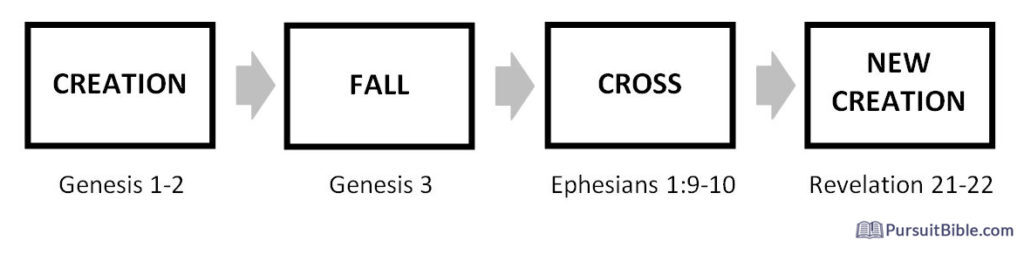
    When Jesus returns, He is bringing heaven with Him. He is bringing the Kingdom of God fully to the earth. Ephesians 1:9-10 summarizes the entire Bible. God’s plan and purpose all along has been to bring heaven and earth together.

    Making known to us the mystery of his will, according to his purpose, which he set forth in Christ 10 as a plan for the fullness of time, to unite all things in him, things in heaven and things on earth.

    Eph. 1:9-10 (ESV)

    To pray Your Kingdom Come Your Will Be Done is to look forward to the day when God’s will is fully done on the earth.

    In heaven, God’s will is fully done. It will be done here on earth just as it is in heaven.  This happens at Jesus’ Second Coming. Heaven and Earth will be united. And God Himself will dwell with mankind as that was His original design in the beginning.

    Then I saw a new heaven and a new earth, for the first heaven and the first earth had passed away, and the sea was no more. And I saw the holy city, new Jerusalem, coming down out of heaven from God, prepared as a bride adorned for her husband. And I heard a loud voice from the throne saying, “Behold, the dwelling place of God is with man. He will dwell with them, and they will be his people, and God himself will be with them as their God. He will wipe away every tear from their eyes, and death shall be no more, neither shall there be mourning, nor crying, nor pain anymore, for the former things have passed away.”

    Rev. 21:1-4 ESV (emphasis added)

    God created the heavens and the earth in Genesis. 

    He will restore and bring about a New Heaven and a New Earth, where there will be no brokenness or sin (Rev. 21:4).

    Until then, God calls us to repentance and faith in the Gospel of Jesus Christ, to fully surrender to Him, and to eagerly long for His return.

    If you want to explore more on this topic, I would recommend this article: How Does the Bible End? (Link opens in a new window). In it, I explore what Bible says about Jesus’ glorious leadership at the end of this age.

    What Does It Mean to Seek First the Kingdom of God?

    In Matthew 6:33, Jesus says: “But seek first the kingdom of God and his righteousness, and all these things will be added to you.”

    Jesus mentions this while telling His disciples not to be anxious about life (Matt. 6:25). God knows what you need (Matt. 6:32) and He will take care of you even as He takes care of all creation. Life is so much more than getting our needs met. To know Jesus is to know life (John 14:6).

    To seek first the Kingdom of God means that you are looking for God’s will first in your life and in the world.

    How can you seek first the Kingdom of God?

    • Start each day by inviting Jesus into your day. Pray “Your Kingdom Come Your will be done here on earth as it is in heaven.”
    • When you find yourself getting anxious about life, be reminded of Our Father in heaven. What are the things that keep you up at night? Learn to bring those things to the feet of the cross. 

    Casting all your anxieties on him, because he cares for you.

    1 Pet. 5:7 (ESV)

    It’s not wrong to seek the things that you need. Jesus says to seek God’s Kingdom first. Always seek to do the right thing in God’s eyes, what is approved by Him.

    • Store up your treasures in heaven. Don’t live for this life only. First live for God’s Kingdom. Don’t let your pursuit of the things of this world define you. Seek to obey Jesus first.

    Do not lay up for yourselves treasures on earth, where moth and rust destroy and where thieves break in and steal.

    Matt. 6:19 (ESV)

    God’s promise is that your needs will be met (Phil. 4:19). He will supply all your needs, your daily bread. The Lord’s Prayer follows this order. First is “Your Kingdom come…” Then we ask “Give us this day our daily bread.”

    We live in a world that is experiencing brokenness caused by sin. People look for meaning in a successful career, a happy family, a secure future. These things cannot ultimately satisfy apart from God.

    In light of these things, I think Jesus would say “Put your hope in me. Seek first the things I have for you. If you pursue the things in this world, it will lead to anxiety and hopelessness. Only my Kingdom can bring you peace and true joy.”

    Let’s pray together with believers throughout history: “Your Kingdom Come.”


    Subscribe to my newsletter for updates and encouraging content.

    If you enjoyed this article, here are others that I would recommend:

    Put on the Whole Armor of God – What it Means & How to Do It. I hope this article will bring clarity to what the armor of God is so you can experience God’s power in your life. It’s an important truth so that you can stand in the face of any spiritual pressures.

    Does God Love Me? – How You Can Know for Sure. In it, I explore 3 biblical ways that you can overcome doubt, shame, and guilt so you can be confident of God’s love.

    How to Be a Better Person According to the Bible. This article explains the biblical principles of how God transforms your life. You will see lasting change and growth in your life as you grow in Christ.
  • Summary of Ephesians: Meaning, Outline & Application

    Summary of Ephesians: Meaning, Outline & Application

    Book of Ephesians

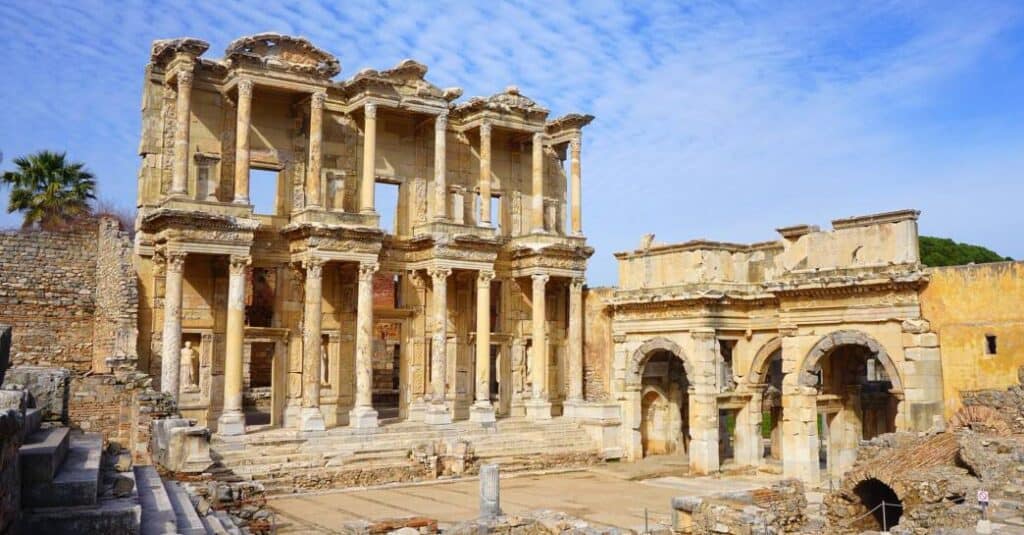
    I had the opportunity to study and teach the Book of Ephesians for an entire year. I also got to visit the actual ruins of the city of Ephesus in modern-day Turkey. I want to share with you some of the things that I learned during that year. I hope it’ll be helpful for you in understanding the Letter to the Ephesians.

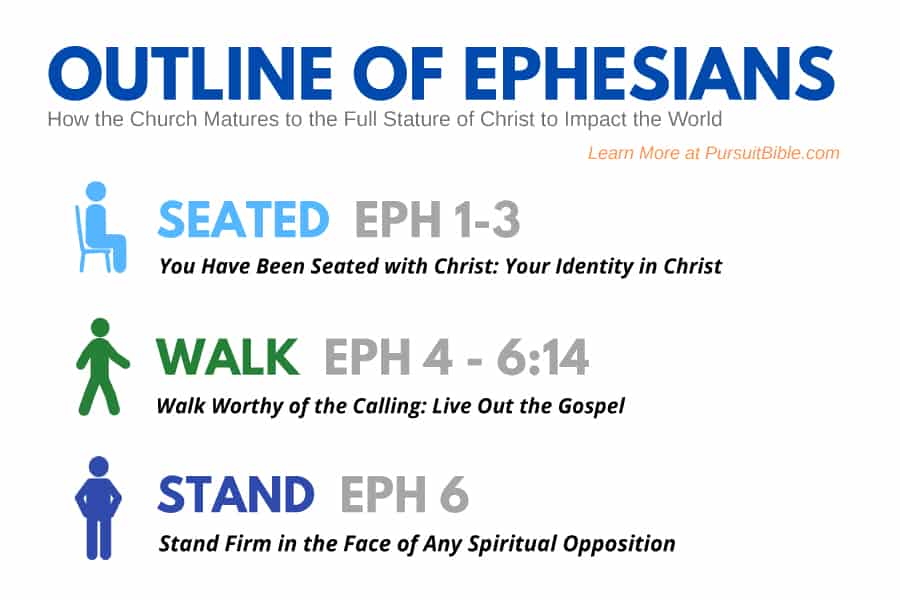
    The book of Ephesians explains how the Church comes to full spiritual maturity in Christ. The first part describes the Good News of what God has done (Eph. 1-3). The second section gives instructions on how to live in light of those blessings (Eph. 4-5). Ephesians ends with an encouragement to stand firm in the face of any hardships (Eph. 6).

    It is important to study the book of Ephesians because one of the greatest revivals in the history of the early church was based in Ephesus. 

    The Book of Ephesians offers an insider’s view of the faith and mindset that sparked one of the greatest revivals of that time.

    From the city of Ephesus, the Gospel went to the entire region of Asia Minor, with an estimated population of 8-15 million people, in 2 years. All this took place without any church buildings and none of the fancy and flashy things that we have today.

    In the book of Ephesians, we learn about the impact of the Gospel of Jesus Christ and how it can transform our culture. The preaching of the Gospel changed everything from marriages to the economy. Many people choose to follow Jesus and burn their magic scrolls which were common in the region.

    Ephesians presents the Gospel of Jesus Christ as the answer to the brokenness in this world – to a culture that is marred by injustice and oppression.

    Ephesians reveals that the Gospel of Jesus Christ is the only way to see true transformation in the world. The root problem in the world is not racism, oppression, or lack of education. At the core, the problem is sin in the human heart. Fair laws, social justice, and reform are needed, but these cannot change the human heart.

    Ephesians shows that the Gospel is not mainly about trying to force other people or circumstances to change. The Gospel is looking to Jesus and living out in the reality of what He has done.

    The Gospel brings about a true change in the human heart. When we all begin to live this out as the church, it begins to shift the culture of the world. The Gospel brings a true sense of hope into even the most desperate of situations.

    In general, the culture of that day in Ephesus did not see women as equal to men. There was also a form of slavery that was common at that time. Sometimes Christians were persecuted, very severely at times. The Gospel eventually changed all of that from the inside-out. The Gospel conquered the Roman Empire one heart, one marriage, one home at a time. 

    The Gospel transformed the culture of the region without direct political involvement, big budgets, or mass gatherings. It was simply the raw power of the Gospel on display.

    What happened in Ephesus is an example of what can happen when people believe and live out the message of the Gospel of Jesus Christ. It is what happens when the Church comes to maturity in the full stature of Christ. God’s will for His Church is nothing less than this fullness of Christ.

    Until we all attain to the unity of the faith and of the knowledge of the Son of God, to mature manhood, to the measure of the stature of the fullness of Christ.

    Eph. 4:13 (ESV – emphasis added)

    The Apostle Paul wrote the letter to the Ephesians to encourage believers to full spiritual maturity. What did he teach the believers at Ephesus that brought about those results? Let’s take a closer look into this book which many have called the “Alps of the New Testament.”

    Who Is the Book of Ephesians Written To?

    Paul wrote the book of Ephesians as a letter, or epistle, to the Christians who were in the city of Ephesus. He probably wrote it from prison or possibly under house-arrest while awaiting trial (Eph. 3:1; 4:1; 6:20). Although Paul was imprisoned when he wrote the epistle to the Ephesians, the Word of God was prevailing (Acts 19:20).

    It is helpful to understand a little bit of the background of Ephesians: Ephesus was a revival center during the time of the Apostle Paul. Paul stayed in Ephesus for about 3 years (Acts 20:31), preaching the Gospel, the Good News of Jesus Christ. The Gospel went to all of Asia Minor (the region which is now modern day Turkey), which some scholars estimate the population to be around 8-15 million people (Acts 19:10).

    We know more about the Church at Ephesus than any other church in the New Testament. Paul left Priscilla and Aquila to minister there. Apollos, a man who was skilled in expounding Scriptures was also stationed there. The books of 1 and 2 Timothy were both addressed to Timothy in Ephesus and both were about the church in Ephesus.

    The Apostle John was mostly likely in Ephesus when he was arrested during Domitian’s rule. He probably wrote the 3 letters of John and the Gospel of John while he was there with Mary, the mother of Jesus. The church at Ephesus sounds like the Who’s Who of the New Testament!

    Outline of Ephesians

    As with many of Paul’s letters, there’s a clear transition in the middle of the book of Ephesians. The first part is about what God has done. The second part is how to live in light of that as followers of Jesus.

    Here’s the outline that I settled on after seeing many others adopt something similar. I explained earlier that the main theme of Ephesians is how the Church matures to the full stature of Christ to impact the world.

    There are 3 postures that describe how a spiritually mature Church receives and lives out God’s blessings.

    1. SIT (Eph. 1-3)

    And raised us up with him and seated us with him in the heavenly places in Christ Jesus – Eph. 2:6 (ESV)

    • Ephesians reveals our identity “in Christ.” It also speaks of the wealth we have received in Christ (Eph. 1:3).

    2. WALK (Eph. 4:1 – 6:9)

    I therefore, a prisoner for the Lord, urge you to walk in a manner worthy of the calling to which you have been called – Eph. 4:1 (ESV)

    • Followers of Jesus are to walk worthy of their calling. The Gospel is to be lived out in marriage (Eph. 5:22-33), family (6:1-4), and in work and culture (6:5-9).

    3. STAND (Eph. 6:10-23)

    Finally, be strong in the Lord and in the strength of his might. Put on the whole armor of God, that you may be able to stand against the schemes of the devil – Eph. 6:10-11 (ESV)

    • Believers have been resourced by God to stand firm in the face of spiritual warfare (Eph. 6).

    The overview of Ephesians shows that out of the reality of our being seated with Christ flows our walk (how we live this out) and our standing in the face of any spiritual opposition.

    If you’re doing an in-depth study of the book of Ephesians, you might be interested in this article where I share my thoughts on How to Study a Book of the Bible (link opens in a new window). It’s the process that I used in my study of the book of Ephesians.

    Ephesians Summary
    The Remains and Reconstruction of the Library of Celsus in Ephesus

    What Can We Learn From Ephesians?

    Here are a few insights from the outline and overview of Ephesians.

    Is the order of the outline of Ephesians significant? 

    To sit is to relax and to rest. It’s not to struggle or strain. It’s not work. Our salvation is by grace through faith.

    This first part explains why you can and should live differently. It’s the basis of the whole book. The second part explains what that life looks like. The last section gives assurance to keep living that way even in the face of spiritual opposition.

    Your walk cannot come before understanding your identity and rest in Christ. You need to understand that you’ve been seated with Christ in heavenly places, having been given every spiritual blessing in the heavenly places. Works (how you walk it out) does not come before faith (how you’ve been seated with Christ).

    You are seated in the heavenly realms with Christ but your walk is on Earth. Your walk comes out of your sitting. Your walk, or Christian life, is very practical. Sitting speaks of your position of rest in Christ. You’re not trying to get to God. God has come to us in Jesus Christ and raised us up with Him even when we were dead in our sins.

    Understanding your identity in Christ, how you’re seated with Him, is first in order and first in importance. It’s also the longest section. In other words, you don’t start with DO or don’t do. You start with DONE. Because of what Jesus has already accomplished on the cross, you can BE and BECOME.

    How you stand in the face of any spiritual warfare is based on how you’ve been seated and how you’re walking it out. Spiritual warfare is not about a technique or a special way to pray. To put on the whole armor of God in Eph. 6 means to believe all that Jesus has done for you (Eph. 1-3) and to live it out in your daily life (Eph. 4-5). 

    Ephesians concludes with living in the power of everything that God has done in every area of life even when there are challenges. The real struggle is to stand in the finished work of Jesus. That’s the frontline of the real warfare in your life.

    Ironically, a wrong view of spiritual warfare can become a distraction from accessing God’s true power to stand in the face of opposition. I did a more in-depth study of the armor of God if you’re interested in it: Put on the Whole Armor of God – What it Means & How to Do It (Link opens in a new window).

    Summary of Ephesians

    Here is a brief summary of the book of Ephesians in the Bible. These are some of the highlights and major points in the letter. It’s not meant to be exhaustive but serves as a broad and general commentary of Ephesians.

    Summary of Ephesians 1

    Ephesians 1 shows us that God has spoken and acted in all space and time to bring about His secret plan to redeem us and to bring us gloriously to Himself.

    After the introduction to the letter in the first couple of verses, the rest of the first chapter of Ephesians is only 2 very long sentences.

    Ephesians 1:3-14 is the longest sentence in the Bible. This single sentence in the original Greek language of the Bible spans 12 verses and includes 202 words. The sentence is stretched out by the use of 32 prepositional phrases and other genitive expressions.

    Ephesians 1:3-14 is one long expression of praise to God. To bless means to speak well of or praise. Paul blesses God because God has blessed us with every spiritual blessing.

    Blessed be the God and Father of our Lord Jesus Christ, who has blessed us in Christ with every spiritual blessing in the heavenly places

    Eph. 1:3 (ESV)

    The verses following that descibe all the ways that God has blessed us in Christ.

    In Christ, You Are…

    1. Blessed with every spiritual blessing (v. 3)
    2. Chosen to be holy and without blame (v. 4) 
    3. Predestined (v. 5)
    4. Adopted as sons (v. 5)
    5. Accepted in the Beloved (v. 6)
    6. Redeemed through His blood, according to the riches of His grace (v. 7)
    7. Forgiven of your sins (v. 7) 
    8. Given wisdom and understanding of His will (v. 8-9)
    9. Given an inheritance (v. 11)
    10. To bring praise and glory to God (v. 12)
    11. Sealed with the Holy Spirit (v. 13)
    12. Guaranteed of inheritance until your redemption is fulfilled (v. 14)

    Some people have noted that these blessings can be categorized in several different ways:

    GodheadTruth/ActionTime
    Father (v. 3-6)ChoosesPast
    Son (v. 7-12)RedeemsPresent
    Holy Spirit (v. 13-14)SealsFuture
    The Actions of God to Bless in Ephesians 1

    The next section, Ephesians 1:15-23, is also one long sentence in the original Greek language. It’s not far behind in length to the previous section, with 169 words in Greek. It’s a prayer birthed out of thanksgiving. It’s a prayer to know God more, to know how God feels about us (we are His inheritance), and to experience His power in our lives.

    The first sentence (vs. 4-14) is an expression of praise and describes what God has done. The prayer in vs. 15-23 is that we would know the God who has blessed us in all those ways. 

    Application of Ephesians 1:

    We’re much too quick to look for answers everywhere except in Christ. We go endlessly from one thing to another: one counselor to another, seeking a word that will deliver us or waiting for some spiritual breakthrough. There things are all valid and have their place, but we need the foundation of our identity to be firmly established in Christ. We need the foundational truths of Eph. 1-3.

    The only way we will stand ablaze in love for Jesus in these days is if we will get a hold of every spiritual blessing we have been given in Christ.

    Lastly, there has been a lot of debate throughout history around the understanding of election and predestination. It would take too long to discuss the topic in this article. 

    Regardless of where we find ourselves in that debate, we see in Ephesians 1 that Paul praised God for the revealing of the mystery of God’s will (Eph. 1:9). The one thing everyone is called to do is to be filled with thanksgiving because of this amazing fact: God’s will includes us! The good pleasure of His will (Eph. 1:5) includes you and me and He has called us to be adopted as His children.

    Summary of Ephesians 2

    Ephesians 2 explains how the blessings describe in Ephesians 1 are worked out in a world of brokenness, sin, and death. Though we were dead in our sin, God has made us alive through Christ and has seated us with Christ in the heavenly places.

    All of these astounding blessings and spiritual truths are a gracious gift from God. We can only simply receive it by faith, in believing in Jesus, the One who accomplished redemption for us. It is not something that can be earned through trying to meet God’s standards in the Law or tying to live a good life.

    Eph. 2:11-22 explains another tremendous spiritual blessing: Both Jews and Gentiles (non-Jews) have been reconciled to God through the blood of Christ. We’ve all been given God’s blessings. God’s purpose is that His entire family receive all of His blessings.

    In an environment where there were religious and racial tensions between Jews and Gentiles, the Church was to live and model radical unity. The Church that Jesus shed His blood for does not have any barriers whether they be race, economic standing, or anything else.

    In America, where I live, radical individualism is perhaps one of the biggest reasons that the Gospel is not received and lived out. 

    We as Christians need to love and pray for the Jewish people. We are all called to live in unity in the Body of Christ, all connected to one another.

    Summary of Ephesians 3

    In Ephesians 3, Paul explains the revelation of the mystery of Christ that was given to him. It’s something that was hidden in the past, but God was now revealing.

    God’s redemptive plan was not only to the Jewish people but to all the world. The Gentiles were now being made fellow heirs of the promises of God which were previously only available to the Jewish people. This promise was made available now through what Jesus did. (Eph. 3:6)

    Although Paul is a prisoner, Paul reminds the believers not to lose heart because of his troubles (Eph. 3:1, 13). Through the church, the manifold wisdom of God was being made to the spiritual powers in the heavenly places (Eph 3:10-11). There is no stopping the advance of God’s Kingdom.

    Eph. 3:14-21 is a long, beautiful prayer that God would strengthen the Church to know the love of Christ and for us to be filled with all the fullness of God. The full dimensions of God’s love can only be experienced  together with all the saints.

    Paul ends this prayer with praise to God, “who is able to do exceedingly abundantly above all that we ask or think, according to the power that works in us” (Eph. 3:20 – ESV)

    Summary of Ephesians
    Ephesus Stadium Where a Riot Took Place Because of the Gospel (Acts 19:23-41)

    Summary of Ephesians 4

    Ephesians 4 is a call for Christians to live worth of God’s calling. It describes how followers of Jesus are to live in light of all that God has done as described in Ephesians 1-3.

    Ephesians 4 also describes what God is building, the church, and why He is building it. The church is called to keep the unity that the Spirit of God has brought us into by living in meekness and gentleness.

    The resurrected and ascended Christ gives gifts to His church. There is a 5-fold manifestation of Christ’s grace through His Church.

    These come in 5 manifestations: apostles, prophets, evangelists, pastors and teachers. It’s easier to just focus on the ones that we identify with most. But in order for the church to come into its fullness to be the expression of Jesus to the world, we need all 5.

    The Apostolic church has a the sense of mission and purpose. Jesus was sent by the Father and now He sends us.

    The Prophetic church emphasizes the sense of God’s presence and seeks His heart and voice. It also seeks the expression of God’s justice. Jesus made known the heart and mind of God.

    The Evangelistic Church seeks to have God’s heart for the lost. Jesus came to proclaim the Good News of the Kingdom.

    The Pastoral Church seeks to build people up and nurture people unto spiritual maturity. 

    The Teaching Church makes known the clarity of God’s will so that there will be long-term growth, health and stability.

    These gifts are given so that the church will come to unity and to the stature of the fullness of Christ.

    Till we all come to the unity of the faith and of the knowledge of the Son of God, to a perfect man, to the measure of the stature of the fullness of Christ.

    Eph. 4:13 (ESV)

    God’s answer to the brokenness in this world is to send His Son, Jesus. Jesus builds His church so that the image of the Son of God, the fullness of Christ would be displayed on the earth. The Church is the Body of Christ. And God’s goal for us is nothing less than the Fullness of Christ.

    Ephesians 4 also gives the blueprint for a changed life. We’re no longer to walk and live as we used to (Eph. 4:17). In light of what God has already done (Eph. 1-3), we are to put off the old self, be renewed in mind, and put on the new self (Eph. 4:22-24).

    It’s not completely biblical to pray something like: “God, please take my impatience.” God will not take it away. He calls you to do to do something in light of what Jesus has done. There’s a subtle line, but it’s the difference between the Gospel vs. self-improvement. I wrote an article which discusses it more: How to Be a Better Person According to the Bible (link opens in a new window).

    Summary of Ephesians 5

    Ephesians 5 instructs believers how to live out the Gospel of Jesus Christ. We are to be imitators of God. It continues from the teaching in Ephesians 4, that our lives are to be different now that we follow Christ. We were once in darkness, but now we are the light in the Lord. We are to walk as children of light (Eph. 5:8).

    Ephesians 5 includes the command to be filled with the Spirit rather than being drunk with wine. Ephesians 5:18-21 is another of Paul’s long sentences in the Greek. The outflow of the fullness of the Spirit involves expressions of praise through singing, thanksgiving, and mutual submission. Mutual submission needs to be understood in context of Ephesians 5 and the entire book of Ephesians.

    Mutual submission out of reverence to Christ is one of the signs that you are filled with the Holy Spirit (Eph. 5:21). Submission literally means to arrange under. The main idea of submission in the Bible is to come under God’s arrangement. We are submitting to God’s plan, coming under Jesus as the head over all things. In light of that, we can submit mutually to one another.

    The highest model of submission is Jesus (Phil 2:6-7). He humbled Himself as a servant, even to the point of going to the cross.

    The idea of submission may seem strange or offensive in some cultures because individualism is emphasized and valued. At the core is a rebellion against God’s order. Christians are called to respond by coming under Jesus as the head over all things.

    Biblical mutual submission is never harsh, assertive or self-promoting.

    It takes the fullness of the Spirit to be able to rightly submit under Christ and to one another. When we are filled with the Holy Spirit, Christ comes to dwell in us by His Spirit, we overflow with a spirit of worship and praise, thanksgiving and mutual submission out of reverence to God and Jesus Christ as the head over all things.

    If you want to begin to see the restoration of God’s plan for your life, find yourself under Christ as the head. Then relate to others in the light of that. In this place, God releases His authority and power in your life.

    Biblical submission is a vital expression of being filled with the Holy Spirit.

    Biblical submission is aligning under God’s order. Submission is not meant to limit someone but to bring the fullness of Christ and God’s restoration to the broken places in life.

    As I submit to Christ as the head, I can rightly practice biblical submission and relate to the brokenness in my life and the brokenness in the world around me. Submission is about the headship of Jesus and alignment in God’s Kingdom. It’s out of reverence to Christ that we submit to one another.

    Ephesians
    Terrace Houses in Ephesus

    Ephesians also gives teaching on biblical marriage. How does the Gospel impact marriages? First of all, there is mutual submission which includes husbands submitting to their wives and wives submitting to their husbands (Eph. 5:21). 

    There is also the role and responsibility of the husband as the head. Again, this never includes domineering, belittling, or selfishness on the part of the husband. Rather, it is out of tender and sacrificial love as Christ would display to His Bride, the Church.

    Husbands are to love their wives as Christ loves the Church. This involves how husbands speak to their wives. Husbands are to sanctify and cleanse their wives with the words that they speak (Eph. 5:26). This is what Jesus does for us, His Church. His words affirm, encourage, and bring us to our fullest potential.

    How husbands treat their wives shows the true state of the heart and how they think about their relationship with God. As a husband, if I don’t cherish my wife, I can’t fully know that I am and cherished by God in Christ.

    For a biblical understanding of marriage, I highly recommend Tim Keller’s excellent book: The Meaning of Marriage: Facing the Complexities of Marriage with the Wisdom of God (link to Amazon). 

    We took a year to go through it in our Men’s group at church and found it very helpful. It’s not easy reading, but definitely worth working through. It’s not focused on the typical marriage advice like “improve your communication.” It goes to the root of the issues of the heart and explains that it’s only the Gospel of Jesus Christ that will allow us to have a fulfilling marriage.

    Wives are to respect their husbands. Again, it takes the Gospel of Jesus Christ for a successful marriage. 

    At the end of the day, in my years of counseling married couples, even the most complex marriage problems almost always comes down to this: Wives don’t feel loved by their husbands and husbands don’t feel respect by their wives.

    Ephesians 5 teaches us how we can apply the Gospel to our closest relationships, including marriage. If we do worship services (experiences) well but don’t experience the kingdom of God in our homes, our closest relationships and in our work, we miss the majority of life.

    Ephesians 5 gives us true hope. It takes nothing less than the Good News of Jesus’ death, burial, and resurrection for us to experience God’s true blessing in our marriage and in our home.

    Summary of Ephesians 6

    Ephesians 6 explains how the Gospel applies to families and to work or society in general.

    Ephesians 6:1-4 explains how the Gospel is applied to families. It gives instruction for children to be obedient to their parents because it is right in God’s sight. Commandments don’t need a promise, but this one has one. It’s a two-fold promise. The blessing of following God’s order in families is the promise that things would go well and long life to enjoy those blessings.

    Paul saw transformation in the world because the Gospel touched individuals, marriages, and families.

    This meant a strong and mature church that can impact the world. Strong marriages and strong families are the bedrock of society. These become the building blocks of a mature church and in turn, affects the culture around them. 

    Ephesians 6:4 instructs fathers to not provoke their children to wrath, but to bring them up “in the training and admonition of the Lord” (ESV). It can be a challenge for fathers to either become passive or overly aggressive in raising their children. Either extreme can discourage children and spark a rebellious spirit that leads to wrath. It takes the Gospel of God’s grace to raise children according to God’s way.

    God is a Father and He instructs us to imitate Him because we are His children (Eph. 3:1). No matter how your upbringing or family background was, there is grace in Christ to be a godly parent or nurturing Father. This applies to natural children and spiritual children.

    The Gospel of Jesus Christ is not just for a church service, but to be lived it out in daily life where you live, work and play.

    Ephesians 6:5-9 gives instructions on the relationship between masters and bondservants. It can be applied generally to work or vocation. It can also be applied to the broader concept of how the Gospel impacts culture and how Chrsitains are to seek social justice.

    In Ephesus, at the time that Paul wrote, there was racism, inequality, oppression, and at times persecution of Christians. Sometimes the persecution was very cruel and severe. Change did not come about by protesting for social justice, but by seeking to live as citizens in God’s Kingdom.

    It was common in the Roman empire for many to become bondservants and serve their masters. Of course, this is not in line with the Bible where all people were seen as equal in God’s eyes (Gal. 3:28).

    The Good News of Jesus Christ goes to the very core of the issues of our day and deals with the root cause of sin in the human heart.

    The Gospel is not about confronting the government directly. Rather, Christians are to pray for those in leadership. The Gospel does not directly protest social injustices. Yet, how did Gospel transform the region? It looked to a higher Kingdom.

    Paul presented the Gospel as the answer to the brokenness in this world and to a culture that was marked by injustice and oppression. It transformed the Roman Empire from the inside-out: one marriage, one family, on church at a time. It was the undeniable, raw power of the Gospel of Jesus Christ.

    Ephesians 6:10-20 gives the charge to stand firm in the Gospel in the face of any spiritual opposition. The full armor of God is needed in order to press on through the challenges that will eventually arise. To understand what it means to put on the full armor of God, the context of entire letter to the Ephesians needs to be kept in mind.

    A wrong understanding of the armor of God can lead to confusion about what the Christian life is about. It can also distract from the main and plain teachings of the Bible. Here is an article that goes in-depth into this important topic: Put on the Whole Armor of God – What it Means & How to Do It.

    Just to touch on it briefly here, to put on the whole armor of God is to believe all that God has done (Eph. 1-3) and to live it out in daily life (Eph. 4-6). To put on the full whole armor of God is to apply all of the Gospel to all of your life.

    The whole armor is the expression of your full trust in God and what He has done for you through Jesus Christ. Your victory in spiritual warfare was secured at the cross of Christ and the blood that was shed there (Rev. 12:11).

    Ephesians 6:21-24 concludes the letter with Paul’s personal farewell and blessing to the believers at Ephesus.

    Best Commentaries on Ephesians

    I looked at over a dozen commentaries on Ephesians during my studies. There were two that I kept coming back to more often than others.

    I found Clinton Arnold’s Ephesians in the Zondervan Exegetical Commentary on the New Testament (link to Amazon – opens in a new window) to be the most helpful. It was quite thorough and touched on more of my questions than any of the other commentaries.

    I also recommend Harold W. Hoehner’s Ephesians: An Exegetical Commentary (link to Amazon).


    Subscribe to my newsletter for updates and encouraging content.

    If you found this article to be helpful, here are a few others that I’d recommend:

    Book of James: Summary, Meaning & Application. The book of James has been attacked and misunderstood throughout history. Some people have questioned whether it’s even helpful for Christians to study this book. This study in the book of James looks at the essential pieces that James provides in understanding the Gospel that Jesus proclaimed.

    11 Ways to Study the Bible: Methods, Techniques & Tips. In this article, I share different methods of Bible Study, including how to study a book of the Bible. My studies in Ephesians combined a few of the methods in the article. Try some of the different methods and see which one works the best for you.

    One resource that I highly recommend is: Unlocking the Bible: A Unique Overview of the Whole Bible (You can check out the reviews on this link to Amazon). It has a chapter on every book of the Bible, is very clear, and has great insights. Be sure to get the book and not the one that just has diagrams, charts, and images. The covers look very similar.

    The main theme of the Bible is the Kingdom of God. In this article, I explore what that means and how it can help you grasp a big-picture view of the entire Bible. The Main Message of the Bible: Its Central Theme & Purpose.

    Ephesians Bible Verses

    Lastly, here are some of the most popular Ephesians Verses that touch on some of the theme discussed above. These verses in Ephesians cover a wide range of topics from love, marriage, parenting, faith, to identity in Christ.

    May God stir true revival in our time, to see the Church come to the full stature of Christ, to the glory of His name!

    Ephesians Bible Verses
    The Library of Celsus in Ephesus

    Blessed be the God and Father of our Lord Jesus Christ, who has blessed us in Christ with every spiritual blessing in the heavenly places. (Eph. 1:3)

    But God, being rich in mercy, because of the great love with which he loved us, 5 even when we were dead in our trespasses, made us alive together with Christ—by grace you have been saved— 6 and raised us up with him and seated us with him in the heavenly places in Christ Jesus (Eph. 2:4-6)

    For by grace you have been saved through faith. And this is not your own doing; it is the gift of God, 9 not a result of works, so that no one may boast. (Eph. 2:8-9)

    For we are his workmanship, created in Christ Jesus for good works, which God prepared beforehand, that we should walk in them. (Eph. 2:10)

    To me, though I am the very least of all the saints, this grace was given, to preach to the Gentiles the unsearchable riches of Christ (Eph. 3:8)

    That according to the riches of his glory he may grant you to be strengthened with power through his Spirit in your inner being, (Eph. 3:16)

    Now to him who is able to do far more abundantly than all that we ask or think, according to the power at work within us, 21 to him be glory in the church and in Christ Jesus throughout all generations, forever and ever. Amen. (Eph. 3:20-21)

    I therefore, a prisoner for the Lord, urge you to walk in a manner worthy of the calling to which you have been called, 2 with all humility and gentleness, with patience, bearing with one another in love, 3 eager to maintain the unity of the Spirit in the bond of peace. (Eph. 4:1-3)

    There is one body and one Spirit—just as you were called to the one hope that belongs to your call— 5 one Lord, one faith, one baptism, 6 one God and Father of all, who is over all and through all and in all. (Eph. 4:4-6)

    And he gave the apostles, the prophets, the evangelists, the shepherds and teachers, 12 to equip the saints for the work of ministry, for building up the body of Christ, 13 until we all attain to the unity of the faith and of the knowledge of the Son of God, to mature manhood, to the measure of the stature of the fullness of Christ (Eph. 4:11-13)

    Rather, speaking the truth in love, we are to grow up in every way into him who is the head, into Christ, 16 from whom the whole body, joined and held together by every joint with which it is equipped, when each part is working properly, makes the body grow so that it builds itself up in love. (Eph. 4:15-16)

    And do not grieve the Holy Spirit of God, by whom you were sealed for the day of redemption. (Eph. 4:30)

    Be angry and do not sin; do not let the sun go down on your anger, 27 and give no opportunity to the devil. (Eph. 4:26-27)

    Therefore be imitators of God, as beloved children. 2 And walk in love, as Christ loved us and gave himself up for us, a fragrant offering and sacrifice to God. (Eph. 5:1-2)

    Look carefully then how you walk, not as unwise but as wise, 16 making the best use of the time, because the days are evil. (Eph. 5:15-16)

    And do not get drunk with wine, for that is debauchery, but be filled with the Spirit, (Eph. 5:18)

    Submitting to one another out of reverence for Christ. 22 Wives, submit to your own husbands, as to the Lord. (Eph. 5:21-22)

    Husbands, love your wives, as Christ loved the church and gave himself up for her (Eph. 5:25)

    “Therefore a man shall leave his father and mother and hold fast to his wife, and the two shall become one flesh.” 32 This mystery is profound, and I am saying that it refers to Christ and the church. (Eph. 5:31-32)

    Children, obey your parents in the Lord, for this is right. 2 “Honor your father and mother” (this is the first commandment with a promise) (Eph. 6:1-2)

    Put on the whole armor of God, that you may be able to stand against the schemes of the devil. (Eph. 6:11)

    For we do not wrestle against flesh and blood, but against the rulers, against the authorities, against the cosmic powers over this present darkness, against the spiritual forces of evil in the heavenly places. (Eph. 6:12)

    Therefore take up the whole armor of God, that you may be able to withstand in the evil day, and having done all, to stand firm. 14 Stand therefore, having fastened on the belt of truth, and having put on the breastplate of righteousness, 15 and, as shoes for your feet, having put on the readiness given by the gospel of peace. 16 In all circumstances take up the shield of faith, with which you can extinguish all the flaming darts of the evil one; 17 and take the helmet of salvation, and the sword of the Spirit, which is the word of God (Eph. 6:13-17)

    Scripture quotations are from the ESV® Bible (The Holy Bible, English Standard Version®), copyright © 2001 by Crossway, a publishing ministry of Good News Publishers. Used by permission. All rights reserved. May not copy or download more than 500 consecutive verses of the ESV Bible or more than one half of any book of the ESV Bible.


    Image by Salih Altuntaş from Pixabay

    Image by laomi lv from Pixabay 

    Image by Ronan Reinart / CC BY-SA

    Image by Zigor Agirrezabala Vitoria from Pixabay

  • Put on the Whole Armor of God – What it Means & How to Do It

    Put on the Whole Armor of God – What it Means & How to Do It

    Put on the Whole Armor of God

    The armor of God is an important truth to understand and apply. It’s not just for children’s coloring pages with a cute soldier in full armor. It’s after all, a command in the Bible, to put on the whole armor of God.

    I had an opportunity to spend an entire year studying and teaching on the book of Ephesians. It was one of the most impactful things that I’ve experienced. I want to share some of the things that I learned as it sheds light on what the armor of God in Ephesians 6 really is and how you can put it on.

    Ephesians 6:14-17 describes the 6 pieces of the armor of God.  To put on the whole armor means to believe all that Jesus has done (Eph. 1-3) and to live it out in daily life (Eph. 4-5). It is living in the power of everything that God has done in every area of life even when there are challenges.

    In other words, to understand the armor of God in Ephesians 6 correctly, you have to look at what Ephesians chapters 1-5 say. It has to be understood in its right context.

    Putting on the whole armor of God is not mainly about a technique or paying attention to darkness and evil. It’s not about a secret prayer, a mystical spiritual experience, or visualization techniques. 

    To put on the full armor of God is to apply all of the Gospel to all of your life.

    The armor of God is often misunderstood and misapplied. It’s meaning is vague, so people don’t know how to put it on. The Armor of God is receiving and applying everything that God has done for you. This is explained in Ephesians chapter 1-5.

    The whole armor of God is the expression of your full trust in God and what He has done for you through Jesus Christ. Your victory in spiritual warfare was secured at the cross of Christ and the blood that was shed there (Rev. 12:11).

    A wrong understanding of the armor of God can lead to confusion about what the Chrisitan life is about. If taken out of the context of the Bible, it can become a distraction from the main and plain teachings of Jesus.

    One of the greatest revivals in the history of the early church took place in Ephesus. The Gospel went to the entire region of Asia Minor in 2 years and unusual miracles took place to confirm the message of Jesus. It toppled the worship of a Roman goddess and many people burned their magic scrolls to follow Jesus instead.

    All this took place because of the message of the Gospel that Paul lays out in Ephesians. The Gospel conquered the Roman Empire one heart, one home at a time. It transformed the culture of the region without direct political involvement, big budgets, or events. It was the raw power of the Gospel, including the right application of it through the armor of God.

    In  this article, let’s look at what putting on the full armor of God means in more detail so you can apply it correctly to your life. The full armor is meant to bring strength, stability and encouragement so you can receive all that God has for you.

    What Does It Mean to Put on the Whole Armor of God?

    Full Armor of God

    The whole armor of God is mentioned in chapter 6, the last chapter, of Paul’s letter to the Ephesians.

    When you understand Ephesians 1-5, you can understand what Paul’s final point in Ephesians 6 means. Paul starts in chapter 6 with the word finally. Ephesians 6 is Paul’s last point in the letter. It builds on what he’s been talking about in the previous 5 chapters.

    Finally, my brethren, be strong in the Lord and in the power of His might. Put on the whole armor of God, that you may be able to stand against the wiles of the devil.

    Eph. 6:10-11 (ESV – emphasis added)
    • The first 3 chapters of Ephesians explain your position in Christ. It describes how you’ve been seated with Christ in heavenly places.
    • Ephesians 4 through 5 describe how you’re to walk, or live, as a follower of Jesus. 
    • Ephesians 6 is the conclusion that describes how you’re to stand even in the face of opposition.

    To put on the armor of God is to first understand all the spiritual blessings that God has already blessed you with (Eph. 1:3). The first chapter describes the way God has blessed you.

    In Christ, You Are…

    1. Blessed with every spiritual blessing (v. 3)
    2. Chosen to be holy and without blame (v. 4) 
    3. Predestined (v. 5)
    4. Adopted as sons (v. 5)
    5. Accepted in the Beloved (v. 6)
    6. Redeemed through His blood, according to the riches of His grace (v. 7)
    7. Forgiven of your sins (v. 7) 
    8. Given wisdom and understanding of His will (v. 8-9)
    9. Given an inheritance (v. 11)
    10. To bring praise and glory to God (v. 12)
    11. Sealed with the Holy Spirit (v. 13)
    12. Guaranteed of inheritance until your redemption is fulfilled (v. 14)

    To put on the full armor is to understand every single blessing, not missing any piece. God has given you every blessing in the heavenly places and every blessing is necessary.

    Blessed be the God and Father of our Lord Jesus Christ, who has blessed us in Christ with every spiritual blessing in the heavenly places.

    Eph. 1:3 (ESV – emphasis added)

    Every piece of the armor in Ephesians 6 serves a different purpose to protect you, so you need to put on the full armor of God.

    In the same way, every blessings in Ephesians 1 addresses a different point of attack that you might experience, whether it’s an attack against your faith, a sin that makes you feel guilty, or feeling confused about what to do in your life. We’ll look at this in more detail below when we look at each piece of armor and what blessing in Ephesians 1 it corresponds to.

    How to Put the Armor of God On? You put on the full armor of God by believing what God has done for you through Jesus Christ (Eph. 1-3) and by living out the elements of the armor in every area of your life (Eph. 4-5).

    Spiritual Warfare and the Armor of God

    The reason for the whole armor of God is because you need it in order to withstand the spiritual pressures that you’re going to face.

    Put on the whole armor of God, that you may be able to stand against the schemes of the devil.

    Eph. 6:11 (ESV)

    The full armor of God is what protects you when you have doubts, fears, and guilt. The way you stand against the accusations of the Enemy is to believe what God’s Word says about you instead.

    Spiritual warfare is the term that some people use to describe this spiritual battle that Eph. 6 talks about. The battle is real and can’t be ignored, but so are the armor and weapons that God has already give you so you can stand against anything that comes your way.

    Effective spiritual warfare is God-centered, not Devil-centered.

    Spiritual warfare in the Bible is focused on God and what Jesus has done for you.  Jesus and the Apostles in the New Testament were not focused on the devil.

    Ephesians 6 does not talk about engaging with spiritual forces in the heavenly realms directly. Are there spiritual forces in heavenly places? Absolutely. Eph. 6:12 even explains the spiritual hierarchy of the realm of darkness.

    The spiritual realm is real, but the way you engage and respond to spiritual attack is by focusing on God and on what Jesus has done for you.

    A wrong emphasis on spiritual warfare can lead to distraction, powerlessness, and confusion. If spiritual warfare is misunderstood, or focused on demons or trying to get other people to change, it’s possible to use spiritual warfare as an excuse and not deal with the real underlying issues.

    For example, if there’s a problem in your relationship with someone, you might want to just pray and do “spiritual warfare” to make it better or to force the person to change. This is not what the Bible teaches.

    If it’s a relational issue, you need to talk to the person in humility and with wisdom, not just pray and “do spiritual warfare.” In other words, you can’t do Ephesians 6 armor of God without doing Ephesians 5, living out the Christian life that Jesus has made available to you. This is how you engage in the spiritual warfare around you according to the Bible.

    You’ve been blessed with every spiritual blessing, you are a child of God, you’ve been forgiven of all your sins. Now, you can go and stand in the face of this relationship challenge no matter what the outcome will be and no matter how the other person responds.

    Helmet of Salvation

    God is a Deliverer and Jesus sets the captives free. God delivers you from the bondage of sin and the power of it over your life. Call out to Jesus to set you free and He will deliver you. 

    Many people pray something like “God take away my anger.” Then they feel bad that they got angry again in a few days. If it just stops at a prayer, then they’re not receiving fully all that Jesus has made available to them.

    Jesus has so much more for you. He wants to restore you and transform you into His image.

    Jesus died on the cross for the penalty of sin and the power of sin to control your life. The way you gain victory is by believing what He said and turning from your old ways. You put off the old, be renewed in the spirit of your mind, and put on the new (Eph. 4).

    Spiritual warfare is not asking God to take away your sin. Jesus did that on the cross. It’s applying the Word of God because of what Jesus has done. Receiving His power and standing in the face of struggle – confident in Christ and being transformed daily more into Christ’s image.

    I wrote an article about the Biblical way how you can apply Ephesians 4-5 in your life and how to experience the new life that Jesus makes available to you. If it’s something you want to look into more I think it’ll be very helpful: How to Be a Better Person According to the Bible.

    Spiritual warfare is not a secret method of prayer to change a person, a city a church or a nation. It’s the preaching of the Gospel of Jesus Christ and the right response to it in repentance and faith that brings real transformation.

    The power in spiritual warfare is the cross of Christ and the blood that was shed there. How you apply it to your daily life is what it means to put on the full armor of God.

    And you, who were dead in your trespasses and the uncircumcision of your flesh, God made alive together with him, having forgiven us all our trespasses, by canceling the record of debt that stood against us with its legal demands. This he set aside, nailing it to the cross. He disarmed the rulers and authorities and put them to open shame, by triumphing over them in him.

    Col. 2:13-15 (ESV – emphasis added)

    Where in the Bible Does It Talk About the Armor of God?

    The Bible mentions the armor of God in several places.

    • Ephesians 6:10-18
    • 1 Thes. 5:8
    • Romans 13:12
    • Isaiah 59:17

    Ephesians 6 gives the most detailed explanation and mention of the whole armor of God in the Bible. It describes the 6 pieces of the armor that we’ll look at in more detail in the next section.

    1 Thessalonians 5:8 also mentions 2 of the pieces of the armor: the breastplate of faith and love and the helmet of the hope of salvation. Romans 13:12 says to put on the armor of light. In that passage, to put on the armor of light is to “put on the Lord Jesus Christ” (Rom 13:14) and to live as He calls you to live.

    What we can take away from this is that the importance of the armor of God is not so much in the analogy of the armor, but in what each part does. In other words, the main point is not that the breastplate is righteousness as in Ephesians or it’s faith and love in 1 Thessalonians. The point is that righteousness is important as well as faith and love.

    The main point of the armor is not the analogy of the individual pieces but the reality and power of the spiritual weapons God has given you.

    Isaiah 59:17 describes the Lord putting on 2 of the pieces of the armor we see in Eph. 6: Righteousness as a breastplate and a helmet of salvation on His head. 

    He put on righteousness as a breastplate,

        and a helmet of salvation on his head;

    he put on garments of vengeance for clothing,

        and wrapped himself in zeal as a cloak.

    Isa. 59:17 (ESV)

    So why is the armor of God called that in the Bible? It’s not just because it comes from God, but it is God’s. He gives you His armor to wear. It’s actually what He wears.

    It’s not an armor that man can make up. It’s God’s armor. You’re not trying to resist temptation in your own strength or will-power. It’s all in God’s strength.

    What Are the 6 Pieces of the Armor of God?

    In Ephesians 6, the 6 pieces of the armor of God are:

    1. Belt of truth
    2. Breastplate of righteousness
    3. Shoes – readiness of the Gospel of peace
    4. Shield of faith
    5. Helmet of salvation
    6. Sword of the Spirit

    Some people say that there is a 7th piece, which is praying at all times in the Spirit. That is an important thing to do in order to stand against spiritual attack but it’s not connected to a piece of armor like the others are in Ephesians 6.

    It’s more accurate to say that praying in the spirit is an activity that flows out of putting on the full armor of God. It’s not technically one of the pieces of the armor.

    Now, let’s look at each piece of the armor of God in more detail.

    Belt of Truth

    What Is the Belt in the Armor of God?

    The belt of truth is the first piece of the armor of God that’s mentioned in Ephesians 6. 

    Some Bible scholars explain that the belt keeps all the pieces of the armor together. Other say that the belt in the Roman armor provides support to the solider like a weight-lifter might wear a belt to reduce stress on his back.

    The main point of the belt is not the part of the armor that it’s associated with. That’s the analogy. The point is that we need to live in truth.

    To put on the belt of truth means to put your full trust in God’s truth and in what He says. It means that you value God’s truth more than the lies that the Accuser might whisper or shout in your ear. Will you believe what God says about you or will you believe the Devil, the deceiver?

    Blessed be the God and Father of our Lord Jesus Christ, who has blessed us in Christ with every spiritual blessing in the heavenly places,

    Eph. 1:3 (ESV)

    You put on the belt of truth when you say: “I’m not trusting in the lies of the enemy. I believe all that the Bibles says about what Jesus did for me.” Eph. 1:3 says that God has given you every spiritual blessing in the heavenly places in Christ. It says that you’ve been raised with Christ and seated with Him. It says that you’ve been chosen, adopted, redeemed, forgiven, and sealed with the Holy Spirit.

    Putting on the belt of truth means choosing to trust what God has done for you more than how you might feel at the moment.

    Are you wondering if God still loves you? Instead of looking to yourself or listening to the lies of the Accuser, choose to look at the cross, where Jesus died for you. It’s where God’s love was fully displayed for you. It’s the constant, where Jesus, the Truth (John 14:6) died for you.

    Are you feeling the weight of guilt and shame because you fell into the same sin again? Will you choose to believe that God accepts you and likes you because of what Jesus has already done for you? Will you trust in God’s love for you because Jesus has already paid the price of the penalty of your sin? Will you believe God’s truth?

    If this is a battleground for you and you want to to be confident in God’s love, here’s an article you might be interested in: Does God Love Me – How You Can Know for Sure (link opens in a new window). In it, I explore 3 biblical ways that you can overcome doubt, shame, and guilt.

    If you believe God’s truth, then you’ll be able to stand against the wiles of the enemy. It’ll be like a belt that supports you so that you can stand.

    What Does the Breastplate of Righteousness Mean?

    The breastplate of righteousness is what protects the core of your being from every spiritual attack. The breastplate covers what’s closest to your heart. 

    It affects whether you walk in confidence as someone who is sure that God loves them. It affects how you feel about yourself at the heart-level. Are you trying to earn God’s favor in your life?

    You put on the breastplate of righteousness by trusting in what God has done for you in Jesus. Righteousness, the fact that you are good enough to be received by God, is a gift that’s given to you, not something that you could ever earn on your own.

    For if, because of one man’s trespass, death reigned through that one man, much more will those who receive the abundance of grace and the free gift of righteousness reign in life through the one man Jesus Christ.

    Rom. 5:17 (ESV – emphasis added)

    You put on the breastplate of righteousness when you can say: “I don’t have to trust my own goodness. I trust Jesus to be righteous for me.” God accepts you and enjoys you because of what Jesus did.

    To put on the breastplate of righteousness means to belive what Ephesians 1:4-6 says about you. You have been chosen by God to be holy and without blame before Him in love, you’ve been predestined to be adopted by God, you are fully accepted by God through His Beloved, Jesus.

    What Does Feet Shod With the Gospel of Peace Mean?

    In Ephesians 6, the armor of God includes covers for the feet. A modern equivalent would be shoes or sandals.

     It’s described as the preparation or readiness that comes from the Gospel of peace.  As part of the armor of God that helps you stand against any spiritual attack, it’s an important piece.

    But in your hearts honor Christ the Lord as holy, always being prepared to make a defense to anyone who asks you for a reason for the hope that is in you; yet do it with gentleness and respect

    1 Pet. 3:15 (ESV – emphasis added)

    This means that you can always be prepared to take the message of God’s peace to the people around you. God has gone to the utmost to reconcile us to Himself through Christ (2 Cor. 5:18). You are now His ambassador. You are the salt and light of the world.

    The shoes are of peace because God’s peace is made available to people through what Jesus, the Prince of Peace did on the cross in dying for sin. The Gospel, or Good News, is that the sin that separated people from God has been paid for by Jesus. Through faith in Christ and receiving this gracious gift of God, there can be peace and reconciliation with God.

    Why is this part of the armor of God? It’s there as an encouragement so that even when times get tough, you can always share the message of God’s love with people. Even through times of discouragement or even persecution, you can stand and do God’s will. You can tell people about the Good News of Jesus, the Gospel of Peace.

    You put on the preparation or readiness that comes from the Gospel of peace when you say: “Lord, I’m ready to go whenever, wherever You call.”

    Shield of Faith

    What Does the Shield of Faith Mean?

    The shield of faith is the part of the full armor of God (Eph. 6) that protects you from the flaming darts of the enemy.

    Faith is an important part of your relationship with God. It’s impossible to please God without faith (Heb. 11:6).

    Faith is how you start in your walk with God, by believing in Jesus. Faith is also how you progress in spiritual growth. Faith is what will help you keep standing until the end, when you stand before Jesus, the founder and perfecter of our faith (Heb. 12:2).

    To take up the shield of faith means to put your personal trust in God in every circumstance.

    It means putting your faith in God’s power, His will, and His desire to bring it about in the world and in your life.

    You take up the shield of faith when you choose to trust in God more than anything else.

    God alone is able to forgive you, save you, and finish the work that He began in you.

    When the enemy attacks, it’ll be to try to shake your faith and trust in God. He will come to shake your trust in God’s Word, in His Love for You, and in His plans for your life. He comes to shake your confidence in God.

    Your feelings and your mind can change but when you choose to take up the shield of faith, you grasp firmly to the unchanging God, Who is the source of all that is good (James 1:17).

    What Is the Helmet of Salvation in the Bible?

    The helmet of salvation is part of the spiritual armor (Eph. 6) that points to the truth that God is the One who saves and delivers.

    1 Thessalonians 5:8 also describes this piece of the whole armor of God as the helmet of hope of salvation.

    In Isaiah 59:17, the Lord puts on the helmet of salvation. This means that He is the one who saves and delivers. The world is in a state of brokenness. Darkness will continue to increase until Jesus returns. But, you can have a hope in God’s salvation that will help you stand through any trouble in this life.

    This is the same helmet that you’re invited to put on. It’s God’s armor.

    God is the One who brings salvation to the world. Jesus’ very name means “the Lord Saves.” 

    The helmet of salvation brings protection to your mind and brings hope no matter what happens in this life. The Good News of Jesus brings real hope. The Gospel is not only that Jesus died and was buried. He also rose again. And Jesus will return again at the end of this age to bring God’s Kingdom fully on the earth (Revelation 21-22).

    Salvation is not only about going to heaven when you die. It’s about God making all things new when Jesus returns (Rev. 21:5).

    You put on this helmet of salvation when you put your hope fully in God. Look to the One who started the work of redemption and will one day complete it.

    Sword of the Spirit

    What Is the Sword of the Spirit in the Armor of God?

    Ephesians 6 concludes the list of spiritual armor with the sword of the Spirit, which is the word of God. 

    Hebrews 4:12 also describes the word of God as a two-edged sword.

    For the word of God is living and active, sharper than any two-edged sword, piercing to the division of soul and of spirit, of joints and of marrow, and discerning the thoughts and intentions of the heart.

    Hebrews 4:12 (ESV)
    The word of God brings truth and freedom to the very core of your being. It’s a weapon that can be used to destroy the crafty works of darkness.

    Jesus used the word as a sword three times in Matthew 4:1-11. Jesus countered every temptation from the Devil with the Word. Jesus answered each temptation by saying: “It is written” and quoted from the Scriptures.

    But he answered, “It is written, “‘Man shall not live by bread alone, but by every word that comes from the mouth of God.’”

    Matt. 4:4 (ESV)

    As you commit to read and obey God’s Word, you are using the sword of the Spirit. Let God bring freedom and deliverance to your mind and to the core of your being.

    You use the sword of the Spirit by engaging with the Word of God and committing to follow all that Jesus commands.

    What Does It Mean to Pray in the Spirit on All Occasions?

    To pray in the Spirit on all occasions is to engage your heart with God at the deepest level of your heart. 

    It’s prayer from the depths of your spirit empowered by the Holy Spirit. It’s prayer that is ongoing, on all occasions. The Holy Spirit’s role is to take of the things that belong to Christ and make them known to you (John 16:14). So in order to put on the full armor of God, the ministry of the Holy Spirit is essential.

    Praying in the Spirit is not mentioned as one of the 6 pieces of the full armor of God, but it flows out of putting on the armor of God. After you’ve put on the full armor of God, it naturally follows that you’ll be praying in the Spirit. Take the sword of the Spirit, which is the word of God, and pray in the Spirit.

    It’s not prayer just on the surface, of simply asking God for stuff. Rather, praying in the Spirit is an ongoing communion with God. It’s a longing to know His heart and mind. This is Paul’s prayer in Eph. 1:17-23, that God would give you a spirit of wisdom and revelation that you might know Him more.

    Some connect praying in the spirit with speaking or praying in tongues (1 Cor. 14:6, 14-15). Paul explains that praying in tongues is to pray with your spirit and brings benefit personally. Jude also explains that praying in the Holy Spirit is related to being built up in your faith.

    But you, beloved, building yourselves up in your most holy faith and praying in the Holy Spirit.

    Jude 1:20 (ESV)

    Stand Firm

    What does stand firm mean in the Bible? Ephesians 6 gives the exhortation to “stand” 3 times, in verses 11, 13 and 14. To stand firm means to resist and overcome the schemes of the devil (Eph. 6:11).

    You can stand firm because you’ve already been seated with Him (Eph. 1-2) and are walking according to His word (Eph. 4-6). 

    Putting on the whole armor of God is not asking God to make the battle stop. It’s standing in the victory of Jesus on the Cross and applying it to your daily life. 

    The Bible says that there will be tensions, tribulations, and even persecution in the days ahead before Jesus returns (Matt. 24:9-24). Keep standing firm by keeping your eyes fixed on Jesus and His glorious leadership. He has overcome the world!

    I have said these things to you, that in me you may have peace. In the world you will have tribulation. But take heart; I have overcome the world.”

    John 16:33 (ESV)

    Knowing God is one of the keys to experiencing His goodness, power, and wisdom. This book is a real gem that has helped many people press into the knowledge of God. It’s definitely a classic: The Knowledge of the Holy: The Attributes of God: Their Meaning in the Christian Life (link to Amazon – opens in a new window). 

    “What comes into our minds when we think about God is the most important thing about us.”

    “The man who comes to a right belief about God is relieved of 10,000 temporal problems…”

    (A. W. Tozer, The Knowledge of the Holy)

    Subscribe to my newsletter for updates and encouraging content.

    If you enjoyed this article, here are others that I would recommend:

    Summary of Ephesians: Meaning, Outline & Application. In this article, I share my full studies in the book of Ephesians. The believers at Ephesus experienced one of the greatest revivals of that time. What did they believe and how did they live? Ephesians reveals how Paul unpacks the Gospel and how we can apply it to our daily lives.

    Thy Kingdom Come – What It Means & How to Pray It. It’s from the prayer that Jesus taught His disciples. It explores the powerful prayer which summarizes the entire Bible.

    If you want to start taking up the sword of the Spirit, I recommend you try out using a Bible Study tool called the Sword Method of Bible Study. In the article, I share an easy and effective way to study the Bible.

    25 Most Powerful Bible Verses: How to Apply Them to Your Life. It’ll help you apply some of the principles we looked at in the Armor of God.
  • 5 Surprising Truths About Heaven in the Bible: What Is Heaven Like?

    5 Surprising Truths About Heaven in the Bible: What Is Heaven Like?

    What is heaven like

    Myths & Misconceptions About Heaven – What the Bible Really Says

    The Bible describes what heaven is like and it’s different than the way many people think it’s going to be. Even as Christians, our view of heaven is often shaped more by popular books, movies, and traditions than the Bible. 

    The biblical view of heaven is much better and brings more meaning and hope for life on earth now. There are a lot of myths and misconceptions, so let’s look at what the Bible really says.

    What is heaven like? Heaven is a place where God has His way completely. It’s an eternal place of great beauty and glory without any evil. The Bible teaches that heaven will come down to earth. Heaven is not one long church service and people will do meaningful work.  Everyone’s reward will be different. Perhaps the biggest surprise of all will be who is in heaven and who is not.

    Heaven will not be boring and it’s not an eternal vacation or retirement. People will not be floating around with wings like spirits without bodies. Heaven is not an endless musical production where people sing all day long. These things are not true according to the Bible.

    These myths and misconceptions are a distraction from the real beauty and power of what the Bible teaches about heaven. These myths cause us to live disconnected from what seems like a completely different world that we will go to after we die. 

    Heaven will be much better than people think! Let’s look at what the Bible really says and uncover some of the commonly held myths and misconceptions about heaven.

    After you read this article, if you still have unanswered questions about heaven, I recommend you check out this book: Heaven (link to Amazon – opens in a new window). It answers just about any question you might have about heaven and it’s recommended by many respected pastors.

    Heaven Is a Place Where God Has His Way Completely

    Heaven is a place where God’s will is completely done. That’s why Jesus taught His disciples to pray: “Your kingdom come, your will be done, on earth as it is in heaven” Matt. 6:10 (ESV).

    Right now on earth, we live in brokenness. We’ve left God’s perfect design and choose to go our own way. Our sin has led us into this brokenness. There is sickness, crime, war, and death. But in heaven, there will be no more tears, no death, or any pain (Rev. 21:4).

    He will wipe away every tear from their eyes, and death shall be no more, neither shall there be mourning, nor crying, nor pain anymore, for the former things have passed away.”

    Rev. 21:4 (ESV)

    Heaven is where God dwells. (Deut. 26:15). It’s where people who open to God’s love and forgiveness will go. Jesus says in Luke 18:17 that people need to receive God’s love with faith and trust like a child. It’s through what Jesus did on the cross that would open the door for people to enter God’s Kingdom, heaven.

    God is the King and His will is done completely in heaven, His Kingdom. And He wants His Kingdom to fully come to earth

    Heaven and Earth Will Be Joined Together

    This brings us to our first major myth and misconception.

    Most people hope to “go to heaven” when they die and pass from this world. Is heaven on earth or is heaven in the clouds?

    The Bible’s teaching on heaven is much more rich and meaningful than that.

    “Heaven,” as people usually refer to it, is a temporary place that people go to until God makes a New Heaven and a New Earth.

    Then I saw a new heaven and a new earth, for the first heaven and the first earth had passed away, and the sea was no more. And I saw the holy city, new Jerusalem, coming down out of heaven from God, prepared as a bride adorned for her husband. And I heard a loud voice from the throne saying, “Behold, the dwelling place of God is with man. He will dwell with them, and they will be his people, and God himself will be with them as their God. 

    Rev. 21:3 (ESV)

    What Jesus taught us to pray will be fully answered at that time. This has been God’s plan all along, to unite heaven and earth, through Jesus, when the time is fulfilled.

    If there was one verse to summarize the entire Bible, Eph. 1:10 would probably be a great choice.

    As a plan for the fullness of time, to unite all things in him, things in heaven and things on earth.

    Eph. 1:10 (ESV)

    Most people only think of heaven as a place where we go when we die. But heaven and earth will be united under Jesus as the head over all things. We see in Revelation 21-22 that heaven, the New Jerusalem actually comes down to earth. 

    There will be a New Heaven and a New Earth. It will still be heaven and earth, but it will be completely renewed.

    This table shows how God’s plan from the very beginning, in Genesis, will be fulfilled at the end, as shown in Revelation.

    HEAVEN & EARTH (Gen. 1-2)NEW HEAVEN & NEW EARTH (Rev. 21-22)
    In the Beginning (Gen. 1:1)All things New (Rev. 21:5)
    God’s Kingdom Lost (Gen. 3)God’s Kingdom Fully Restored (Rev. 22)
    Mankind Separated from God (Gen. 3:9)God Dwelling with Man (Rev. 21:3)
    Comparison Between Heaven and Earth and the New Heaven and New Earth

    God will dwell with man. We will get to see His face (Rev. 22:4). The tree of life in Genesis 2:9 will be accessible again in Rev. 22:2. Will heaven be like the Garden of Eden? It will be like what Adam and Eve experienced in the Garden of Eden. But it won’t just be restored, it’ll be fully upgraded and fulfilled.

    To be precise, the New Earth will be our eternal home. We will be with the Lord forever as He comes to dwell with man once again. (Rev. 21:1-3; Isa. 65:17; 66:22; 2 Pet. 3:13; Eph. 1:9-10)

    The Bible speaks many times of the earth as continuing forever. It will be our inheritance (Matt. 5:5; Ps. 37:29; 78:69; 104:5; 105:10-11; 125:1-2; 1 Chr. 23:25; 28:8; Isa. 60:21; Ezek. 37:25; Joel 3:20). Here are 2 verses from this sampling of verses.

    Blessed are the meek, for they shall inherit the earth.

    Matt. 5:5 (ESV)

    The righteous shall inherit the land and dwell upon it forever.

    Psa. 37:29 (ESV)

    Here’s a diagram from another article that I wrote that gives an overview of the main message of the Bible in a simple way: The Bible Explained for Beginners (Simple Guide & Diagram). It sums up what we’ve been talking about so far.

    Overview of the BIble
    Diagram of the Big-Picture Overview of the Entire Bible

    We Will Do Meaningful Work in Heaven

    This brings us to a 2nd common misconception about heaven:

    It’s often thought that work is only for this earth. Heaven is often portrayed in movies and books as a place of eternal retirement and relaxation.

    The Bible teaches that there will be work “in heaven” and it will be entirely effective and fulfilling. As we looked at in the previous section, our eternal home is the New Earth, where the New Heaven will come to be joined with.

    The Bible says that we will have resurrected bodies like Jesus had after He rose from the dead. Jesus is called the first fruit (Col. 1:15, 18) and we will be like Him. We won’t be floating around like spirits without a body.

    Also, the Bible never says that people have wings, nor do most angels for that matter. There are several spiritual beings in the Bible like the Seraphim and Cherubim that do have wings, but they are the exception.

    Won’t we get bored in heaven? Wouldn’t heaven be boring without anything to do?

    We will have a lot of work to do in the New Heaven and New Earth. The difference between now and eternity is that on the New Earth, the curse will no longer be in effect (Rev. 22:3-5; Gen. 317-19). That means work will be entirely fulfilling and meaningful.

    Imagine how fulfilling work can be if there is no insecurity, injustice, jealousy, or deception. We will be able to work and cooperate with God and with each other. Work is frustrating on earth right now because we are under the curse of sin (Gen. 3:17). That curse will be completely removed in the New Earth.

    No longer will there be anything accursed, but the throne of God and of the Lamb will be in it, and his servants will worship him. They will see his face, and his name will be on their foreheads. And night will be no more. They will need no light of lamp or sun, for the Lord God will be their light, and they will reign forever and ever.

    Rev. 22:3-5 (ESV)

    We will serve God (Rev. 1:6) and we will reign as God’s representatives in His Kingdom (Rev. 1:6; Luke 19:17; 1 Cor. 6:2-3; 2 Tim. 2:12; Rev. 2:26; Matt. 19:28; Matt. 5:5; Rev. 20:6)

    We will rule and reign over God’s creation (Rev. 22:5). It won’t be to take advantage of others, but to serve and bring creation to its fullest potential (Matt. 20:25-26)

    Therefore, my beloved brothers, be steadfast, immovable, always abounding in the work of the Lord, knowing that in the Lord your labor is not in vain.

    1 Cor. 15:58 (ESV)

    Your life on this earth is an internship for the real work “in heaven.” Your work now, whether it’s caring for family, working in an office, or serving others, all matters to God.

    One surprise in heaven will be that the strong and powerful in this age will not be the ones who are great in the age to come. It’s those who are meek who will inherit the earth (Matt 5:5) “So the last will be first, and the first last.” (Matt. 20:16).

    Heaven Is Not One Long, Never-Ending Church Service

    This brings us to our third myth or misconception about heaven.

    Some people mistakenly think it’ll be better to party in hell than to be stuck in a boring church service forever. But this is not the view that the Bible presents. Heaven will not be one never-ending musical where we sing in a choir all day long. Rinse. Repeat… Forever.

    This doesn’t take away from the fact that God is worthy of worship day and night, forever. There are angelic beings that worship around His throne day and night (Rev. 4). But this does not mean that it’s the only thing going on in heaven forever.

    Our worship of God will be more meaningful in heaven than ever before. We won’t be hindered by any doubt or shame, or the limits of our mind. We’ll be able to fully and freely receive from God and give our hearts fully to Him without any sin. We’ll be able to fully and completely love God with all our heart, soul, strength, and mind.

    As we stand on the sea of glass before God’s throne (Rev. 15:2), the gathering place of heaven, our hearts will be fully alive and experience God fully (Rev. 22:4)

    There is constant worship in heaven, but we’ll also be doing a lot of other things (Acts 3:21; Rev. 20:1-6; Isa. 2:1-4; 9:6-9; 11:1-16; 51:1-8; 60-62; 65:17-25; Ps. 2:6-12; 110:1-7; Deut. 8; 28; Mt. 5:5; 6:10; 17:11; 19:28; 28:19; Acts 1:6; 3:21).

    God doesn’t just create the entire universe and then throw it all away, never to be seen again. God redeems all of creation through Jesus Christ. Even the earth is groaning until that day (Rom. 8:19-23). Right now, there are sickness, earthquakes, famines, and natural disasters. There won’t be any of those in the New Heaven and New Earth.

    There is a lot more continuity in the New Heaven and New Earth that we might imagine. The Bible doesn’t give a lot of details, but enough for us to know that it’ll be completely fulfilling and exciting.

    Everyone Will Be Rewarded Differently

    Another myth or misconception about heaven is about our eternal rewards.

    It’s sometimes assumed that being in heaven and being with God Himself are the rewards and there won’t be any need for anything else. That is true, but God Himself chooses to give rewards.

    The Bible teaches that the only way anyone can get into heaven is through faith in Jesus Christ. This is the way to open to God’s love (John 14:6).

    You can only get into heaven based on your faith in Christ, but your rewards are according to your works. This means that everyone’s reward will be different (1 Cor. 3:8-15; 2 Cor. 5:10; Rev. 22:12; Matt. 16:27).

    Each one’s work will become manifest, for the Day will disclose it, because it will be revealed by fire, and the fire will test what sort of work each one has done. If the work that anyone has built on the foundation survives, he will receive a reward. If anyone’s work is burned up, he will suffer loss, though he himself will be saved, but only as through fire.

    1 Cor. 3:13-15 (ESV)

    What can these rewards be? One of the rewards in heaven, or on the New Earth, is strategic work assignments (Matt. 25:21; 19:28; 20:21-23; 25:23; Lk. 19:17-19; 22:29-30; 1 Cor 6:2-3; 2 Tim. 2:12; Rom 8:17; Matt. 19:30). In ruling and reigning with God, people will have different assignments.

    Another reward is heavenly praise or honor from God (1 Pet. 1:7; 1 Cor. 4:5; Luke 19:17).

    You can ask yourself: Am I living for the praise that only Jesus can give? Am I being faithful with the resources, opportunities, relationships that God has entrusted into my life and that are in my sphere of influence?

    You Can’t Go to Heaven by Being a Good Person

    This brings us to our last myth or misconception about heaven.

    Will I go to heaven or hell? Many people hope that their good deeds will outweigh their bad deeds and they will somehow make it into heaven.

    The Bible teaches that people don’t go to heaven automatically. Heaven is actually not our default destination. No can can go to heaven based on their good works (Rom. 3:23; 6:23) because no one can be “good enough.”

    For all have sinned and fall short of the glory of God

    Rom. 3:23 (ESV)

    For the wages of sin is death, but the free gift of God is eternal life in Christ Jesus our Lord.

    Rom. 6:23 (ESV)

    No one can be good and righteous enough to enter heaven on their own merit (Isa. 59:2; John 14:6)

    The Good News that the Bible offers is that Jesus died on the cross to pay for the penalty of your sin. You don’t have to wait until you die to know if you’re going to heaven or not. You can know today and open your heart to God’s love. Is there anything that’s keeping you from opening to God’s love right now?

    Here’s an article where I explain how you can know for sure if you’re going to heaven rather than leaving it to chance.: How to Get to Heaven According to the Bible: It’s NOT by Being Good.

    Jesus said to him, “I am the way, and the truth, and the life. No one comes to the Father except through me.”

    John 14:6 (ESV)

    Here on Earth as It Is in Heaven

    Heaven is an amazing and beautiful place, full of God’s glory. It’s going to be everything you love about this world without any of the things that make it terrible.

    What difference does the Biblical teaching on heaven make in your life right now on earth? How does setting your mind on things above give you a sense of purpose here on earth?

    A wrong view of heaven makes people live disconnected with life as it is today. Some people look forward to an endless existence as spirits floating around in the clouds. Because of these misconceptions about heaven, people live disconnected with the beautiful eternal reality that the Bible presents.

    You will get to see God’s face, there won’t be a need for the sun or any light because God Himself will be the light. If you believe what the Bible says about heaven, it will help you connect that eternal reality with whatever you’re going through now.

    You don’t have to wait until you die. You can live for God today. You don’t have to live life bored or without hope. You can live life with full hope and purpose. 

    The reality of heaven brings purpose and meaning to life here on earth right now.

    Things on earth can be good, but they’re not meant to satisfy the deepest longings in your heart. You are a person made in God’s image, with a spirit that can only be fully alive if you encounter God’s love.

    Faith is more than just about praying and reading the Bible. Your entire life matters to God. Your family, your work, your studies, and your recreation all matter. It can be more meaningful now and in heaven, on the New Earth, where heaven and earth will be joined together, you’ll find your deepest fulfillment in God.

    And he who was seated on the throne said, “Behold, I am making all things new.” Also he said, “Write this down, for these words are trustworthy and true.” 

    Rev. 21:5 (ESV)

    Here are a few questions that I didn’t touch on in this article, but in case you were wondering:

    Will we eat in heaven? The resurrected Jesus ate with His disciples. He prepared them a meal and ate bread and fish with them. (John 21:4-14). The Bible speaks of food in God’s Kingdom (Luke 22:29-30; Rev. 2:7; 21:5-6; 22:2).

    Will there be animals in heaven? Isa. 11:6-9 describes the New Earth, where there will no longer be any hurt nor destruction. God saved animals from the flood (Gen. 6:19-20) and He established the Covenant with “every living creature” (Gen. 9:9-17).

    Will we be reunited with our pets? Will I see my dog in heaven? The Bible doesn’t say specifically that we will or not. It’s something we “leave on the shelf” until God reveals more. But based on what we know about God, it would not be inconsistent with the Bible for God to reunite us with our pets.

    If then you have been raised with Christ, seek the things that are above, where Christ is, seated at the right hand of God. Set your minds on things that are above, not on things that are on earth. For you have died, and your life is hidden with Christ in God. When Christ who is your life appears, then you also will appear with him in glory.

    Col. 3:1-3 (ESV)


    Subscribe to my newsletter for updates and encouraging content.


    If you enjoyed reading this article, here are a few that I think you’ll also enjoy:

    What Does God Look Like – Why It Matters in the Bible. In it, I look at the throne-room scene in heaven. Heaven is a reflection of who God is and what He looks like.

    How to Get to Heaven According to the Bible: It’s NOT by Being Good. I share a couple of videos in it that describe how you can be sure you get into heaven and not leave it to chance.

    What Is the Meaning of Life According to the Bible? In it, I explore the question of the meaning of life. The point is not to get to heaven but to know the beautiful God who has made a way for us to be with Him.


    Photo by Jasper Boer on Unsplash

  • Does God Love Me – How You Can Know for Sure

    Does God Love Me – How You Can Know for Sure

    3 Ways to Overcome Doubt, Shame & Guilt

    Does God Love Me? How You Can Know for Sure

    It’s easy to believe that God loves you when things are going well. It’s when things get difficult that you might begin to wonder if God really loves you. If God loves you, why would bad things happen? Could God still love you if you did something bad or hurt someone? Is there a way to know for sure that God loves you? Let’s look at how the Bible answers these important questions.

    How Can I Be Sure God Loves Me?

    You can know God loves you from what He says in the Bible. 

    You might try looking for the answers in your emotions, your thoughts or your circumstances. The answer that satisfies the longing of your heart won’t be found anywhere else than in God’s Word. You have to go to God and His Word to know whether He loves you or not.

    You can’t know whether God loves you based on other things:

    • How you feel at the moment.
    • Whether something bad happened to you or you’re having a bad day.
    • If you fell into your old bad habits or addictions.
    • If you’re looking for a special spiritual experience.

    Those things will always change so you can’t base God’s love on those things. People grasp for answers when there’s pain and heartache. You can run to God, instead of away from Him to other things. Then you can settle down your heart and listen to God through His Word.

    Instead of trying to be a better person (link to an article where I share what the Bible says about how to see lasting positive changes in your life), put your focus on what God did for you.

    If you base it on other things, you will be on an endless roller coaster, depending on how you feel. You might feel good if you had a good day. But you might feel doubt and shame if you fall into old habits, patterns, or addictions to numb your pain.

    Even the excitement of special spiritual experiences and miracles will fade eventually. Seeing a sign or getting a special feeling only lasts for a short time.

    God delivered the people of Israel from slavery in Egypt, but they still grumbled (Exo. 16). God fed them for 40 years with the miracle of manna, but they even got tired of that. They got tired of a miracle.

    The only way to be sure whether God loves you is to listen to what God Himself says in the Bible.

    What does the Bible say?

    3 Ways You Can Know That God Loves You

    You can know God loves you because Jesus died on the cross.

    In this the love of God was made manifest among us, that God sent his only Son into the world, so that we might live through him. In this is love, not that we have loved God but that he loved us and sent his Son to be the propitiation for our sins.

    1 John 4:9-10 (ESV)

    The cross is the demonstration of God’s love. It’s how you can measure how much God loves you. If you ever needed proof that God loves you, it’s the cross.

    The cross is not God’s reward to you for being a good person. The cross is God’s love displayed to you before you even looked for Him.

    The cross is the proof that God loves you. When you face doubt, guilt, or shame, you can run to God because of the cross of Jesus.

    God gives Himself to you (Gal. 2:20). God didn’t just give you good gifts and blessings in life. God gives none less than Himself to you. Law and justice could not force God to love you. He gives Himself to you on the cross out of love.

    If you’ve never opened your heart to God’s love, know that God is inviting you. The way you open to God’s love is by receiving Jesus. God’s love is displayed on the cross where Jesus died for your sin.

    Admit to God that you’ve turned away from Him. Believe in Jesus, that He’s the Son of God, who died for you on the cross for your sin. Commit yourself to Jesus and to follow His Word. Will you begin to love Him back because He first loved you?

    When you do, God forgives you of your sin, adopts you as His child, and fills you with His love. You can know for sure you’re going to heaven.

    You can know that God loves you because He adopted you as His child (Rom. 8:15-17)

    For you did not receive the spirit of slavery to fall back into fear, but you have received the Spirit of adoption as sons, by whom we cry, “Abba! Father!” 16 The Spirit himself bears witness with our spirit that we are children of God, 17 and if children, then heirs—heirs of God and fellow heirs with Christ, provided we suffer with him in order that we may also be glorified with him.

    Rom. 8:15-17 (ESV)

    When you said “yes” to God, there was a cry in your heart that said “Daddy!” Abba is the Aramaic word in the Bible for father (V. 15). God adopted you as His son or daughter to show that He loves you (John 1:12). 

    Ephesians 1:18 even says that you are God’s inheritance. God has everything in the world because He’s the Creator. The only thing God doesn’t have is your voluntary love. 

    An amazing truth in Eph. 1:18 is that you are His inheritance. You are the riches of His glorious inheritance. At the end of the day, God gets your voluntary love, and to Him, it’s glorious. This is how much He loves you. That’s why He gives Himself to you.

    You can know that God loves you if you love others with God’s love (1 John 4:7–8)

    Beloved, let us love one another, for love is from God, and whoever loves has been born of God and knows God. Anyone who does not love does not know God, because God is love.

    1 John 4:7–8 (ESV)

    When you are able to love others, it’s a reminder that love is from God. You can love others because God loves you. You can forgive others because God forgave you (Matt. 6:14-15).

    Does God Love Me When I Sin?

    When things are going well, you might not wonder whether God loves you or not. But what if you sin, go your own way, and live your life apart from God? Is God’s love unconditional? Does God love you no matter what?

    In the sense that God’s heart is always open to you, yes, absolutely. His love never fails. He never changes. In this sense, God’s love is unconditional. God forgives and loves the unforgivable and the unlovable. There’s nothing that anyone can do to earn God’s love.

    God loved you while you were His enemy (Rom. 5:10). He made a way for you to come to Him before you even wanted to. God doesn’t love you because you are a good person. He loves people who sin. Jesus didn’t die for you because you had better potential than others. He died for you out of love.

    God’s love is displayed on the cross where Jesus died. It’s not based on your performance.

    But it’s also true that if you’ve received God’s love, you naturally want to do His will and not go your own way. God’s love is constant, but that doesn’t mean it’s automatic. You have to choose and want to receive God’s love voluntarily. God will not force His love on you and He will not force you to love Him back. It’s voluntary on your part.

    You can’t do good things to try to get God to love you. You can only respond to God’s love because He loved you first.

    If you find yourself living in rebellion, not wanting to follow Jesus, then it’s possible you never understood or received how much God loved you as He displayed on the cross.

    If you’re continuing to turn away from God and live in sin, then ask if you’ve really opened to God’s love. Is it possible that God loves you, but you don’t receive His love and you don’t love Him back?

    If you’ve sinned and turned away from God, what can you do? Turn back to Him. He loves you. He has always loved you, as you can tell from the cross. Christ died for sinners and enemies. Christ died for the ungodly, the broken, the fragile, and the hurting.

    If you’re asking “does God love me even when I sin?” Yes, absolutely. That’s why He wants you to come back to Him.

    Confess your sin to Him. God didn’t change. You did, but it’s okay. If you pretend that you don’t have sin, then, you’re being blind to it. Everyone has sinned. Rather than running away from God, you can run straight to Him.

    If we confess our sins, he is faithful and just to forgive us our sins and to cleanse us from all unrighteousness. If we say we have not sinned, we make him a liar, and his word is not in us.

    1 John 1:9-10 (ESV)

    Jesus once told a story about the Prodigal Son (Luke 15:11-32). It’s about the lavish love of a father. Even when his son took his inheritance money and squandered it all, the father still loved him. The father always loved him. 

    When the son came back with a repentant heart, the father forgave him and gave him the best he had. This is how God responds to you when you’ve sinned. He wants you to come back to Him. He’ll run to you when you do.

    Hebrews 12:1-2 explains that Jesus went to the cross because of the joy that was set before him. This means that He went to the cross – remember this is while you were his enemy – He did it out of joy. Jesus’ joy is you. You are the prize of His heart. Jesus went to the cross out of joy for you even when you didn’t want Him.

    God’s love makes you want to love Him back and put away the things that hinder His love. You can stop living for yourself and pursue Jesus from now on.

    Therefore, since we are surrounded by so great a cloud of witnesses, let us also lay aside every weight, and sin which clings so closely, and let us run with endurance the race that is set before us,  looking to Jesus, the founder and perfecter of our faith, who for the joy that was set before him endured the cross, despising the shame, and is seated at the right hand of the throne of God.

    Heb. 12:1-2 (ESV)

    Stop living for yourself, put aside every weight and sin which hinders you from pursuing God. Turn back to Him like the prodigal son turned back to his father.

    God still loves you when you sin. And if you really know that God loves you, you will turn back and not want to sin.

    In John 8:1-11, the religious leaders brought to Jesus a woman who was caught in adultery. Jesus challenged the religious leaders and told them that the one who doesn’t have sin can be the first to throw a stone at the woman.

    Jesus shows her mercy and compassion instead of condemning her. When the woman’s accusers all leave her, Jesus’ speaks to the woman. And it sums up what we’ve talked about so far.

    …And Jesus said, “Neither do I condemn you; go, and from now on sin no more.”

    John 8:11 (ESV)

    God’s love is constant. It never changes whether you sin or not. Open to God’s love and turn back to Him. Go and sin no more. Live for God.

    Does God Love Everyone?

    This also applies to the question of whether God loves everyone or not. He absolutely loves everyone. The cross is proof of God’s love.

    Because God loves everyone, everyone has a chance to respond to the cross. God does not hold it back from anyone. Everyone can receive forgiveness of sin through faith in Jesus. 

    This means that they can also reject God’s love because it needs to be received voluntarily. God doesn’t force His love on people and force them to love Him.

    Jesus went to people who were rejected and outcast by others. Jesus went to everyone to seek them out. He also went to the cross for everyone.

    God loves everyone, but His love is displayed in its fullness on the cross. God loved the world in a very specific way: He gave us His Son (John 3:16). He so loved the world. That means He loved the world in this way. 

    The cross of Jesus is the most extravagant, magnificent display of love, where a sinless God died for His enemies to make them His children.

    God loves everyone. Everyone can come to the cross and put their faith in Jesus.

    Come to me, all who labor and are heavy laden, and I will give you rest.

    Matt. 11:28 (ESV)

    How to Be Confident in God’s Love

    Do you ever find yourself doubting and wondering does God love me? Have you been on the roller coaster of doubt, going through the ups and downs of not being sure?

    It’s like picking petals from a flower and wondering: He loves me… He loves me not… He loves me.. He loves me not…

    You can keep from falling back into doubt and move forward in faith. How do you do this?

    The key to being confident in love is to take your focus off of yourself and put it on God. Then let His love flow through you to others.

    If you put your focus on how you feel, whether you’re having a bad day, or how long it’s been since you had a special spiritual experience of hearing God’s voice, then you’ll be doubting God’s love for you over and over again.

    If you put your focus on the cross, where God’s love was displayed, you’ll find strength and know God’s embrace. 

    Begin to thank God for His love for you on the cross instead. You can take your focus off the things that don’t bring confidence in God’s love.

    Instead of wondering if God loves you, go and love someone in your life.

    You can also focus on loving the people in your life.

    But the fruit of the Spirit is love, joy, peace, patience, kindness, goodness, faithfulness, gentleness, self-control; against such things there is no law.

    Gal. 5:22-23 (ESV)

    When you love God and love others, you can know that it’s the fruit or result of God’s Spirit in your life. It’s His fruit, not yours. You can find confidence that His love is in you as God pours out His love in you (Rom. 5:5, 8).

    Are you having a hard time believing that God can love you? You can make this your prayer:

    Pray: Lord, You say you love me. I will believe and receive it. I open to Your love, God. Thank You for loving me even to the point of death on the cross. Empower my heart to love You back, to live in Your love and to love others.

    You live out God’s love in your daily choices, big and small. These small steps of thanksgiving to God and loving others will add up day by day.

    Paul prayed for the believers at Ephesus that they would be rooted and grounded in love (Eph. 3:17). That’s God’s heart for you that you would be like a tree with roots that go down deep into the good soil of God’s love. Then you can receive His power and strength in your life.

    So that Christ may dwell in your hearts through faith—that you, being rooted and grounded in love.

    Eph. 3:17 (ESV)
    I wrote an article about How to Get to Heaven According to the Bible (link opens in a new window). It talks about how you can’t get to heaven by being a good person. It will encourage you to fully open to God’s love displayed on the cross and not try to earn it.

    God Cares for You

    Luke 12:7 says that God has a number for every single hair on your head. He doesn’t just know how many there are. Each of your hairs has a number. That’s how much God cares for you.

    If you find yourself doubting God’s love, think about the ways that you can know for sure.

    When you find yourself asking does God love me? Ask yourself:

    • What does the Bible say?
    • What does the cross of Jesus say?
    • How can I love God back and love let His love flow to others?

    You can be rooted and grounded in His love. Love God back and let His love flow through you to people in your life.

    People might change, but God never changes. His love is constant.

    Your steadfast love, O Lord, extends to the heavens, your faithfulness to the clouds.

    Psalm 36:5 (ESV)

    For I am sure that neither death nor life, nor angels nor rulers, nor things present nor things to come, nor powers, nor height nor depth, nor anything else in all creation, will be able to separate us from the love of God in Christ Jesus our Lord.

    Rom. 8:38-39 (ESV)


    Subscribe to my newsletter for updates and encouraging content.

    If you found this article to be helpful, I think you’ll also enjoy:

    Put on the Whole Armor of God – What it Means & How to Do It. I hope this article will bring clarity to what the armor of God is so you can experience God’s power in your life. It’s an important truth so that you can stand in the face of any spiritual pressures.

    Thy Kingdom Come – What It Means & How to Pray It. It’s from the prayer that taught His disciples. It explores the powerful prayer which summarizes the entire Bible.


    Photo by frank mckenna on Unsplash

  • What Does God Look Like – Why it Matters in the Bible

    What Does God Look Like – Why it Matters in the Bible

    What Does God Look Like

    The Bible reveals who God is and how He related to people. There are a lot of Scriptures that describe what God is like, His character. But there are also a few places in the Bible that have a description of God’s actual appearance. And these descriptions are quite similar throughout the Bible.

    What does God look like? There are several people in the Bible who saw God and lived to tell about it. They describe God’s appearance as a brilliant light and a consuming fire. They also describe the details around His throne. All this reveals who God is and how He relates to people.

    The Bible describes God’s appearance as a brilliant light because there is no darkness in Him at all (1 John 1:5). This describes God’s beauty, holiness, and purity. God is completely good and pure in His dealings with mankind.

    This is the message we have heard from him and proclaim to you, that God is light, and in him is no darkness at all.

    1 John 1:5 (ESV)

    God’s appearance is also described as fire because of His fiery desire and burning passion (Heb. 12:29). God is not an emotionless being or an impersonal spirit. The consuming fire speaks of His passion for His people and His fiery zeal for justice.

    For our God is a consuming fire.

    Heb. 12:29 (ESV)

    People who saw God also describe His throne. God is the creator and ruler over everything.

    People also mention the rainbow that surrounds God’s throne. The rainbow speaks of God’s mercy and faithfulness. This is a reassurance that all God’s dealings with mankind are surrounded by His mercy.

    There are other descriptions of God in the Bible, but these are the most common and significant ones. When we put all these pieces together, we get a stunning picture of who God is.

    It’s important to note that God is all these, not just one. He is light, but He is also a consuming fire. He has a deep desire and love for His people, but this also means that He will remove all that gets in the way of that love. He will also make a way for people to come to Him and He is patient in all His ways.

    How is God described in the Bible?

    God is beautiful, pure, and good. He is also full of desire and passion for His people. This passion means that He will remove anything that hinders love. God sits on a throne that is above every other throne but He still deals with mankind in mercy and compassion.

    What does this mean for you? God reveals these things about Himself in the Bible throughout human history so you can know how He feels about you and what He has done for a hurting and broken world.

    The descriptions of God’s appearance point us to who He is and His character. These insights into what God looks like is not just for trivia, but to strengthen God’s people through every struggle that they face.

    The descriptions above are from encounters with God over a period of about 1,500 years, from Moses to the Apostle John. Others, like Ezekiel, Daniel, and Isaiah also saw God and their descriptions are quite similar.  Let’s look at some of these God-encounters in more detail and we’ll also look at some of the other Bible verses describing God.

    The picture that the Bible paints really brings out the beauty and majesty of God. We’ll start with the encounter John records in the book of Revelation. John was the last person in the Bible to see God. And he gives the fullest description of God.

    John shares what God looks like in revelation to encourage people who are being persecuted for their faith. You are meant to live in that reality of God right now. The Bible explains God’s appearance so that as you gaze on God’s beauty and majesty, you’ll be strengthened and encouraged in your faith.

    What Does God Look Like in Revelation?

    John, a disciple of Jesus Christ, had an encounter with God that is recorded in the book of Revelation. He was imprisoned on the Island of Patmos for his faith. Revelation is the last book of the Bible and a fitting conclusion and a summary of the Bible. John also records a physical description of God in Revelation.

    The book of Revelation shows the leadership of Jesus at the end of this age. God’s physical description fits in well with how He relates to the world. I’ll explain this in more detail after we look at God’s appearance.

    First, let’s look at the text and then we’ll look at some of the descriptions in more detail.

    At once I was in the Spirit, and behold, a throne stood in heaven, with one seated on the throne. And he who sat there had the appearance of jasper and carnelian, and around the throne was a rainbow that had the appearance of an emerald. Around the throne were twenty-four thrones, and seated on the thrones were twenty-four elders, clothed in white garments, with golden crowns on their heads. From the throne came flashes of lightning, and rumblings and peals of thunder, and before the throne were burning seven torches of fire, which are the seven spirits of God, and before the throne there was as it were a sea of glass, like crystal.

    Rev. 4:2-6 (ESV)

    God is Light

    What is God’s appearance like? John describes God’s appearance as jasper, a precious stone (Rev. 4:3).

    Jasper is a stone, like a diamond, that shines brightly when light goes through it. John is highlighting the radiance and clarity of God’s appearance. It speaks of God’s dazzling purity. There’s no darkness in Him at all. Rev. 21:11 describes jasper as a precious stone that is as clear as crystal.

    Having the glory of God, its radiance like a most rare jewel, like a jasper, clear as crystal.

    Rev. 21:11 (ESV)

    John also describes in another book of the Bible that God is light.

    This is the message we have heard from him and proclaim to you, that God is light, and in him is no darkness at all.

    1 John 1:5 (ESV)

    Those who encounter God often experience the light that surrounds Him (Dan. 10; Eze. 10:4; Rev. 4). Paul explains that God dwells in unapproachable light (1 Tim. 6:16). Psalm 104:2 describes God as having light as a garment that surrounds Him. He is crystal clear and brilliant in His purity and He wraps Himself with light.

    The first act of God as Creator was to call light into being and separate it from the darkness. It reflects who He is.

    Then God said, “Let there be light”; and there was light. And God saw the light, that it was good; and God divided the light from the darkness.

    Gen. 1:3-4 (ESV)

    Why Does It Matter That God Is Light?

    God is light and He is surrounded by light. This speaks of His beauty, holiness, and purity. God is good and He related to mankind in His goodness and purity. There is not even a hint of evil or wickedness in Him.

    1. God is light, so you can know that every good and perfect gift comes from Him. 

    James describes God as the Father of lights (James. 1:17). Because God is the Father of lights, He is pure and constant in His goodness and purity. He is not 99.99% pure. There is no evil in Him at all.

    Every good gift and every perfect gift is from above, coming down from the Father of lights, with whom there is no variation or shadow due to change.

    James 1:17 (ESV)
    1.  God wants you to live in His light. God relates to us in the manifestation of His light. The greatest blessing is to have the light from God’s face shine on you. This is part of the blessing that Aaron the priest would pray over the people of Israel in the Old Testament.

    The LORD make His face shine upon you, And be gracious to you.

    Numbers 6:25
    1. In the age to come, we will live in the light of God (Rev. 22:5; 21:23). The book of Revelation ends with God’s people living in His light. There is no night there and there’s no need for a light source like the sun because God Himself is their light. 

    God Is a Consuming Fire

    John describes God’s appearance as sardius (Rev. 4:3), deep red . Carnelian is the modern term. It’s a stone with a deep red color. Some also say that it could be like a ruby.

    This speaks of God’s fiery desire and burning passion. The Bible talks about the zeal of God, His great energy and enthusiasm. God has a great desire for His people.

    This also speaks of God’s zeal for justice. There is zeal to remove all that is not holy.

    John sees the God of sardius-like passion upon His throne. One of the first direct descriptions of God in the Bible is that He is a consuming fire. This means that He is calling for absolute loyalty to Him. 

    For the Lord your God is a consuming fire, a jealous God.

    Deut. 4:24 (ESV)

    God had just delivered the people of Israel out of Egypt where they were oppressed as slaves. God tells them that He wants them to be His people. He wants all the nations to be blessed. He calls His people to live in righteousness and justice.

    Being jealous has a negative side to it when it’s fleshly, but when it’s applied to God, it speaks of His zeal, fervor, and passion.

    Not only does God’s appearance resemble light and fire, holy fire surrounds His throne. There are also seven lamps of fire and seraphim (spiritual/angelic beings whose names literally mean burning ones) burn before it. There is also a sea of glass which is ablaze before the throne of God.

    Whenever people encounter God’s glory in the Bible, they also see the manifestations of fire: clouds, lightnings, thunderings. Moses saw God on Mt. Horeb and saw His glory in the burning bush (Exo. 3:2, 6). Moses learned that God is holy, separate. Isaiah saw Seraphim, the burning ones, that worship around the throne of God (Isa. 6:2). Daniel saw the throne of God a fiery flame (Dan. 7:9).

    Why does it matter that God has sadius-like passion and zeal? God is not only light, purity, and goodness. He is focused on the ones that He loves and this zeal desires exclusivity in the relationship. 

    Jesus said that the first and greatest commandment is to “love the Lord your God with all your heart and with all your soul and with all your mind (Matt. 22:37).

    God’s love is not passive. Love is not toleration, but pure desire.

    Desire implies want, but not lack. Jesus lacks nothing but still wants us. The jealousy of God is essential to His moral character. It causes worship and confidence in His people, and fear in all who come against that fiery love (Heb. 12:28-29).

    God Is on a Throne Surrounded by a Rainbow

    People who saw God in the Bible also describe His throne and the rainbow that surrounds it.

    The throne represents God’s rule and reign. We have rulers and governors over nations and regions. There is a throne that is high above every throne. This throne is completely pure and just. There’s no wickedness or injustice with God, the Judge upon His throne.

    Ezekiel saw the same things that John later saw in Revelation. He saw God, the light all around Him and the sea of glass beneath the throne. Ezekiel also saw the throne and the rainbow around it (Eze. 1:26-28; 1:22). 

    Isaiah and Daniel also saw God’s throne, although they don’t mention the rainbow around the throne (Isa. 6:1-8; Dan. 7:9-10). Isaiah also mentions the seraphim, the burning-ones that John later saw.

    What’s the importance of what all these people saw? First of all, there is a throne. There is one who sits upon it. On the throne, there is a King and He is also the Judge. Life is different when this is true.

    The throne shows that God’s throne and His Kingdom are above every other throne and government. He is patient so that people will have time to turn to Him. But ultimately, God will bring justice on the earth. He has to punish the evil that is on the earth, otherwise, He would not be a just judge. His purity and justice require it.

    The good news is that there is a rainbow around His throne. All of His dealings with mankind is tempered by His mercy. The rainbow speaks of God’s mercy, patience, and faithfulness. This is great news because otherwise, no one would be in His Kingdom.

    Where else did a rainbow appear in the Bible? After God sent the flood in Noah’s time, God gives the rainbow as a sign of His ongoing mercy and patience from that point on (Gen. 9:12-16).

    What this means is that God is pure and just, but He relates to you in His mercy. Everyone has turned away from God’s design and pursued life apart from God. But God makes a way out and gives people time to turn to Him.

    The Lord is not slow to fulfill his promise as some count slowness, but is patient toward you, not wishing that any should perish, but that all should reach repentance. 

    2 Pet. 3:9 (ESV)

    God’s justice will catch up with the earth, but He is patient and merciful to make a way out and gives people time to turn to Him.

    Jesus Is the Fullness of the Glory of God

    Looking at what the Bible says about God’s appearance wouldn’t be complete without looking at Jesus Christ, the Son of God.

    John describes Jesus as the light that has come into the world (John 1:4-5). There was a time when Jesus revealed His glory to His disciples and they saw His face shining like the sun (Matt. 17:1-2). And Jesus says in John 8:12 (ESV):   “I am the light of the world. He who follows Me shall not walk in darkness, but have the light of life.”

    Colossians 2:9 (ESV) explains that in Jesus, the  “whole fullness of deity dwells bodily.”

    This means that when people saw Jesus, they saw God (John 14:9). That’s one of the reasons Jesus came to earth, to reveal God’s true nature to mankind. People had wrong ideas and religions about what God is like. Jesus removes the blinders.

    One amazing thing is that we are created in God’s image (Gen. 1:27). God created you to look like Him and not like any other animal or creature. God became a man and dwelt among us (John 1:14).

    And the Word became flesh and dwelt among us, and we have seen his glory, glory as of the only Son from the Father, full of grace and truth.

    John 1:14 (ESV)

    When you look at Jesus, you can see the love of God, His justice and His mercy. The way Jesus, the Son of God, relates to people in the Bible is how God relates to you. Jesus laid down His life on the cross to pay the penalty of our sin. The cross is where love and justice meet. God’s justice is satisfied through Christ’s death and His love is extended to you.

    Jesus is fierce in His judgment against religious people who hinder others from coming to God. He goes into the temple in Jerusalem and flips over all their tables where people were trying to make money in the house of prayer (Matt. 21:13). But Jesus is tender-hearted and gentle with the hurting and broken.

    Come to me, all who labor and are heavy laden, and I will give you rest. Take my yoke upon you, and learn from me, for I am gentle and lowly in heart, and you will find rest for your souls. For my yoke is easy, and my burden is light.

    Matt. 11:28-30 (ESV)

    We Will See God’s Face

    Some people might wonder whether it’s even necessary or proper for people to be curious about what God looks like. Shouldn’t it be enough that you believe in Him?

    One thing to note about studying God’s appearance is that people can’t see the fullness of God’s glory yet. It would be too much in this life (Exo. 33:20).

    You can’t stare at the sun directly for long without damaging your eyes. If you see the fullness of the sun, you might never see anything else again! And the sun is millions of miles away. With God, we’re not just talking about physical intensity, but One who is perfect and holy in being.

    Although you can’t see Him fully, the Bible repeatedly reveals different aspects of what God looks like. God reveals Himself. And what He does is meant to bless you. 

    Why does the Bible show how God looks? So that you will be fascinated in your spirit and heart (Psa. 27:4). Also to strengthen and sustain you to endure through hardships and difficulties.

    When the early church was living in persecution and tribulation, God gave them a revelation of Jesus through the book of Revelation. He showed them what He looks like.

    God does the same for you. He reveals His beauty and majesty to you so you can trust Him, know that He is good, and His justice will triumph. The descriptions of God’s appearance from the Bible is meant to produce something in you. It releases a spirit of wisdom (Eph. 1:17-21) to know God so that your love and loyalty will be stirred up.

    Right now, you might only see Him dimly (1 Cor. 13:12) but Revelation 22:4 says that you will ultimately get to see the face of God. Right now, you might not know the shape of His face or how tall He looks. But, you can know things about Him that are real and significant.

    The human heart longs to be fascinated. You were created by God to draw near to Him and reflect His glory in your life (2 Cor. 3:18). Every other craving in life will leave you empty until they are satisfied in God.

    And this is eternal life, that they may know You, the only true God, and Jesus Christ whom You have sent.

    John 17:3 (ESV)

    Does your view of God give you strength to endure and press in to know this beautiful God? That requires a higher vision. The knowledge of God ruins us for status quo Christanity. You cannot stop at anything less than the knowledge of this living God.

    This has just been an introduction to the beauty and majesty of God’s appearance in the Bible. I hope it’ll encourage you to press in to know God more. Not just as a curiosity, but as something that is meant and given by God in the Bible to exhilarate your spirit.

    One thing have I asked of the Lord,
    that will I seek after:
    that I may dwell in the house of the Lord
    all the days of my life,
    to gaze upon the beauty of the Lord
    and to inquire in his temple.

    Psalm 27:4 (ESV)

    If you want to go deeper in the knowledge of God, I highly recommend A.W. Tozer’s book The Knowledge of the Holy (Link to Amazon – opens in a new window) One of my favorite quote from that book is:

    “What comes into our minds when we think about God is the most important thing about us.”

    A. W. Tozer (The Knowledge of the Holy)

    Also, you might be interested in this article where I explore what the Bible says about heaven and uncover the 5 most commonly held myths and misconceptions: 5 Surprising Truths About Heaven in the Bible: What Is Heaven Like? [link opens in a new window]

    And lastly, I wrote an article about 11 Ways to Study the Bible [link opens in a new window]. I want to encourage you to take one of those methods and go deeper in your pursuit of God through His Word.


    Subscribe to my newsletter for updates and encouraging content.


    Photo by frank mckenna on Unsplash

  • What Version of the Bible Is Easiest to Read – Beginner’s Guide

    What Version of the Bible Is Easiest to Read – Beginner’s Guide

    The Bible can be difficult to read. It was originally written a few thousand years ago in Hebrew, Aramaic, and Greek. This, by the way, is amazing: God’s Word is still changing lives and stirring faith in people throughout history. 

    Have you found the Bible to be difficult to read? Are you get stuck in your reading and felt guilty that you’re not enjoying reading the Bible as you think you should? You’re not alone. I have a few suggestions for you. I hope it can remove some of the barriers that keep you from receiving the benefits of studying God’s Word.

    What version of the Bible is easiest to read? For many people, the New Living Translation (NLT) is the easiest version of the Bible to read because it uses normal modern English. It is an accurate thought-for-thought translation of the original languages of the Bible and is widely accepted.

    Although the NLT is the best overall choice for most people, it’s not necessarily the best choice for everyone. Every version of the Bible has a slightly different aim in its translation. Here are my expanded recommendations. You can compare the text of each one on websites like Bible Gateway.

    Overall Best Choice for Easiest to Read Version:
    New Living Translation (NLT)
    Higher Reading Level, but Also Good for In-Depth Bible Study:
    English Standard Version (ESV)
    Best for Children and Second Language Readers:
    Contemporary English Version (CEV)

    If you want to try the NLT, you can take a look at the reviews on Amazon for this NLT Bible (opens in a new window). And here is a Children’s Bible in the CEV (also available on Amazon).

    As you check out the options, you might also want to see if you like the ESV first. If you find it easy enough to read, it might be a good choice because you can also use it for more serious Bible Study in the future. It’s the version that I use for this website.

    I enjoy the NLT but use the ESV because of its versatility. The one I use for my Bible reading is the ESV Personal Reference Bible (link to Amazon – opens in a new window).

    Easiest to read Bible version

    When it comes to choosing a Bible version or translation, there is no one right answer. Some of the decision is based on personal preference. There is usually more than one way to translate from one language to another. It’s a balance of being true to the original and saying it in a way that flows naturally in English.

    Most modern English translations of the Bible are fairly accurate to the original text. But, each version has its strengths and limitations which makes it better for some uses than others. Some are good for reading and others are better for more serious Bible Study.

    The best bible version for beginners will be the one that fits the needs of the person reading. To help you decide, let’s look at a few more details.

    What Is the Most Readable Version of the Bible?

    Here are a few more details on my Top 3 Recommendations for Bible Versions for Beginners:

    New Living Translation (NLT)

    The NLT aims for a 6th-grade reading level. It’s not the lowest reading level on this list, but for most people, it’s the best overall choice. The NLT is what’s sometimes referred to as a thought-for-thought translation and strikes a good balance between being literal and easy to read. It’s not a word-for-word translation, which the ESV is closer to, but is still a good choice for Bible Study.

    The NLT is best for: The NLT is a good translation for most people who are looking for a Bible that is easy to read. It’s a great translation for reading and is good enough for in-depth Bible Study.

    What is a good bible for beginners? The New Living Translation (NLT) is a good Bible for most people who are starting out. It’s a great balance of being readable and accurate to the original text of the Bible.

    English Standard Version (ESV)

    The ESV aims for an 8th – 10th-grade reading level. It’s not as easy to read as the NLT which we just looked at, but it’s still clear and easy to read. The ESV is becoming a popular translation because it’s close to a word-for-word translation, but still clear and readable. 

    The ESV is best for: The ESV is a great version for people who are looking for a Bible that is a good balance of easy to read but still great for serious Bible Study. 

    Contemporary English Version (CEV)

    The CEV aims for a 5th-grade reading level. It’s the lowest reading level in my top 3. The CEV is not as well known as some of the other translations, but it can be a good choice for some people. It’s recommended here because it’s still based on the original text of the Bible.

    In terms of reading level, the CEV is the easiest bible to read.

    Many of the Children’s Bibles on the market are paraphrases or storybooks. These are marketed as Bibles, but they’re more like stories based on the Bible and not translations of the original text.

    The CEV is best for: The CEV is a good version for a Children’s reading Bible. It’s a full text of the Bible based on the original text but aimed at a lower reading level. It is also a good choice for those who are learning English as a Second Language.

    Reading Level of Bible Translations

    BIBLE VERSION/TRANSLATIONREADING LEVEL
    New International Version (NIV)7th grade
    New Living Translation (NLT)6th grade
    English Standard Version (ESV)8th – 10th grade
    King James Version (KJV)12th grade
    Christian Standard Bible (CSB)7th grade
    New King James Version (NKJV)7th – 9th grade
    Reina ValeraSpanish Translation
    New International Reader’s Version (NIrV)3rd grade
    New American Standard Bible (NASB)11th grade
    The Message (MSG)4th grade

    Here are a few things to note about the chart: 

    These are the top 10 most popular Bible translations based on data from the ECPA Bestsellers – January 2023.

    The King James Version (KJV) is great for historical value and poetic language. It’s not on my recommended list of easy-to-read versions because it uses Elizabethan English from the 1600’s. I do enjoy the New King James Version (NKJV) though, which is an updated edition that preserves the beauty of the language.

    Some of the reading levels have a range because different publishers and groups have different standards for how to measure them.

    The 10th on the list is the Message, which is a paraphrase of the Bible and intended for reading, not as a Study Bible. Most paraphrases are influenced by one person and not based on a group of language experts like the other translations on this list.

    I don’t recommend paraphrases of the Bible for beginners. Paraphrases lean more towards making the original text flow smoother in English. They can also contain biases from one individual translator rather than a team.

    This doesn’t mean that paraphrases don’t have their place as devotional-type reading Bibles. I recommend paraphrases to enhance your understanding, but not to rely on as your main version of the Bible. Most people who are starting out only have one version of the Bible, so I wouldn’t recommend a paraphrase to be the one.

    Which Bible Version Is the Most Accurate and Easy to Understand?

    There are a lot of translations and versions, so how do you know which one to choose? Who should you trust? There are so many opinions and options out there, so I want to explain the reasons why I recommend the NLT, ESV, and the CEV. Then you can make an informed decision that you feel confident about.

    It’s helpful to know the two major approaches in translating the Bible from the original text. 

    The Bible was originally written in Hebrew and Greek with a little bit of Aramaic here and there.

    The two main approaches to translating the Bible are word-for-word and thought-for-thought.

    In simple terms: Word-for-word translations try to stick as closely as possible to each word of the original languages. The thought-for-thought translations lean more towards being clear and expressing the Bible in modern English. This doesn’t mean that they are not accurate. It’s just a different emphasis and approach in translation.

    Bible Translation Spectrum: word-for-word to thought-for-thought
    Bible Versions/Translations Fall Somewhere in this Spectrum

    Translations like the ESV are more word-for-word. The NLT and CEV are more thought-for-thought. Paraphrases like the Message would be on the far right of that spectrum. Paraphrases take the meaning and express it with words that are not in the original text.

    A lot more can be said about Bible versions and translations, but that’s the essence of it.

    Which Bible version is the most accurate and easy to understand? Word-for-word versions are “more accurate” and thought-for-thought usually means “easy to understand.” As you can see, that’s the tension. The ESV can be considered slightly more accurate since it leans towards word-for-word. And many people consider the NLT to be easier to read since it is translated thought-for-thought.

    If I have to pick just one, I’d go with the ESV because people usually don’t argue about its accuracy and it is still clear and easy to read. That’s why the ESV is gaining in popularity as the study bible of choice for a lot of people. 

    If you compare the different translations, you’ll probably find that most wordings are similar. The meaning is almost always the same. There are a few places where translators disagree. This is why it’s usually safer to have a team of language experts rather than one person’s paraphrase.

    Lastly, there is one thing I need to mention about the NLT and the CEV. They both lean towards gender-neutral language in some places. For example, it’ll say in Genesis 1:27 that God created humans whereas more word-for-word translations like the ESV will say that God created man – which is the more literal translation of the original text in Hebrew.

    The NLT and CEV are not nearly as far leaning as some other translations like the NIrV (which is not included in my top 3 list here). For that reason, I don’t recommend the NIrV here.

    Most of the gender-neutral leanings in the NLT and CEV are more for English usage reasons in my view and less so than translations like the NIrV and the newer versions of the NIV. For this reason, it’s not a deal-breaker for me. I have my convictions about what God’s Word says but I can also see that in English, it’s more natural for people to say that “God created humans” than to say that “God created man.”

    For serious Bible Study, I recommend the more word-for-word translations like the ESV, so this is not an issue, but for a reading Bible, it’s something that I wanted to mention so you’re aware of it. 

    A lot more can be said about Bible translations in general. But for most people, this is probably way more information than needed.

    The conclusion is that the most popular Bible translations are good and you can know what God’s Word says. I feel confident recommending the 3 versions: ESV, NLT, and the CEV. Whichever one you decide to go with, ask Holy Spirit to lead you into all truth (John 16:13).

    Let me know in the comments below or through the Contact Us page if you have any questions or suggestions on what types of articles or resources would be the most helpful to you.

    There will never be an end to scholarly and academic debates. If you keep your focus on wanting to know what God says and following Jesus, you’ll be well on your way to receiving all that God has for you through His eternal Word.

    All Scripture is breathed out by God and profitable for teaching, for reproof, for correction, and for training in righteousness, that the man of God may be complete, equipped for every good work.

    2 Tim. 3:16-17 (ESV)

    Subscribe to my newsletter for updates and encouraging content.

    If you found this article to be helpful, I think you’ll enjoy 21 Valuable Benefits of Studying the Bible. In it, I share some of the benefits and blessings of reading and studying the Bible.

    There is a simple way to study the Bible, called the Sword Method Bible Study. In the article, I share how I personally use it, but how it’s simple enough that children can use it: The Easiest Way to Study the Bible (link opens in a new window).

    Lastly, here are 21 Encouraging Bible Verses for Strength, Comfort & Perseverance. In it, I share Scriptures that will encourage you when you face difficult times.