Category: Bible Basics

Bible Basics, Bible Study for Beginners, Bible Overview, Bible Facts

  • What Version of the Bible Is Easiest to Read – Beginner’s Guide

    What Version of the Bible Is Easiest to Read – Beginner’s Guide

    The Bible can be difficult to read. It was originally written a few thousand years ago in Hebrew, Aramaic, and Greek. This, by the way, is amazing: God’s Word is still changing lives and stirring faith in people throughout history. 

    Have you found the Bible to be difficult to read? Are you get stuck in your reading and felt guilty that you’re not enjoying reading the Bible as you think you should? You’re not alone. I have a few suggestions for you. I hope it can remove some of the barriers that keep you from receiving the benefits of studying God’s Word.

    What version of the Bible is easiest to read? For many people, the New Living Translation (NLT) is the easiest version of the Bible to read because it uses normal modern English. It is an accurate thought-for-thought translation of the original languages of the Bible and is widely accepted.

    Although the NLT is the best overall choice for most people, it’s not necessarily the best choice for everyone. Every version of the Bible has a slightly different aim in its translation. Here are my expanded recommendations. You can compare the text of each one on websites like Bible Gateway.

    Overall Best Choice for Easiest to Read Version:
    New Living Translation (NLT)
    Higher Reading Level, but Also Good for In-Depth Bible Study:
    English Standard Version (ESV)
    Best for Children and Second Language Readers:
    Contemporary English Version (CEV)

    If you want to try the NLT, you can take a look at the reviews on Amazon for this NLT Bible (opens in a new window). And here is a Children’s Bible in the CEV (also available on Amazon).

    As you check out the options, you might also want to see if you like the ESV first. If you find it easy enough to read, it might be a good choice because you can also use it for more serious Bible Study in the future. It’s the version that I use for this website.

    I enjoy the NLT but use the ESV because of its versatility. The one I use for my Bible reading is the ESV Personal Reference Bible (link to Amazon – opens in a new window).
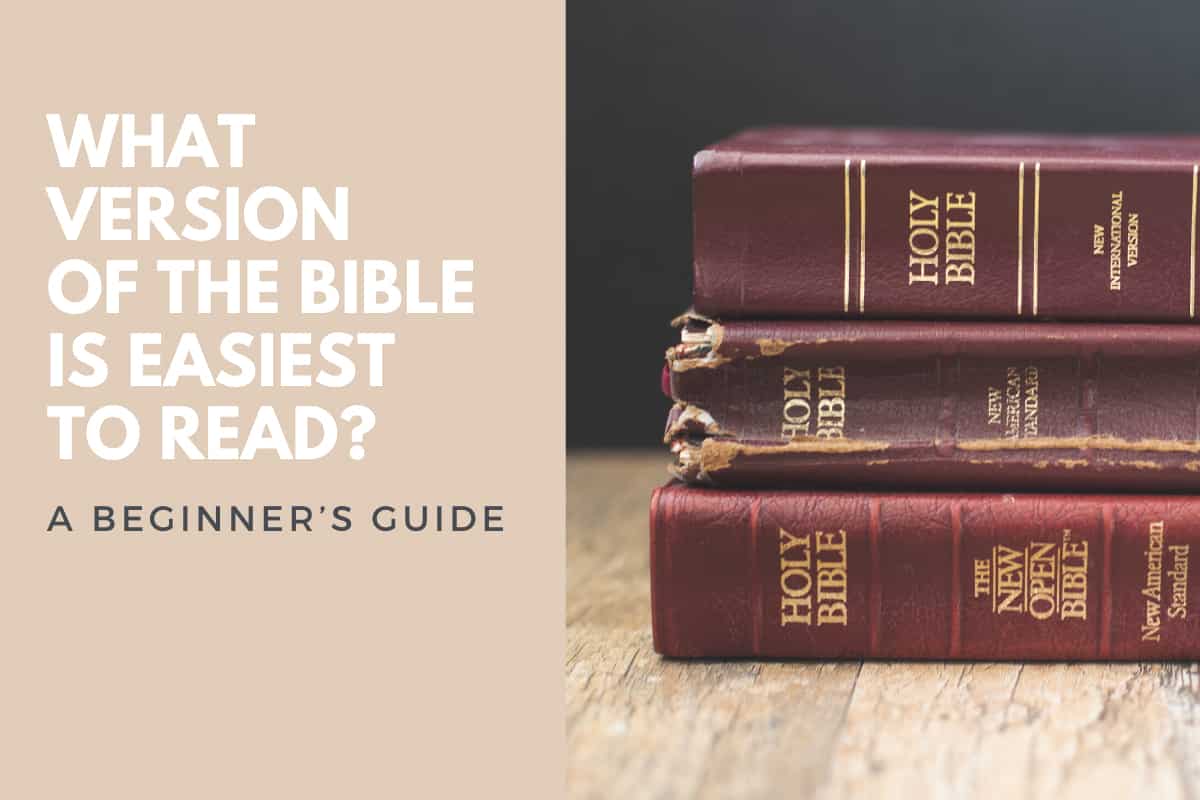
    Easiest to read Bible version

    When it comes to choosing a Bible version or translation, there is no one right answer. Some of the decision is based on personal preference. There is usually more than one way to translate from one language to another. It’s a balance of being true to the original and saying it in a way that flows naturally in English.

    Most modern English translations of the Bible are fairly accurate to the original text. But, each version has its strengths and limitations which makes it better for some uses than others. Some are good for reading and others are better for more serious Bible Study.

    The best bible version for beginners will be the one that fits the needs of the person reading. To help you decide, let’s look at a few more details.

    What Is the Most Readable Version of the Bible?

    Here are a few more details on my Top 3 Recommendations for Bible Versions for Beginners:

    New Living Translation (NLT)

    The NLT aims for a 6th-grade reading level. It’s not the lowest reading level on this list, but for most people, it’s the best overall choice. The NLT is what’s sometimes referred to as a thought-for-thought translation and strikes a good balance between being literal and easy to read. It’s not a word-for-word translation, which the ESV is closer to, but is still a good choice for Bible Study.

    The NLT is best for: The NLT is a good translation for most people who are looking for a Bible that is easy to read. It’s a great translation for reading and is good enough for in-depth Bible Study.

    What is a good bible for beginners? The New Living Translation (NLT) is a good Bible for most people who are starting out. It’s a great balance of being readable and accurate to the original text of the Bible.

    English Standard Version (ESV)

    The ESV aims for an 8th – 10th-grade reading level. It’s not as easy to read as the NLT which we just looked at, but it’s still clear and easy to read. The ESV is becoming a popular translation because it’s close to a word-for-word translation, but still clear and readable. 

    The ESV is best for: The ESV is a great version for people who are looking for a Bible that is a good balance of easy to read but still great for serious Bible Study. 

    Contemporary English Version (CEV)

    The CEV aims for a 5th-grade reading level. It’s the lowest reading level in my top 3. The CEV is not as well known as some of the other translations, but it can be a good choice for some people. It’s recommended here because it’s still based on the original text of the Bible.

    In terms of reading level, the CEV is the easiest bible to read.

    Many of the Children’s Bibles on the market are paraphrases or storybooks. These are marketed as Bibles, but they’re more like stories based on the Bible and not translations of the original text.

    The CEV is best for: The CEV is a good version for a Children’s reading Bible. It’s a full text of the Bible based on the original text but aimed at a lower reading level. It is also a good choice for those who are learning English as a Second Language.

    Reading Level of Bible Translations

    BIBLE VERSION/TRANSLATIONREADING LEVEL
    New International Version (NIV)7th grade
    New Living Translation (NLT)6th grade
    English Standard Version (ESV)8th – 10th grade
    King James Version (KJV)12th grade
    Christian Standard Bible (CSB)7th grade
    New King James Version (NKJV)7th – 9th grade
    Reina ValeraSpanish Translation
    New International Reader’s Version (NIrV)3rd grade
    New American Standard Bible (NASB)11th grade
    The Message (MSG)4th grade

    Here are a few things to note about the chart: 

    These are the top 10 most popular Bible translations based on data from the ECPA Bestsellers – January 2023.

    The King James Version (KJV) is great for historical value and poetic language. It’s not on my recommended list of easy-to-read versions because it uses Elizabethan English from the 1600’s. I do enjoy the New King James Version (NKJV) though, which is an updated edition that preserves the beauty of the language.

    Some of the reading levels have a range because different publishers and groups have different standards for how to measure them.

    The 10th on the list is the Message, which is a paraphrase of the Bible and intended for reading, not as a Study Bible. Most paraphrases are influenced by one person and not based on a group of language experts like the other translations on this list.

    I don’t recommend paraphrases of the Bible for beginners. Paraphrases lean more towards making the original text flow smoother in English. They can also contain biases from one individual translator rather than a team.

    This doesn’t mean that paraphrases don’t have their place as devotional-type reading Bibles. I recommend paraphrases to enhance your understanding, but not to rely on as your main version of the Bible. Most people who are starting out only have one version of the Bible, so I wouldn’t recommend a paraphrase to be the one.

    Which Bible Version Is the Most Accurate and Easy to Understand?

    There are a lot of translations and versions, so how do you know which one to choose? Who should you trust? There are so many opinions and options out there, so I want to explain the reasons why I recommend the NLT, ESV, and the CEV. Then you can make an informed decision that you feel confident about.

    It’s helpful to know the two major approaches in translating the Bible from the original text. 

    The Bible was originally written in Hebrew and Greek with a little bit of Aramaic here and there.

    The two main approaches to translating the Bible are word-for-word and thought-for-thought.

    In simple terms: Word-for-word translations try to stick as closely as possible to each word of the original languages. The thought-for-thought translations lean more towards being clear and expressing the Bible in modern English. This doesn’t mean that they are not accurate. It’s just a different emphasis and approach in translation.
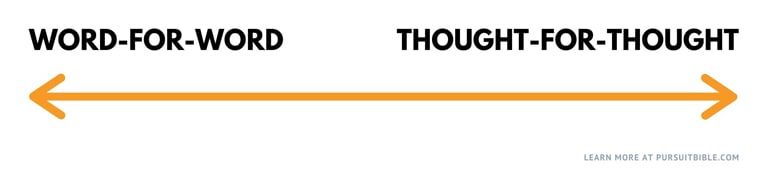
    Bible Translation Spectrum: word-for-word to thought-for-thought
    Bible Versions/Translations Fall Somewhere in this Spectrum

    Translations like the ESV are more word-for-word. The NLT and CEV are more thought-for-thought. Paraphrases like the Message would be on the far right of that spectrum. Paraphrases take the meaning and express it with words that are not in the original text.

    A lot more can be said about Bible versions and translations, but that’s the essence of it.

    Which Bible version is the most accurate and easy to understand? Word-for-word versions are “more accurate” and thought-for-thought usually means “easy to understand.” As you can see, that’s the tension. The ESV can be considered slightly more accurate since it leans towards word-for-word. And many people consider the NLT to be easier to read since it is translated thought-for-thought.

    If I have to pick just one, I’d go with the ESV because people usually don’t argue about its accuracy and it is still clear and easy to read. That’s why the ESV is gaining in popularity as the study bible of choice for a lot of people. 

    If you compare the different translations, you’ll probably find that most wordings are similar. The meaning is almost always the same. There are a few places where translators disagree. This is why it’s usually safer to have a team of language experts rather than one person’s paraphrase.

    Lastly, there is one thing I need to mention about the NLT and the CEV. They both lean towards gender-neutral language in some places. For example, it’ll say in Genesis 1:27 that God created humans whereas more word-for-word translations like the ESV will say that God created man – which is the more literal translation of the original text in Hebrew.

    The NLT and CEV are not nearly as far leaning as some other translations like the NIrV (which is not included in my top 3 list here). For that reason, I don’t recommend the NIrV here.

    Most of the gender-neutral leanings in the NLT and CEV are more for English usage reasons in my view and less so than translations like the NIrV and the newer versions of the NIV. For this reason, it’s not a deal-breaker for me. I have my convictions about what God’s Word says but I can also see that in English, it’s more natural for people to say that “God created humans” than to say that “God created man.”

    For serious Bible Study, I recommend the more word-for-word translations like the ESV, so this is not an issue, but for a reading Bible, it’s something that I wanted to mention so you’re aware of it. 

    A lot more can be said about Bible translations in general. But for most people, this is probably way more information than needed.

    The conclusion is that the most popular Bible translations are good and you can know what God’s Word says. I feel confident recommending the 3 versions: ESV, NLT, and the CEV. Whichever one you decide to go with, ask Holy Spirit to lead you into all truth (John 16:13).

    Let me know in the comments below or through the Contact Us page if you have any questions or suggestions on what types of articles or resources would be the most helpful to you.

    There will never be an end to scholarly and academic debates. If you keep your focus on wanting to know what God says and following Jesus, you’ll be well on your way to receiving all that God has for you through His eternal Word.

    All Scripture is breathed out by God and profitable for teaching, for reproof, for correction, and for training in righteousness, that the man of God may be complete, equipped for every good work.

    2 Tim. 3:16-17 (ESV)

    Subscribe to my newsletter for updates and encouraging content.

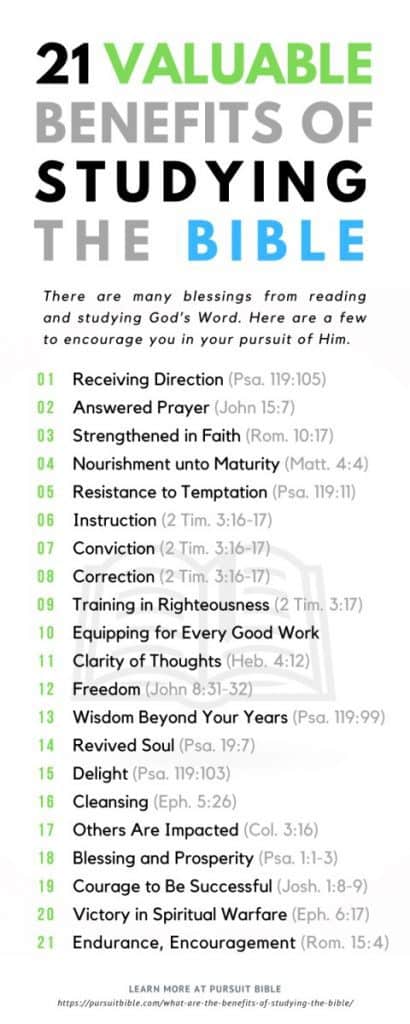
    If you found this article to be helpful, I think you’ll enjoy 21 Valuable Benefits of Studying the Bible. In it, I share some of the benefits and blessings of reading and studying the Bible.

    There is a simple way to study the Bible, called the Sword Method Bible Study. In the article, I share how I personally use it, but how it’s simple enough that children can use it: The Easiest Way to Study the Bible (link opens in a new window).

    Lastly, here are 21 Encouraging Bible Verses for Strength, Comfort & Perseverance. In it, I share Scriptures that will encourage you when you face difficult times.

  • 7 Tips to Help When You’re Struggling to Read the Bible

    7 Tips to Help When You’re Struggling to Read the Bible

    struggling to read the bible

    Even if you know the benefits of regular Bible reading and the difference it can make in your life, the Bible can be hard to read. You might find that it’s hard to understand or that it’s boring.  You might even feel guilty thinking that you shouldn’t feel this way about God’s Word.

    Let’s look at some of the reasons why the Bible is hard to read. After that, I’ll share 7 tips that have helped me through many years of reading the Bible and helping others do the same.

    Why Is It so Hard to Read the Bible?

    Anything worthwhile takes effort. It’s hard to learn a new language, to lose weight, or to change a habit. Some of the reasons that reading the Bible is hard are similar to anything that you try: life gets busy, you don’t see progress, or you lose sight of the motivation that got you started.

    There are also some things that are unique to the Bible that make it hard to read and understand.

    The Bible is a large book, a collection of 66 books, written by about 40 authors over a period of 1600 years. It’s originally written in 3 different languages and includes several literary genres.

    The variety and scope of the Bible make it a challenging book to read. One moment, you can be reading poetry in the psalms, then the next, you might be reading one of the prophetical books with a lot of metaphors and a historical background that might be foreign to you.

    Here are 7 tips that will help you to engage with the Bible when you’re having trouble reading the Bible. They range from motivational to practical tips to help remove some of the roadblocks that keep you from enjoying and benefiting from God’s Word. Try several of them to see which ones are the most helpful.

    7 Tips That Help When You’re Struggling to Read the Bible

    1. Check Your Vision and Your Motives

    Ask yourself: Why am I reading the Bible? Remind yourself what made you want to read the Bible. Was it because you had a spiritual hunger? As with anything, you have to remind yourself of the vision every once in a while.

    Here’s an article where I look at some of the benefits of reading and studying the Bible. You can see if one of the reasons resonates with you: 21 Valuable Benefits of Studying God’s Word (link opens in a new window) It can help reignite your vision for why you wanted to read the Bible in the first place.

    Ask yourself: Do I feel pressure to read the Bible? Do I feel shame and guilt when I don’t enjoy reading it? It’s true that God brings conviction to do the right thing. Sometimes, it’s not God, but your own guilt or shame that puts the pressure on yourself.

    Is it possible that you’re reading the Bible out of legalism? Are you trying to get God to like you more if you read the Bible? Read it instead because God already likes you. What Jesus did on the cross proves it (Heb. 12:2).

    Read it for the right reasons, then you’ll have the vision and strength to go through seasons when it’s not so exciting. It can be the very thing that gives you strength when you come to face trials in life. What you read now can be the thing that Holy Spirit brings to your mind at a later time.

    God is not running a Bible-reading contest from heaven. If you feel like the pressure to read and enjoy the Bible is hindering you, try some of the tips below to help you remove those roadblocks in your journey of Bible reading.

    Why is it so hard to read the Bible?

    2. Read Another Part of the Bible

    If you’re not in a Bible reading contest, there are no rules that force you to read the Bible from cover-to-cover. There’s no rule that says you have to read a certain book of the Bible or in a particular order.

    Try reading another part of the Bible. If you’re reading the Old Testament, try reading somewhere in the New Testament. If you’re stuck in a historical book, try reading some of the poetic books like Psalms or Proverbs.

    All of the Bible is God-breathed (2 Tim. 3:16-17) and is useful for you. Feel free to explore and find a book that you enjoy.

    Through different seasons of your life, you’ll find that certain books of the Bible resonate with you more. Read the parts that you enjoy right now. It’s good to be stretched, grow, and try new things, but it’s also okay to stay where you are at the moment and take your time to receive the full benefits.

    If you have a favorite book of the Bible, it’s okay to read it again instead of going to a new book. When you’re ready, branch out from that book. For example, if you enjoy reading one of the Gospels like Matthew, Mark, Luke, or John, try reading the Book of Acts that picks up the story of Jesus’ Disciples and the early church.

    3. Read a Different Translation of the Bible

    What translation of the Bible are you reading? The Bible was originally written in Hebrew, Greek, and a little bit of Aramaic. The Bible that you’re reading is a translation.

    Several factors come into play when the Bible is translated. When was it translated? The King James Version, or KJV for short, was written in the 1600s. That’s why it has English words from that era. You’ll probably enjoy reading the Bible a lot more if you use a newer translation.

    Some translations are more word-for-word translations like the NASB, ESV, and NKJV. Other translations are thought-for-thought making them sometimes easier to read in English like the NIV and NLT. There are also some that are paraphrases (The Message, the Living Bible).

    I use more word-for-word translations for my in-depth Bible study. For my every-day reading, I enjoy the ESV but sometimes appreciate the NLT because it flows a bit more smoothly.

    I usually suggest the ESV as a good starting point for a general reading Bible, but if you’re struggling to read the Bible, I recommend you give the New Living Translation (NLT) [link to Amazon – check out the reviews] a try. It is easier to read and can be just the boost you need to make Bible reading more enjoyable.

    4. Make It Personal: Apply the Bible

    Even the Bible becomes boring if it doesn’t apply to you. It can feel like you’re reading about random events and ideas if it isn’t meaningful to you. Things are boring when they don’t make a difference in your life.

    The most important point of reading the Bible is to encounter Jesus, the living Word of God, through the Bible, the written Word of God. 

    You search the Scriptures because you think that in them you have eternal life; and it is they that bear witness about me, yet you refuse to come to me that you may have life.

    John 5:39-40 (ESV)

    Make the point of reading the Bible to meet with God. Personalize the Bible and read it as God’s Word to you personally. If you read the Bible with the goal of applying it to your life, you will approach it with a whole new perspective.

    One simple way to apply the Bible is to ask yourself: “What does God want me to do according to this passage?”

    What does God want me to do according to this passage?
    * Is there a Sin to confess?
    * Is there a Promise to claim as my own?
    * Is there an Example to follow?
    * Is there a Command to obey with a joyful heart?

    The main words in each question are the initials S.P.E.C. and can help you remember them.

    Also, approach the Bible as a way to experience God. For example, if you’re stuck in the book of Exodus, connect the story of how God delivered the people of Israel with how God has delivered you. What lessons can you apply to your life? In what ways can you be thankful for His deliverance?

    Also, ask yourself: Who can I share this with? Share the insights and stories that you’re reading in the Bible with someone today. It can be a tremendous blessing to you and to the person you share it with.

    Make the Bible personal and apply it to your life and it can become a great source of God’s Wisdom for your day.

    5. Listen to the Bible

    If you’re stuck in your Bible reading, try listening to the Bible instead.

    When you listen to the Bible, it can take on a whole new meaning or give you a fresh perspective on the flow of thoughts.

    You can listen online with sites like ESV.org. Many Bible apps also offer audio along with the text. My favorite Bible app is Bible.is because it lets me download the audio files ahead of time onto my phone so I can listen anytime. I like to listen to the ESV dramatized version of the Bible while I’m going about my day.

    6. Memorize Bible Verses

    When you’re having a hard time reading and understanding the Bible, try memorizing it. Memorize a short or long passage of the Bible and think about it throughout the day.

    Don’t feel like you have to be rushed and go to a new verse or chapter every day. Feel free to hang out there for a few days, weeks, or even months. Remember, the point is to encounter God and let Him change your life, not check off boxes on a Bible reading chart.

    Memorizing Bible verses is a great way to hide God’s Word in your heart (Col. 3:16). You can think about it anytime. It’s like a pot of stew that’s been simmering on the stove for hours. Memorizing the Bible lets you keep the Word close to your mind and heart so you can understand and apply it to your life.

    Unless it’s your homework assignment to read the Bible, there’s no timeline or timelimit. It’s better to read one verse over and over again and think about what it means and to pray and ask God for insight than to move on quickly.

    Memorize it. Think of who you can share it with and do it. Think of ways that you can apply it to your life.

    7. Study the Bible Instead of Reading It in Passing

    One of the reasons the Bible is hard to read is because of the historical, language, and cultural gap between when it was written and your life today. On a side note, it’s amazing how long ago the Bible was written and it is still changing people’s lives all over the world!

    One way to bridge the gap is to do a little bit more in-depth study to understand the background story of the book you’re reading. When you understand the setting, the people involved, the problems they were facing, you can connect with it better. It begins to matter to you and you begin to connect it to your life.

    One resource that I highly recommend is: Unlocking the Bible: A Unique Overview of the Whole Bible (You can check out the reviews on this link to Amazon). It gives an explanation of every book of the Bible and helps you see how all the books fit together to tell one grand story. Be sure to get the book and not the companion volume that only has diagrams, charts, and images. The covers look very similar.

    For example, if you’re reading one of the Epistles, or letters, in the New Testament, such as the book of Philippians, it can be helpful to know that Paul is writing this letter of joy from prison. He is writing to the people in a church that he started on one of his missionary journeys. What problems were they facing? How does this apply to your life?

    I like to take one or two books of the Bible per year and study them really slowly. The pace is up to you. Feel free to set a goal, but start somewhere and you can always adjust it as you go.

    If you want some ideas on how to go deeper in studying the Bible, here are 11 Ways to Study the Bible: Methods, Techniques & Tips (link opens in a new window). In that post, I share a variety of different ways to study the Bible so you can find the way that works best for you.

    Encounter God Through His Word

    In Matt. 13:1-23, Jesus tells his Disciples a parable about a Sower who goes out to sow seeds. The seed is God’s Word. The soil is your heart.

    There is an enemy that comes to try to snatch the seed away. The cares of this life will try to choke it out. But God’s invitation to you is to receive and understand His Word so that you can know the joy of having a relationship with Him.

    If you’re experiencing spiritual dullness, ask God to restore the first-love that you had before. Commit to follow Him and take time to cultivate a vibrant life in God. I pray that your time in God’s Word will be a source of great joy and wisdom for you.

    Call to me and I will answer you, and will tell you great and hidden things that you have not known.

    Jeremiah 33:3 (ESV)


    Subscribe to my newsletter for updates and encouraging content.

    If you found this article to be helpful, here are a few others that I think you will enjoy:

    Can you use encouragement from God’s Word? Encouraging Bible Verses for Strength, Comfort, Perseverance. In it, I share 21 verses from God’s Word that encourage, inspire, and bring a fresh perspective.

    25 Most Powerful Bible Verses: How to Apply Them to Your Life. These verses will help you experience God’s power, so you can personally know His peace, joy, and comfort. I also include practical ways that you can apply the verses to your life.

    What Version of the Bible Is Easiest to Read. In this article, I explain why I recommend the New Living Translation that I mentioned above.

    Photo by Josh Applegate on Unsplash

    Photo by Priscilla Du Preez on Unsplash

  • Should You Read the Bible in Order? Here are the Best Options

    Should You Read the Bible in Order? Here are the Best Options

    Do you read the Bible like most books, in order from beginning to end? Or are there other recommended ways to read it? This is a common question because the Bible is a long book. It can seem confusing and even intimidating at first to know where to start.

    Everyone who wants to start reading the Bible has been there. I want to share with you what I’ve learned from my experience of reading through the Bible and helping others do the same.

    Should you read the Bible in order? Most people should not read the Bible in order. It is better to start with the books that give an effective overview of the main message of the Bible. This works best for most people because the books of the Bible are not all arranged in the actual order of events.

    Of course, there isn’t just one right order to read the Bible. The important thing is to engage with God’s Word. You can always come back to read the books later. This is what I did when I first “read through” the Bible.

    If you get stuck, just move onto another book and then come back to it later. It might make a lot more sense then.

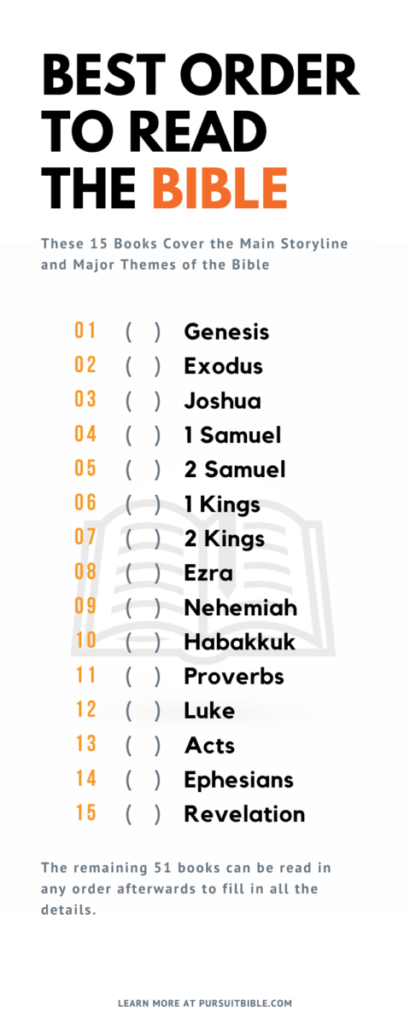
    Best Order to Read the Bible

    Above is a list of the recommended order to read. I’ll mention more details and other options below. It’s a better way because many people who try to read the Bible in order from cover-to-cover tend to get stuck and stop reading. Only a few really determined or disciplined people are able to finish it.

    If you’re ready to start reading the Bible right away, you might want to jump ahead to that list. If you’re interested in a more detailed answer so you’ll be confident that it’s the best way to go, let’s take a closer look.

    Is the Bible Meant to Be Read in Order?

    The Bible is not arranged in the order to be read, but by the type or genre of the books.

    In the Old Testament, all of the books of the Law are grouped together – the first 5 books, from Genesis to Deuteronomy. Then there are the books of History. After that are the 5 books of Poetry. Finally, there are the Prophets.

    The New Testament starts with 4 accounts of the Gospel, the life of Jesus Christ. Then there is one book of history, the book of Acts. It’s followed by many Letters or Epistles. The last book is the book of Revelation, which is the genre of Prophecy.

    If you want to find out more about how the Bible is arranged, you can read this article: How the Bible Arranged: Its Main Structure & Meaning.

    Many people start out doing well through Genesis and Exodus, but get bogged down somewhere near the third book, Leviticus. Leviticus goes into the details of the Law that you can come back to at a later time. Instead of reading in order, you can skip to Joshua, the first book of History, to pick up the major storyline of the Bible for now.

    Then when you get to 1 & 2 Kings, skip over 1 & 2 Chronicles for now because they cover much of the same history. The slightly different perspectives and different purposes of those sets of books can be explored later.

    Then in the New Testament, since there are four accounts of the life of Jesus – Matthew, Mark, Luke, and John – you can just read Mark to start out. You can come back to the other 3 accounts at a later time to compare and contrast the different things that each account emphasizes.

    Comparing the different Gospel accounts is a great study, but one account will be okay for now. Skip on over to the book of Acts, the History type of book, in the New Testament, to see where the major storyline picks up after Jesus’ death and resurrection.

    The recommended order below takes a sampling from each of the types of books in the Bible.

    Order to Read the Bible

    Best Order to Read the Bible for the First Time

    These 15 books are recommended to start out with as they cover all the major themes and storyline of the Bible. The list includes books from every category or genre of the Bible.

    Best Order to Read the Bible for the First Time

    1. Genesis
    2. Exodus
    3. Joshua
    4. 1 Samuel
    5. 2 Samuel
    6. 1 Kings
    7. 2 Kings
    8. Ezra
    9. Nehemiah
    10. Habakkuk
    11. Proverbs
    12. Luke
    13. Acts
    14. Ephesians
    15. Revelation

    After reading these 15 books, you can read the remaining books in any sequence after that to enrich your overall understanding of the Bible and fill in more of the details.

    If you’re interested in this approach and want more background information, you can check out this article which includes a brief summary of each of the books in this list.

    If you’re thinking of reading through the Bible or following the list of 15 books above, a great resource is: Unlocking the Bible: A Unique Overview of the Whole Bible (You can check out the reviews on this link to Amazon). It expalains every book of the Bible and helps you see where each book fits in the big story line. I highly recommend it. Be sure to get the book and not the companion volume which only has charts, diagrams, and images. The covers look very similar.

    Another Option: Read the Bible in Chronological Order

    Another option is to read the Bible in the order that the events actually happened. This approach would be to take the books and sometimes smaller portions of the Bible and arrange them in chronological order.

    The arrangements of the books in the Bible are not chronological. For example, the historical book of Ezra can be enhanced by the prophetical books of Haggai and Zechariah even though they are not in the same section. Haggai and Zechariah were prophets that encouraged the people during the time of Ezra, so it’d be helpful to know what they said when you read Ezra.

    As an example, if you read in the Bible in order, you would read all the historical books and then reading the prophetical books afterward. Rather than doing that, it makes more sense to read the Historical books along with the Prophetical books that happened during the same time as them.

    The recommended list in the section above follows a roughly chronological order of the major events and storyline of the Bible. This second option puts the entire Bible into chronological order.

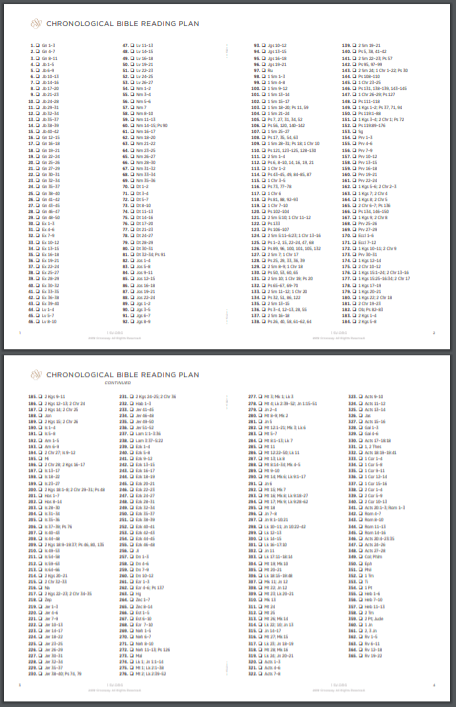
    One way to read the Bible in chronological order is to find a Bible reading chart that organizes it that way. Crossway has a good Chronological Bible Reading Plan that’s divided into 365 days. Click on the image below to download the PDF.

    ESV Chronological Bible Reading Plan
    ESV Chronological Bible Reading Plan
    Taken from Crossway.org. Used by Permission of Crossway.

    Another good way to read the entire Bible this way is to get a chronological Bible like the One Year Chronological Bible NLT (Link to Amazon). It’s conveniently laid out into 365 daily readings in chronological order.

    NLT is a good translation for general reading. The convenience of having the Bible laid out in chronological order is great for developing a Bible reading habit.

    You might also want to consider a resource like the NLT One Year Chronological Study Bible (Link to Amazon). It has a brief commentary for each day so you can understand what you’re reading.

    Some Bible apps have a Bible Reading Plan feature that include a chronological feature. If you like the convenience of reading the Bible on your phone, this might be a good option. Some people prefer to read a paper copy without distractions. You have both options available.

    Keep in mind that there are some differences in interpretation of the order of events. Not every list and chart will agree, but the differences are mostly minor. Don’t let these minor differences bother you. The major pieces will be just about the same.

    Start Reading the Bible Today

    There’s no one right order to read the Bible. Reading the Bible from cover-to-cover is also an option, especially if you’re not new to the Bible. For most people, I’d recommend the list above.

    Don’t feel limited by the order or the details. If you find something really interesting, feel free to stay there. Read the same book again. Keep reading and encountering God in His Word. Let Him lead you on this exciting journey.

    All Scripture is breathed out by God and profitable for teaching, for reproof, for correction, and for training in righteousness, that the man of God may be complete, equipped for every good work.

    2 Tim. 3:16-17 (ESV)

    After helping people read and study the Bible for many years, I’ve found that how you approach the Bible is more important than the order that you read it. In this article, I share 7 Guidelines: How to Start Studying the Bible for Yourself. The guidelines will help you get the most out of your Bible reading.

    I think you’ll enjoy The Bible Explained for Beginners (Simple Guide & Diagram). In it, I share a simple overview and diagram which I think will be really helpful as you read through the Bible.

    Also, here is an article that I think will be helpful as you begin to read through the Bible: How to Read and Understand the Bible for Beginners (Essential Guide) it explains some of the essential people and ideas that will help you get the most out of your Bible reading.

    Reading through the Bible is a great way to grow spiritually and receive God’s wisdom for your life. Here’s an article where I share 21 Valuable Benefits of Studying the Bible. I hope it’ll provide more motivation and encouragement for you as you read and study the Bible.
    Overview of the BIble
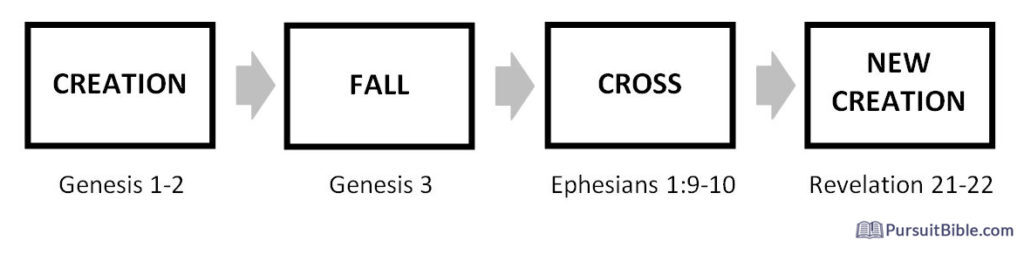
    Diagram of the Big-Picture Overview of the Entire Bible


    Photo by Priscilla Du Preez on Unsplash

  • How to Use a Study Bible: A Helpful Illustrated Guide

    How to Use a Study Bible: A Helpful Illustrated Guide

    How to Use a Study Bible: An Illustrated User Guide

    A Study Bible is a great resource to help take you deeper into your study of the Bible. It combines all the most used resources in one-volume. I remember the excitement of getting my first Study Bible more than 30 years ago. But, it can also be a bit confusing and even intimidating at first to use one because there’s so much in there.

    Let’s go through the major tools in a Study Bible so you can study the Bible with confidence. I’ll be using the ESV Study Bible (Link to Amazon) in the photos and examples. Most Study Bibles will have similar tools although the layout might be different.

    For those just starting out, I recommend the CSB Tony Evans Study Bible (You can check the reviews on Amazon) instead because it has a more devotional approach along with solid Biblical scholarship.

    How to Use a Study Bible: ESV Study Bible
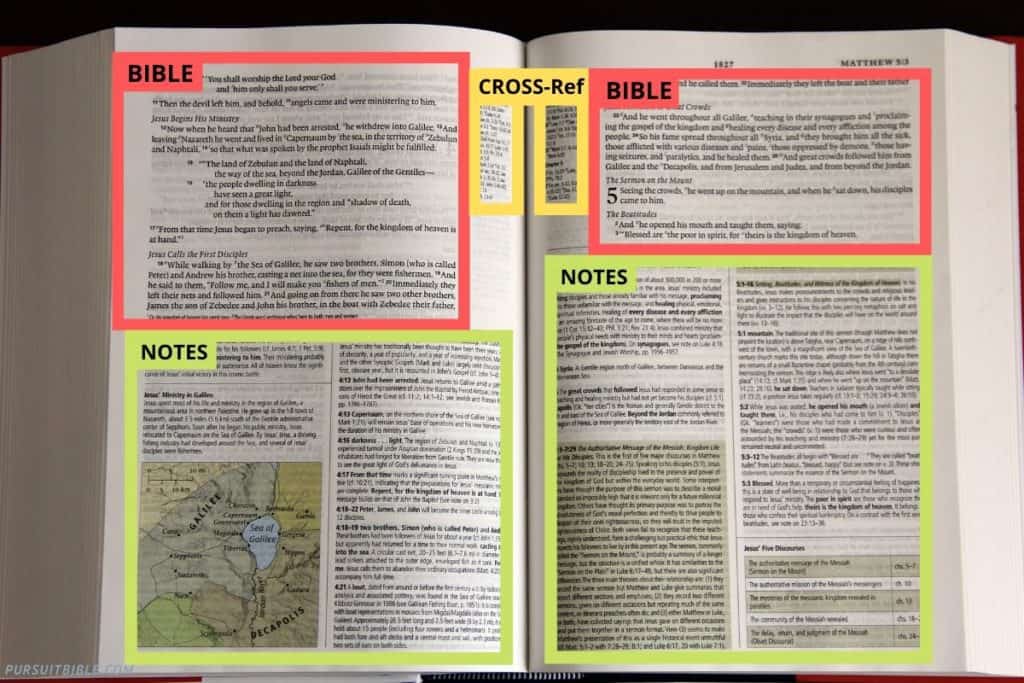
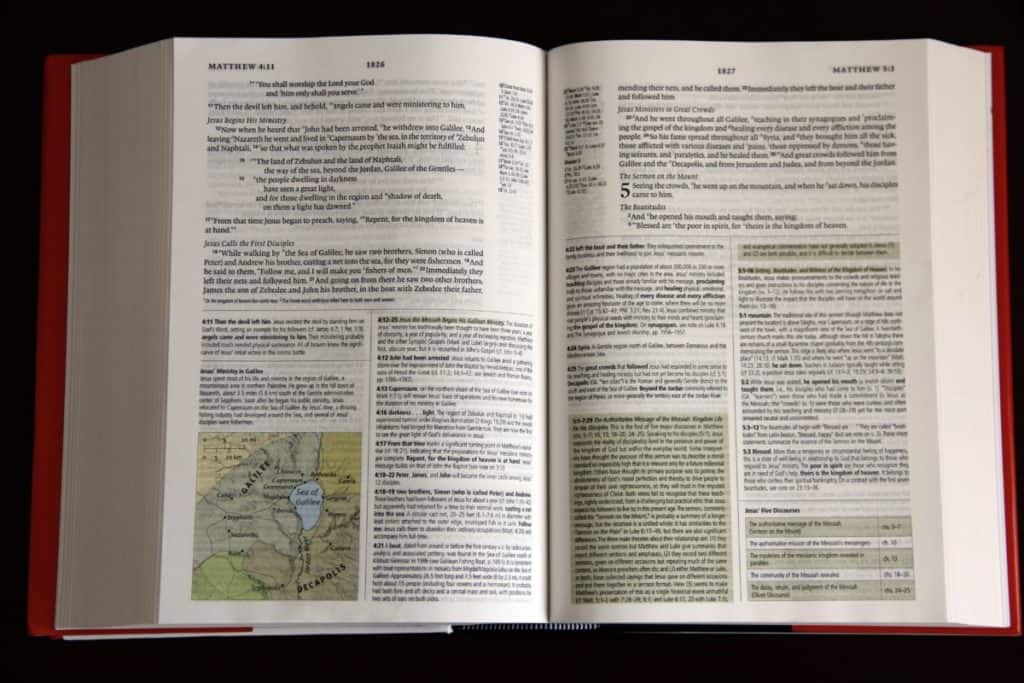
    The text of the Bible [in red], Cross-References [in yellow], and Notes/commentary [in green].

    1. How to Use Cross-References in a Study Bible

    Cross-references connect the verse that you’re reading with other related verses in the Bible. Finding these other passages in the Bible can shed light on what you’re reading and studying. It’s helpful to look at the verse from the larger context of the book that you’re reading or from what the rest of the Bible says about the topic.

    When you look up cross-references, you can look for common themes or patterns. You might notice that there are exceptions that emphasize different aspects of the topic you’re searching.

    These cross-references are usually found in the margins of a Study Bible. Sometimes, they’re just below the text of the Bible. 

    How to Use a Study Bible: Cross-References in the ESV Study Bible
    How to Use Cross-References in a Study Bible

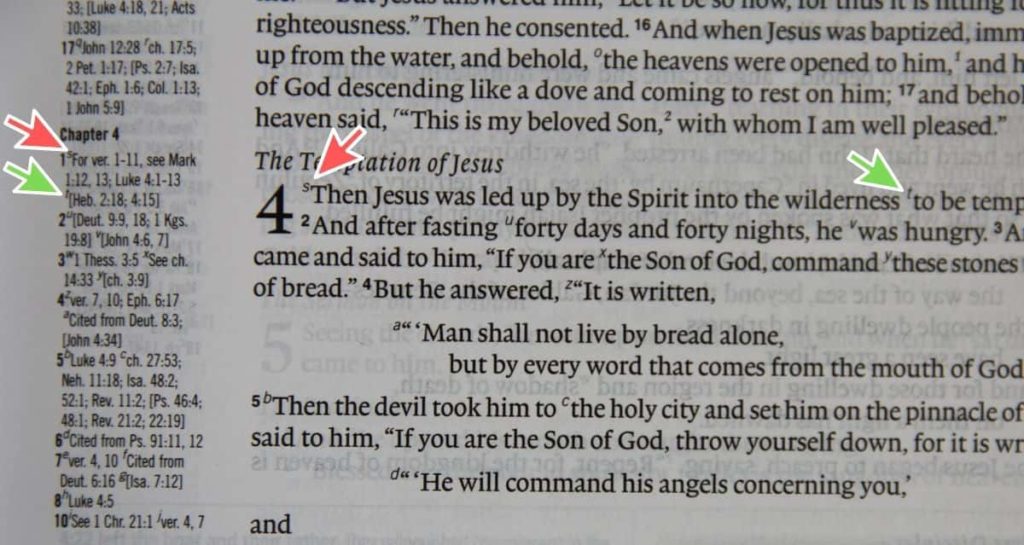
    How do you use these? Let’s say you’re reading Matt. 4:1-11. As you begin reading in verse 1, you’ll see the small italicized letters in the text of the Bible. In the photos, there’s an “s.” Look at the cross-reference and under chapter 4, verse 1, you’ll find an “s.”

    The “s” in the text points you to Mark 1:12, 13 and Luke 4:1-13. These are parallel passages in the Gospels. You can compare each account to see what it includes or emphasizes. You can pick up different details in each passage. 

    These parallel passages can shed new light on the passage that you’re reading. You can also read the different notes and cross-references on these parallel passages. One passage might lead to another and you might find yourself with several bookmarkers at different places in the Bible. This is when it gets fun!

    Don’t feel limited to one passage in the Bible, but at the same time, don’t feel like you have to chase every rabbit trail.

    Next, in the text, you’ll see a “t” before the phrase “to be tempted by the devil.” Go back to the cross-references and you’ll see that the “t” points you to Heb. 2:18; 4:15.

    When you turn in your Bible to Heb. 2:18 and you’ll see that it talks about how Jesus suffered when He was tempted. This passage brings out the application that Jesus is able to help those who are being tempted because He went through these temptations too.

    Next, if you go to Heb. 4:15, it brings out the idea that Jesus experiencing temptation is compared to the role of a high priest in the temple in the Old Testament. It also brings in the fact that Jesus never sinned, even though He was tempted.

    At this point, you can go back to your original passage, Matt. 4, or if any of the topics that you found interest you, you can pursue those. If you want to pursue these at a later point, just circle these passages in the cross-reference section of Matt. 4, and you can continue your study next time.

    There are so many possibilities! The ESV Study Bible has more than 80,000 cross-references in the Bible. As you progress in understanding the Bible, you’ll get more comfortable with the different parts of the Bible and you’ll begin to make the major connections on your own without the cross-references.

    For now, know that these cross-references are there and you can go down this path anytime you choose to.

    2. How to Use the Notes and Commentary in a Study Bible

    The notes or commentaries on the text are written by various contributors to the Study Bible. These are the Bible scholars and teachers who provide notes and comments on the verses.

    The text of the Bible is what we receive as God’s Word. The comments are the explanations written by people and they are different in each Study Bible since the contributors are different.

    All Scripture is breathed out by God and profitable for teaching, for reproof, for correction, and for training in righteousness, that the man of God may be complete, equipped for every good work.

    2 Tim. 3:16-17 (ESV)

    Most Study Bibles bring together a broad range of Bible scholars and teachers so that it will be received by a wider audience. The most helpful comments and notes will describe any major differences in interpretation so that you can be aware of the various approaches.

    The notes and comments are usually at the bottom of the page, sometimes in a different style font and size to contrast it from the text of the Scripture.

    How to Use a Study Bible: Notes and Commentary
    How to Use a Study Bible: Notes and Commentary (ESV Study Bible)

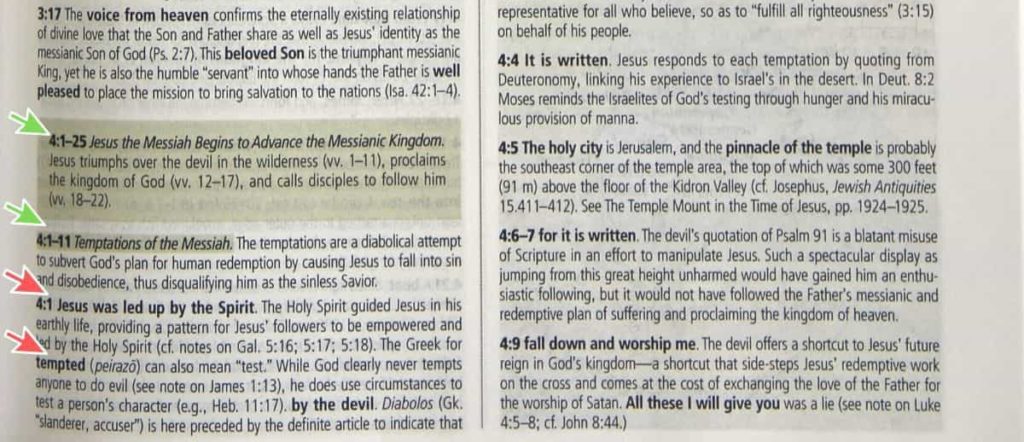
    In the ESV Study Bible, there is a box that describes this major section of the book: Matt. 4:1-25 (first green arrow). You can combine this with the Outline in the Book Introduction, which we’ll look at later. This gives you the big-picture outline of where this fits in the book of Matthew.

    In the example in the photo, you’ll see that there is a general comment or summary on Matt. 4:1-11 (second green arrow).

    After that, you’ll find the comments on each verse. The phrase in bold is the phrase from the text of the Bible that is being commented on. For example, the first comment on Matt. 4:1 is on the phrase “Jesus was led up by the Spirit” (first red arrow). After the comments on that phrase, we go to the next bolded word or phrase, which is “tempted” (second red arrow).

    Different Study Bibles are different in the numbers of notes that they have and the level of detail in the notes. As with all the tools in a Study Bible, they will be limited in number because of the amount of space each one would take up.

    In the beginning, most people look at the notes a lot since they’re very accessible. As you progress in your study, the cross-references could take on more importance. That’s the beauty of a Study Bible. All the tools are there so you can flow from one type of study to another.

    Also, in the notes and comments section, you’ll sometimes find relevant maps, charts, illustrations, or other helpful material.

    In some Study Bibles, these extra resources are listed in one place, either at the beginning or end of the Study Bible. The ESV Study Bible has them listed at the end. Each one of these has cross-references and themes that you can pursue in your Bible study.

    Depending on the Study Bible, you might find other features that highlight things like word studies, application points, and historical background. Some Study Bibles incorporate these into the notes and comments section and don’t put special design elements around them.

    3. How to Use the Book Introductions

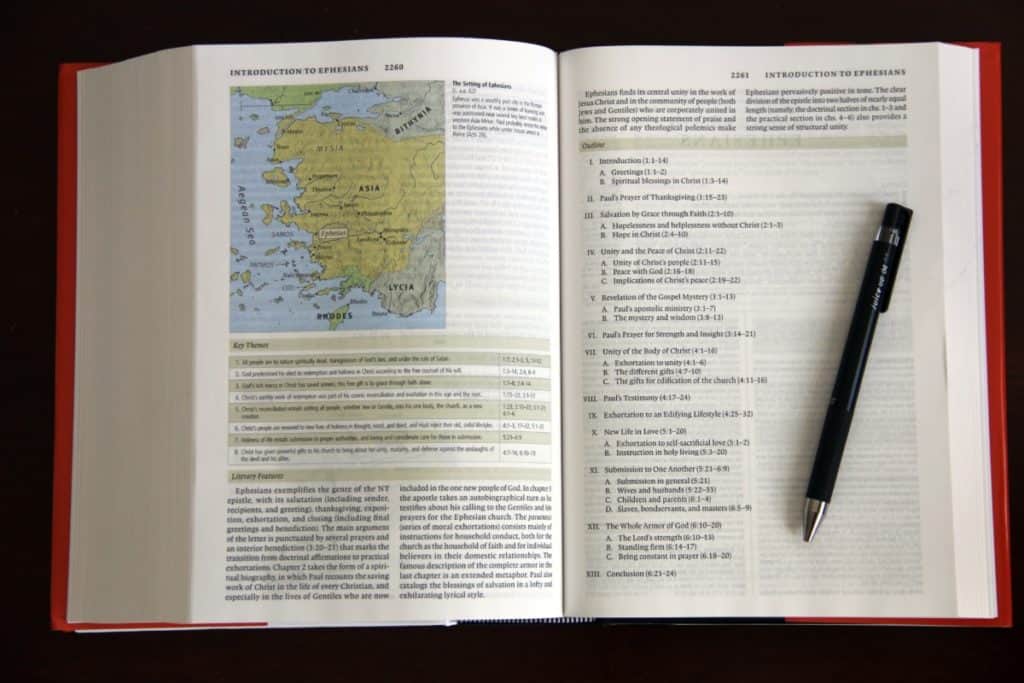
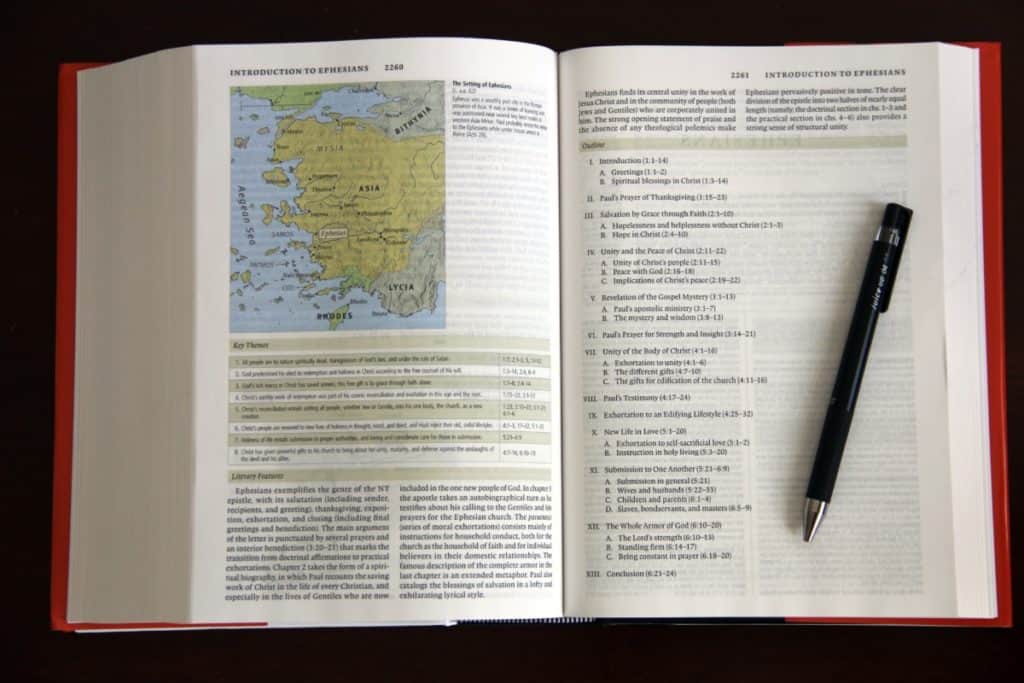
    How to Use a Study Bible: Book Introductions - Ephesians in the ESV Study Bible
    Introduction to Ephesians in the ESV Study Bible

    One of the key resources in a Study Bible is the introduction to each book of the Bible. These cover essentials such as author, recipients, the date the book of the Bible was written, the main theme(s), the purpose the book was written.

    Some might include a timeline, maps, or charts that will help shed some light on the historical background. Most of the background information is straight-forward and doesn’t need that much explanation.

    Many Study Bibles will also include an Outline of the book. These can be helpful in getting a grasp of the big-picture overview of the book. If you’re doing a book study, I would recommend making your own outline early on in your study and tweaking it as you dive deeper into the book.

    My recommendation for the first reading of the book introduction would be to just aim for a general idea of the book. Get enough information to get started, but don’t get bogged down in the details.

    As you read and study the actual text of the book of the Bible itself, plan on revisiting the book introduction again at a later time. A lot of the information will make more sense after you’ve spent some time reading the actual text of the Bible.

    Reading a book introduction is especially helpful if you’re doing an in-depth study of a book of the Bible as opposed to studying a theme or topic in the Bible. Here’s an article in which I explain how you can do that: How to Study a Book of the Bible: 5 Step Guide With Examples (link opens in a new window).

    For example, when you’re studying a book like Ephesians, learning about the background of Colossians can be helpful. Or if you’re studying the book of Ezra, reading the book introduction to Haggai and Zechariah could be helpful since both of these prophets prophesied during Ezra’s time to encourage and guide the people.

    Also, look for other resources that supplement the book introductions. For example, if you’re reading one of the letters of Paul, there might be an article about the Pauline Letters in general. Or there could be articles or introductions to the letters that Paul wrote from prison.

    Every Study Bible is different, so you might have to flip around in the Table of Contents to see if there are other resources that would be helpful in your Study Bible. If there are, take advantage of them. Also, most Study Bibles will have an introduction to the Old Testament and one for the New Testament. There might be one that gives an overview of the Bible.

    Also, look for articles on specific sections of the Bible or genres of books. For example, the ESV Study Bible has articles on introduction to the Pentateuch (the first five books of the Old Testament), the Poetic and Wisdom literature, Prophetic books, Gospels and Acts, and the Epistles.

    For example, if you’re studying the Psalms, after looking at the book introduction to the Psalms, read the Introduction to Poetic and Wisdom literature in the Bible. It might shed some light on how Hebrew poetry is different from poetry in the English language.

    4. How to Use the Maps in a Study Bible

    The best way to use a map is to put yourself in the story.

    The best way to use a map is to put yourself in the story.

    If you’re studying one of the Gospels and looking at the ministry of Jesus, find yourself on the map. What’s the terrain? Is it in the Northern region of Galilee where Jesus grew up or in the Southern area, closer to Jerusalem, the capital?

    If you’re studying the missionary journeys of Paul because you’re in the book of Acts or one of the Epistles, find yourself on the map and imagine the journey that needs to take place. 

    If you’re studying the book of Exodus, Numbers, or Joshua, see the journey from Egypt to the Promised Land. Look at the direct route that they could have taken from Egypt to the Promised Land. Look at the area that they ended up wandering in for 40 years. Lastly, look at the river just before crossing into Jericho. This is where some of the tribes choose not to cross over into the Promised Land.

    Most Study Bibles will have the standard maps like the land during the time of the Patriarchs, during Israel’s monarchy, during the time of Jesus’ ministry and Paul’s Missionary Journeys.

    When you’re studying a book or story in the Bible, look at the Book Introduction and look for any maps, then glance at the back to see if there are larger maps that are related.

    On their own, maps are not that accessible and can seem like random pictures. The maps only become useful when used together with the particular book or books that they correspond to. You’ll have to pair the maps with the book introductions or articles to get the most out of them.

    5. How to Use the Concordance in a Study Bible

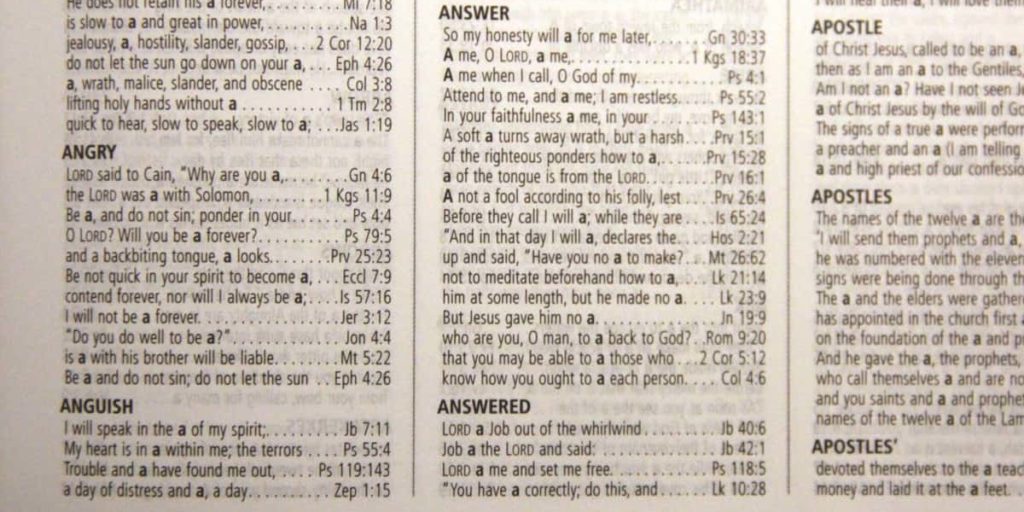
    How to Use a Study Bible: Concordance in the ESV Study Bible
    Concordance in the ESV Study Bible

    How to find Bible verses? A concordance or internet search can help you locate a certain word or verse in the Bible. Most Study Bibles will have some sort of Concordance or index in the back.

    Some Study Bibles will have a more extensive Concordance than others, but keep in mind that these are all limited to major words from the most familiar and popular verses.

    The New Strong’s Expanded Exhaustive Concordance of the Bible (link to Amazon), which is a very popular Concordance, lists many more words but is almost 2000 pages long! It’s a great resource for word studies but has way more information than would fit in a Study Bible.

    With internet searches being just a few clicks away, the concordance isn’t used as much as it used to be. The concordance in the back of the Study Bible is still very helpful in narrowing down the choices. Since it would only list the most popular verses, you don’t have to wade through dozens of verses to find the one that you’re more likely to be looking for.

    For example, searching for the word “anger” on ESV.org turns up 267 results. The concordance in the back of the ESV Study Bible lists 15 verses. If you’re trying to find a verse that you heard about anger, it’s most likely to be one of the 15 verses in the concordance.

    Enjoy the Journey and Encounter Jesus

    There is a bit of a learning curve to using a Study Bible, but I hope you’ll stick with it. The rewards are worth it! There’s a hunger in your heart to know God and learn His ways. It might start as a spark but commit to spending time in His Word and ask the Holy Spirit to help you. He’s a brilliant leader and He delights to bring glory to Jesus, the Living Word.

    But he answered, “It is written, “‘Man shall not live by bread alone, but by every word that comes from the mouth of God.’”

    (Matt. 4:4).


    Subscribe to my newsletter for updates and encouraging content.

    Are you looking for new ways to study the Bible? You can use a Study Bible and use one of these: 11 Ways to Study the Bible: Methods, Techniques & Tips. In the article, I explore different ways to study the Bible for which a Study Bible could be very useful.

    If you’re looking for a thorough Study Bible, I recommend the one I used in the examples for this article: 1) The ESV Study Bible (link to Amazon opens in a new window), and 2) For beginners, the CSB Tony Evans Study Bible (You can check the reviews on Amazon) – it has more of a devotional approach along with solid Biblical scholarship.

  • Best Study Bible for New Believers

    Best Study Bible for New Believers

    Best Study Bible for New Believers

    Study Bibles are a great resource to go deeper in studying God’s Word. I got my first study Bible more than 30 years ago, but I still remember the day like it was yesterday. It’s really exciting to be able to start studying the Bible for yourself.

    Whether you’re looking for one for yourself or for someone who’s just starting out, this is a big step in spiritual growth. There are a lot of options to choose from. What is the best study Bible for beginners or anyone who wants to begin going deeper in studying the Bible?

    I’ll give a few recommendations below, but here’s my top recommendation for most people:

    UPDATE I’ve updated my recommendation to the CSB Tony Evans Study Bible (you can take a look at the reviews on Amazon). It’s a good balance of solid scholarship with application to everyday life. It’s a great fit for new believers that want to go deeper in their understanding of the Bible.

    [I still recommend the ESV Study Bible for some people, for more serious Bible Study, but it leans toward the academic side, so I’ve updated my recommendation.]

    The best study Bible for most new believers is the ESV Study Bible.

    1. It’s thorough enough for an in-depth study.
    2. It’s broadly accepted.
    3. It’s easy to use

    One thing to keep in mind is that the CSB is a good and dependable translation but the ESV is much more popular.]

    The ESV Study Bible (link to Amazon – opens in a new window) doesn’t have as many color photos and fancy designs as some of the other Study Bibles out there.

    It’s more along the lines of being simple, elegant, and straightforward in its design elements. I take this as a positive because you can keep your attention on the Bible and its message and not be distracted by the design features.

    A good study Bible for those starting out should be clear and easy to use. Study Bibles have a lot of resources in one-volume, so it’s important that it be clearly laid out. 

    I wrote an article where I explain how to use several of the Study Bible’s main features. I use the ESV Study Bible in my examples, so you can get an idea of what it looks like: How to Use a Study Bible: A Helpful Illustrated Guide (link opens in a new window.

    The ESV Study Bible has the text of the entire Bible and over 20,000 study notes on specific verses. It has a solid collection of useful Bible tools all in one-volume: Book introductions, outlines, charts, diagrams, photos, and a concordance.

    The ESV Study Bible is not a light-weight by any means. It’s a big book and not something people will be carrying around for a quick study session during their lunch break at work.

    It’s more of the resource people will probably keep at home. Some people might consider taking it on a rare occasion to the coffee shop, but it is a big reference book and quite hefty. But, it’ll be a great investment for many years to come.

    There are a lot of study Bibles out there. Each one has a different emphasis and fills a different need. Although the ESV Study Bible is the best recommendation for most people, your situation might vary slightly, so I’ll explain why I recommend it, and in case your situation is different, what other options you might want to consider.

    A Study Bible for Beginners Should Be Thorough

    A Study Bible for Beginners Should Be Thorough
    A Study Bible for beginners should be thorough and substantial enough for a deeper study of God’s Word [Photo: ESV Study Bible]

    A study Bible for beginners should be thorough and substantial enough for a deeper study of the Bible. The main reason for getting a study Bible is so that you can go deeper into God’s Word. Hearing sermons and being in a Bible study group are important, but studying the Bible for yourself is a vital part of growing spiritually.

    A study Bible is an all-in-one-volume resource of the most used tools to understand the Bible better. It’s often the first “serious” book that people buy when they want to study the Bible for themselves.

    Most study Bibles have a similar line-up of tools and resources. There are pretty standard options like notes and commentary, cross-references, concordance, book introductions, etc… Study Bibles come in all the major English translations of the Bible like the ESV, NIV, NKJV, KJV, and the NLT.

    The biggest difference among Study Bibles is how many notes there are and the amount of detail they get into.

    Each Study Bible has different contributors that write the notes, which are usually at the bottom of each page, often in a smaller sized font than the actual text of the Bible. Some Bible will have minimal notes while others have notes for many if not most verses in the Bible.

    For example, 95 different Bible scholars and teachers contributed toward the ESV Study Bible. Most Study Bibles have many contributors, which makes for good variety, and also broader acceptance from different theological perspectives.

    As you read a passage of Scripture, you can look down at the comments to see what the contributors commented on the verse. It’s helpful in the beginning stages of studying the Bible to have the guidance from these notes. You just have to keep in mind that these notes are people’s research and study of the Bible, not the Bible, the text of God’s Word.

    It’s not a good experience to be struggling with understanding a verse to find that there are no helpful comments on it. Having a study bible that is through will be helpful and less frustrating.

    Study Bibles are not meant to be comprehensive Bible commentaries, but they should “scratch the itch” for the most common questions that beginning Bible students will have.

    The ESV Study Bible is one of the most thorough Study Bibles available now. It has a lot of notes and helps that the beginner will need to get started in understanding the Bible better. It’ll take a bit of a learning curve to learn to use all it has to offer, but it’ll be worth it in the long-run.

    Study Bibles for Beginners Should Be Capable Enough for Serious Study

    There are some Study Bibles for a narrower audience, for example, like ones geared specifically for Women, Men, or with a specific focus, such as leadership, etc… There are Bibles with colors and designs catered toward a specific group or age group.

    These are usually what I would call devotional or application type “study” Bibles. I put “study” in quotes because they’re main aim is not so much for deeper study, but for general Bible engagement for specific groups. These types of Bibles usually have limited comments and notes on individual verses compared to the more general Study Bibles.

    For example, you won’t find many notes on individual verses. Some have little or no commentary at all. With these types of Bibles, you’ll usually find a few articles catered toward the specific group of readers.

    A Study Bible like the ESV Study Bible and the others I’ll mention below are geared toward a more general audience that wants to study God’s Word and not a specific group of people. They’re also for a bit more in-depth study of the Bible.

    A good example of an application or devotional type of Study Bible is The NIV Women’s Study Bible (link to Amazon – opens in a new window), which has over 300 articles on topics geared toward women. These have great articles that apply the Scripture specific to Women and also includes character studies of women in the Bible. 

    The NIV Women’s Study Bible doesn’t have as many notes on individual verses when compared to the ESV Study Bible. This makes space in it for Bible study resources with spiritual mentoring for women. It’s a good combination of both and my best recommendation for a Women’s Study Bible.

    Both are good Study Bibles. It all depends on what you’re looking for and what your goals are in studying the Bible.

    If you’re interested in studying the Bible on a more narrow topic, like a Study Bible geared toward women, men, or a smaller group, one option is to go for the more solid Study Bible like the ESV Study Bible. Then you can look for good books on the topic that you’re looking for.

    Instead of getting Bible with some articles on the topic, find a good book on the topic instead. It will have similar content as these types of Study Bibles, but in a different format. Instead of 300 articles scattered through-out the study Bible, it’ll be in a regular book format with chapters.

    On a side note, I do want to mention that I don’t use a Study Bible nearly as much as I used to. There are more detailed and specific resources such as entire commentaries on just one book of the Bible. But when I do reach for one, the first is usually the ESV Study Bible.

    But a Study Bible, as a one-volume reference with all the most common tools, is a great resource, especially for those just starting out. I definitely wore out my first Study Bible after using it for more than 10 years!

    A Study Bible for Beginners Should Be Easy to Use

    A Study Bible can be a bit overwhelming as it is. Many of the popular ones are over 2000 pages long! There’s a bit of a learning curve to using one and from my experience, many people just end up looking at the notes or commentaries on the individual verses.

    The ESV Study Bible has a clear and easy-to-use layout and is great for beginners. The layout feels very intuitive and things are not overly colorful as to distract from the Bible itself.

    Best Study Bible for Beginners - ESV Study Bible
    [Photo: ESV Study Bible]

    If you’re looking for something with more splashes of color, you might want to consider the NIV Study Bible (link to Amazon – opens in a new window). It has a more contemporary layout with more colorful photos and design elements. It’s a solid Study Bible and very similar to the ESV Study Bible in many ways. It has a bit less “scholarly” feel than the ESV Study Bible.

    The NIV Study Bible isn’t as widely accepted as the ESV Study Bible these days. There is some controversy around the direction of translation with the latest NIV edition, particularly with its use of gender-neutral language. 

    I would recommend the NIV Study Bible for someone who has some awareness of the controversy and not for someone who is just starting out studying the Bible for themselves. Generally for new believers, I would recommend the ESV Study Bible because it’s more broadly accepted by more churches and denominations today.

    Other Options for Study Bibles for Beginners

    The Study Bibles mentioned above have many contributors who wrote notes and articles for them. There are some that are written by one specific Bible-scholar or teacher.

    Jonn MacArthur’s Study Bible is especially good for help in understanding the original historical context of the Bible.

    These types of Study Bibles would, of course, reflect the theological perspectives of one person. If you’re a fan of the author, these are good alternatives.

    Some Bibles have more of a specific theological perspective. The New Spirit-Filled Life Bible is probably the best choice from a Charismatic/Pentecostal perspective. Jack Hayford, the main editor, wrote most of the study notes, and it also includes articles and other helps from many other contributors. It’s a solid Study Bible, but also covers topics that the more general ones don’t get into.

    Both Study Bibles are excellent, but are from different theological perspectives and cater to different people and needs. I personally have used both and can recommend them both for different people.

    Lastly, one alternate recommendation to the ESV Study Bible is the Life Application Study Bible.

    It’s a little lighter on the notes and study resources compared to the ESV Study Bible, but is still a solid Study Bible. Its focus is more toward applying the Bible to your life. That is a great focus to have because it’s easy to get lost in the details and not have God’s Word to transform your life.

    It comes in several different translation options, but the NLT is a good translation for beginners because it’s easy to read but still accurate. Here’s an article I wrote about the NLT where I explain a little bit about different Bible translations: What Version of the Bible is Easiest to Read? (Link opens in a new window).

    Things to Consider When Choosing a Study Bible for Beginners

    1. Get a hardcopy and not an eBook for your first Study Bible.

    I love the portability of an eBook, but for those just starting out, I would very strongly recommend getting a print edition.

    The reason is that you can’t see all the great resources a Study Bible has unless you click several times in an eBook. It’s also not as convenient to click back and forth between resources.

    For example, if you’re starting to use a study Bible, you might not know how useful the cross-references are, and wouldn’t know where to click in an eBook to use it. If you stick to a print edition, you’ll be able to see all the relevant resources on the page right near the text of the Bible you’re looking at.

    Note: Some Study Bibles, like certain editions of the ESV Study Bible, usually the more expensive editions, offer an online- version of the same content if you buy the print edition. This is not true for all editions, so make sure to confirm if this is an option that’s important to you. If one isn’t included, you can consider buying the eBook edition separately.

    2. Look at the different options for font sizes

    Read the reviews or look at photos to make sure the font size will be comfortable for you. Some of the smaller editions, sometimes called Personal or compact sizes, have very small print, especially for the notes. The smaller and thinner Study Bibles are better for carrying around, but they’re smaller because they use thinner paper or smaller font sizes along with thinner margins.

    If you’re mainly going to use the Study Bible in one-place, I’d recommend getting a regular, full-size Study Bible and not a personal edition. Some Study Bibles also have large print editions available, which are bigger than the regular ones.

    If you’re planning on carrying it to different places to study, and don’t mind the smaller font sizes, a Personal Size edition would be a good fit for you.

    3. Consider options with covers & built-in tabs

    A Study Bible is a resource you can use for many years. If you don’t mind spending a little more money, get a cover that will last. The prices vary, sometimes by quite a lot from paperback, hard-cover, imitation leather, to full-grain leather. You’ll get a lot of mileage out of your Study Bible, so invest in the best cover you can afford.

    Also, if an option is available that includes built-in tabs for the books of the Bible, I’d recommend getting it. It’ll pay off in the time that is saved while looking up the different verses in the Bible. And they look much better than the stick d.i.y. tabs that stick out and end up ripping when they get caught on something.

    If you want to look into more details before you choose a Study Bible, I wrote a more detailed article here: How to Choose a Study Bible,

    Encounter God Through His Word

    I hope this article has given you confidence in choosing a study Bible. It’s a great investment towards your spiritual growth. Whether you go with the ESV Study Bible or any of the other great options, “take the plunge” and go deep into God’s Word!

    Blessed is the man
    who walks not in the counsel of the wicked,
    nor stands in the way of sinners,
    nor sits in the seat of scoffers;
    but his delight is in the law of the Lord,
    and on his law he meditates day and night.

    Psalm 1:1-2 (ESV)


    Subscribe to my newsletter for updates and encouraging content.

    If you want to learn more about using a Study Bible, I wrote an article on How to Use a Study Bible: A Helpful Illustrated Guide where I explain how to use the main features. Seeing one “in action” might help you make a better decision of which Study Bible would be the best choice for you.
  • How to Read and Understand the Bible for Beginners (Essential Guide)

    How to Read and Understand the Bible for Beginners (Essential Guide)

    how to read and understand the bible for beginners

    The Bible is like an epic tale. It has its own setting, characters, plot, and twists along the way. It takes time to get familiar with it all, but it’s more than worthwhile when you do. Here are the essentials you need to get started to better understand the Scriptures.

    How to Understand the Bible for Beginners

    1. Read the Bible in Context

    The first step to understanding the Bible is to read it in light of its surrounding context. If you’re stuck on the meaning of a single verse, read the entire paragraph that surrounds it. Then, read the entire chapter that it’s in. Even better than that, read the entire book of the Bible to give you its bigger context.

    Before we look at how to read the Bible in its context: If this is your first time reading the Bible, I recommend that you start with the book of Mark. Here’s an article that I wrote on why I recommend the Gospel of Mark (link opens in a new window), especially if you might only read one book int the Bible.

    If you’re planning on reading more than one book of the Bible, here are the 15 books that I would recommend (link opens in a new window). These will give you the main storyline and major themes of the Bible. The list below is from that article.

    Best Order to Read the Bible

    Those 15 books will give you a good context for the entire Bible.

    Wherever you’re reading in the Bible, here is how you can think about what its context is:

    The Context of the Bible (From Major Sections to Details)

    • Old and New Testaments
    • Genre of the Book
    • Individual Book
    • The Main Divisions of the Book
    • Chapter
    • Paragraph
    • Verse

    If you stick to reading the Bible in context, then the big picture will eventually become clear to you. Later on, you can fill in the details the more you understand the Bible.

    It’s also helpful to know the genre of the book that you’re reading. Here are 2 tables that give an overview of the genre and sections of the Bible so you can read it in its context.

    Genres of Books & Sections of the Old Testament

    Genre/SectionBooks of the Old TestamentTheme
    LawGenesis to DeuteronomyOrigins & How God relates to Israel
    HistoryJoshua to EstherThe history of Israel
    PoetryJob to Song of SongsPsalms, Proverbs & Writings
    ProphetsIsaiah to MalachiCalling Israel back to God

    The books of the Law are historical content and stories mixed in with God’s Law for the nation of Israel. The historical part starts at the beginning of the world and is fairly straightforward.

    The instructions for the people of Israel, like the book of Leviticus, can be a bit too much detail for those who are just starting out in the Bible. Feel free to skip those parts for now and come back to them later.

    The books of History are fairly straightforward. A little bit of historical background from any good Study Bible or other Bible reference tool can be helpful here.

    The books of Poetry are a mix of songs of worship, history, narrative, and proverbs.

    Some of the Prophets wrote in verse and it’s possible they could have delivered the prophecies through music and song (2 Kings 3:15). Other books of the Prophets are historical and narrative.

    Genres of Books & Sections of the New Testament

    Genre/SectionBooks of the New TestamentSubject
    GospelsMatthew to JohnThe Life of Jesus
    HistoryActsHistory of the Early Church
    LettersMost by Paul, several by othersLetters to churches or individuals
    ProphecyRevelationJesus’ Second Coming and Leadership

    The Gospels are 4 different records of the life and ministry of Jesus Christ.

    The book of Acts is the history of the early church and sets up the scene for the rest of the New Testament.

    The Letters, sometimes called Epistles, are written by Paul and others to individual Christians, or to churches. A good Study Bible can be helpful to explain some of the historical backgrounds. Even without the historical background, the letters are fairly straightforward. Sometimes, they can be quite dense with teaching, so don’t get stuck in the details when you’re starting out.

    The Book of Revelation reveals the leadership of Jesus at the end of this age. People have different interpretations of what it means. Here’s an article you might find helpful if you’re interested in studying the book of Revelation: How Does the Bible End?

    One resource that I recommend is Unlocking the Bible: A Unique Overview of the Whole Bible (You can check out the reviews on this link to Amazon) It has a chapter on every book of the Bible and explains how they fit together into the whole. It’s easy and clear to read and has great insights that will help you understand the Bible. Be sure to get the book and not the companion volume that only has diagrams, charts, and images. The covers look very similar.

    2. Learn Who the Main Characters Are

    Each section of the Bible has different figures that are central to the main storyline of the Bible. There are, of course, many more people in both the Old and New Testaments. Here are the 4 major figures in each of the Testaments with the general timeframe in which they’re alive.

    Timeframe and the Main People in the Old and New Testaments

    SectionTimeframeMain People
    Old TestamentCreation to ~400 BCAbraham (2000 BC)
    Moses (1500 BC)
    David (1000 BC)
    Isaiah (500 BC)
    New TestamentThe 1st Century (0-100AD)Jesus
    Peter
    Paul
    John
    Abraham (Genesis 12-50)

    In the Old Testament, God chooses one man, Abraham to be a blessing to all the nations of the world. Abraham responds to God in faith, becoming the father of all who believe (Romans 4). Abraham’s grandson, Isaac, has sons who will eventually become the nation of Israel.

    Moses (Exodus 1-40)

    Moses is the man that God chooses to deliver the people of Israel out of the land of Egypt. The Israelites were living as slaves in the land of Egypt at the time. God delivers the people through Moses and gives them the Law. The Law describes how the Israelites became God’s people and how they’re supposed to live so that God’s plan to bless all the nations of the world will be fulfilled.

    David (1 & 2 Samuel, 1 & 2 Kings, 1 & 2 Chronicles)

    David was the second king of Israel. David ruled over the nation of Israel for 40 years. David makes Jerusalem the capital of Israel.

    Israel was at the height of its glory during David and his son, Solomon’s, reign. It was a major step in establishing the nation of Israel in the land. During Solomon’s reign, there was a civil war that divided the nation of Israel into two: the Nothern region of Israel and the Southern region of Judah.

    Isaiah

    Isaiah was one of the many prophets that God sent to call the nation of Israel back to Himself. The people of Israel don’t follow God for many centuries with the exception of a few instances of revival. The Northern Kingdom falls to the Assyrian army. The Southern Kingdom eventually falls to the Babylonians. The people of Israel are sent into exile in Babylon for 70 years. After the 70 years, some of the exiles return to Judah.

    3. Get Familiar with the Main Storyline

    It’s helpful to become familiar with the main message and the storyline of the Bible. The Bible is not a random collection of 66 books. There is a common thread, a storyline if you look at the big picture.  If you have the big picture overview of the Bible, you can find out what part of the storyline you’re at.

    It’s best to stick to the main and plain things in the Bible. The main idea and themes are very clear. The Bible was written over a period of 1600 years and the main theme is unveiled over that entire time. It’s not necessary to make it more complicated than it is. It’s possible to read the Bible for years and still not have the big-picture overview of the Bible.

    If you stick to the main message of the Bible, it’ll keep you from getting lost in the details. The details can be fascinating because every verse of the Bible is useful and meaningful (2 Tim. 3:16-17). You can literally spend years studying the details and still learn new things.

    Getting lost in too many details can be frustrating, especially in the beginning. It’s easy to get stuck on one verse, or even one word and miss the main point and the big picture.

    The Bible is meant to be understood by ordinary people. Remember that the whole point of the Bible is that God wants to communicate with you. The main things in the Bible are the plain things and the plain things are usually the main things.

    The next few paragraphs are very dense, but if you can grasp the main idea, it’ll be very helpful to understand the entire Bible. If you get stuck, feel free to move onto the next section and come back here whenever you want.

    The two main sections of the Bible are the Old Testament and the New Testament.

    The Old Testament shows that mankind could not fulfill God’s original plan. God created a perfect world without brokenness in people’s lives. People choose to depart from God’s ways. This is what the Bible calls sin. Sin is when we choose to go our own way.

    The Old Testament is about God’s relationship with the people of Israel. The Bible starts in the book of Genesis with the creation of the universe and then it explains God’s plan to bless the entire world (Gen. 12:3). God’s way of doing this is to choose one nation, Israel, to be His own.

    In the Old Testament, God elects the people of Israel to teach all the nations that He will make a new way that everyone can be restored. The people of Israel could not keep up their end of the Law. God had already planned a better way.

    Behold, the days are coming, declares the Lord, when I will make a new covenant with the house of Israel and the house of Judah.

    Jer. 31:31 (ESV)

    This New Covenant that Jeremiah 31:31 mentions is the New Testament. The New Testament is about the life and work of Jesus Christ and the church He established. The Good News of the New Testament is that God pays for the penalty of our sin through the death of Jesus.

    So then, the law was our guardian until Christ came, in order that we might be justified by faith.

    Gal. 3:24 (ESV)

    Our relationship with God is now based on our faith, or trust, in who Jesus is as the Son of God, and what He has done for us by dying on the cross for our sins. The Rest of the New Testament instructs us on how we’re to live now as God’s people.

    4. Choose a Translation of the Bible That Best Fits Your Needs

    There are many English translations of the Bible. Some are more literal, word-for-word to the original languages the Bible was written in, but might not read as smoothly in English. Others are paraphrases and flow well in the English language, but you lose some of the richness of the original languages.

    Choose a modern translation that aims for a good balance of accuracy and readability. Some of the popular translations include the NLT or the ESV.

    I wrote an article that goes into a bit more detail about Bible translations: What Version of the Bible Is Easiest to Read (link opens in a new window). I explain the differences and share my recommendations.

    One way to understand the Bible better is to read a different translation or two to supplement the one you’re most used to. There are websites like Biblegateway that make looking at different translations very easy. I use one translation for my main reading Bible and look up the rest on my phone or computer.

    5. Focus on Applying the Bible to Your Life

    A great way to understand the Bible better is to ask how you can apply it to your life.

    Questions to Help You Apply the Bible

    1. What does God want me to do?
    2. What is the change in perspective that God wants me to have?
    3. How will I think, feel, and live differently after I’ve read this?

    Focusing on the application helps you stay focused on the big-picture of what the Bible is saying and not get lost in the details. Sometimes starting at the end helps you understand the intent. If you start with the end goal of what God wants you to do, the message and meaning of the Bible can become clearer.

    The goal of Bible study is not to get more head-knowledge only. The Bible is meant to transform your heart, mind, emotions – your entire being.

    For the word of God is living and active, sharper than any two-edged sword, piercing to the division of soul and of spirit, of joints and of marrow, and discerning the thoughts and intentions of the heart.

    Heb. 4:12 (ESV)

    If you ever search a controversial topic online, you might notice how harsh people can get in supporting their point-of-view. Don’t be put off by that. It’s good to develop convictions as you read the Bible. 

    But, it’s important to stay humble and teachable. Keeping the focus on applying the Bible to your life will help you do that. Heated theological debates usually do more harm than good for most people.

    Have nothing to do with foolish, ignorant controversies; you know that they breed quarrels. And the Lord’s servant must not be quarrelsome but kind to everyone, able to teach, patiently enduring evil, correcting his opponents with gentleness… 

    2 Tim. 2:23-25 (ESV)

    Whenever you read the Bible, let it be an opportunity to repent. To repent doesn’t mean to feel bad about your sin. To repent in the Bible literally means “to think again” or “to think differently after.”

    After you read the Bible and try to understand what God is saying, how does it change your mind and your actions? What is the perspective God wants you to see? When you change your mind and have a new perspective, that’s repentance.

    There will be times when you hear different interpretations of a particular verse. How do you decide which one is right? Consider these questions and when in doubt, go with the one that makes you pursue God more.

    How do you decide between different interpretations of the Bible?

    Keep the application of the passage in mind by asking these questions:

    1. Does this interpretation encourage me to pursue God more and love Him with all my heart soul strength and mind? Or does it make me comfortable with how I am so I don’t have to change?
    2. Does this verse challenge me to trust God to do things that I would not be able to do in my own strength and ability?
    3. Does this interpretation present to me a view of God that upholds His holiness, majesty, mercy, and justice?

    Unless your goal is to get an academic degree in understanding the Bible, it’s more important to let God’s Word search you heart and let Him bring light and truth to you.

    The Living Flame of God’s Word

    As you seek to understand the Bible better, ask God to teach you and have a teachable spirit. God wants to communicate with you. The Bible is meant to be studied and understood by normal, ordinary people.

    God’s Word is an open door and an invitation to know the mind and heart of God. Keep bringing your heart and mind before the living flame of God’s Word!

    They said to each other, “Did not our hearts burn within us while he talked to us on the road, while he opened to us the Scriptures?”

    Luke 24:32 (ESV)


    Subscribe to my newsletter for updates and encouraging content.

    If you found this article to be helpful, here are others that I think you’ll enjoy:

    21 Valuable benefits of Studying the Bible. The Bible promises these blessings for those who read and study it. I hope you’ll find encouragement and motivation to dig deeper into God’s Word.

    In the Bible Explained for Beginners, I share a simple diagram that gives a helpful overview of the Bible.

    If you want to read more about how to read the Bible in its context, here’s an article I think will be helpful: How the Bible is Arranged: The Main Structure and Its Meaning.

    Photo by Aaron Burden on Unsplash
  • 21 Valuable Benefits of Studying the Bible

    21 Valuable Benefits of Studying the Bible

    Why Should You Read and Study the Bible?

    It’s worth our time and energy to read and study the Bible regularly. Things come up in life that keep us busy and distracted from the most important things. Let’s look at some of the precious benefits of dwelling on God’s Word. It will help us understand and remind us why we’re studying the Bible.

    “How precious to me are your thoughts, O God! How vast is the sum of them!”

    Psalm 139:17

    What Are the Benefits of Bible Study?

    Why read the Bible? Here are 21 reasons to study the Bible. These benefits are not meant to be exhaustive. Each one has a scripture basis and a brief explanation to encourage and motivate you in your reading and Bible Study.

    Benefits of Studying the Bible

    1. Receiving Direction

    Your word is a lamp to my feet and a light to my path.

    Psa. 119:105

    It’s important to study the Bible because God’s Word guides you in the right direction in life. It lights the way ahead of you so you can see clearly which way to go. Through every season of your life, you can be confident that God is always leading you through His Word.

    2. Answered Prayer

    If you abide in me, and my words abide in you, ask whatever you wish, and it will be done for you.

    John 15:7

    Why study the Bible? When God’s Words abide in you, you’ll be able to pray according to His will and have confidence that He hears you (1 John 5:14). This isn’t just wishful thinking. Studying the Bible gives you God’s heart and mind for your life and for people around you. God delights to answer when you pray from this place of abiding in Christ and His Word.

    3. Strengthened in Faith

    So faith comes from hearing, and hearing through the word of Christ.

    Rom. 10:17

    Being exposed to God’s Word will spark faith in you. You’ll know what to believe and what to base your faith on. There will be a deep knowing in your heart that only God’s Word can bring.

    4. Nourishment so You Can Mature

    But he answered, “It is written, “‘Man shall not live by bread alone, but by every word that comes from the mouth of God.’”

    Matt. 4:4

    Life is much more than food and pleasures in the world. The Scriptures become your life-line to a relationship with God. Just as your body needs food to survive, God’s Word nourishes you so you can become spiritually mature as you respond to life’s challenges and temptations (1 Pet. 2:2).

    5. Built-Up in Resistance to Temptation

    I have stored up your word in my heart, that I might not sin against you .

    Psa. 119:11

    Studying God’s word strengthens you to say “no” to lesser things and sin in your life. As more of the Scriptures are stored up in your heart, you’ll be strengthened in the core of your being, your heart.

    6. Instruction

    All Scripture is breathed out by God and profitable for teaching, for reproof, for correction, and for training in righteousness, that the man of God may be complete, equipped for every good work.

    2 Tim. 3:16-17

    The purpose of Bible Study is to bring instruction, conviction, correction, and training in God’s ways so you can be equipped for every good work (2 Tim. 3:16-17). Let’s look at each one of these benefits.

    You can be instructed with teaching from God for wisdom, truth, and everything you need for life and godliness (2 Pet. 1:3). The Bible not only gives you truths to believe but also instruction for how to live life. No matter what your background and experience in life might be, you can receive God’s instructions directly from Him as you study the Bible.

    7. Conviction

    Studying the Bible gives you a strong conviction about what is true and what is God’s will for your life (2 Tim. 3:16-17). God’s Word will build you up in your faith so you can stand up against any storms you encounter in life.

    A person studying the Bible

    8. Correction

    God’s Word corrects you when you’re going the wrong way (2 Tim. 3:16-17). God loves you enough to correct you and discipline you. Correction can be painful at times, but God does it so that you can walk in His blessing and not go in a way where you will have to reap the consequences of your actions.

    A great prayer to pray is Psalm 139:23-24. “Search me, O God, and know my heart! Try me and know my thoughts! And see if there be any grievous way in me, and lead me in the way everlasting!”

    9. Training in Righteousness

    Another reason to read the Bible is because it trains you so you can fulfill God’s plan for your life (2 Tim. 3:16-17). Regular Bible Study trains you in God’s ways. You can understand God’s ways and live out His will.

    10. Equipping for Every Good Work

    The Bible will equip you so that you can fulfill every assignment that God has for you in life, whether it’s family, ministry, or career (2 Tim. 3:16-17). Studying the Bible will equip you to move in God’s wisdom, love, and power. There will always be needs in the world around you. God’s Word equips you to make an impact.

    11. Clarity of Thoughts and Hidden Motivations

    For the word of God is living and active, sharper than any two-edged sword, piercing to the division of soul and of spirit, of joints and of marrow, and discerning the thoughts and intentions of the heart.

    Heb. 4:12

    God’s Word cuts through the distractions and cloudiness in your thinking and emotions so you can know God and understand yourself better. Sometimes you don’t know what’s motivating you in the deepest part of your inner being. The Word of God isn’t just ideas and thoughts in a book. It’s God-breathed (2 Tim. 3:16-17). It’s living and active and will be activated in your life when you study the Scriptures.

    12. Freedom

    So Jesus said to the Jews who had believed him, “If you abide in my word, you are truly my disciples, and you will know the truth, and the truth will set you free.”

    John 8:31-32

    The Accuser will come against you with lies and partial-truths to immobilize you. You might be tempted to fight or run away. When you abide in God’s Word by reading, studying, and living it out, you’ll be free. You’ll receive the truth that liberates you from the distractions and pull of this world. You will be free to follow Jesus and live out God’s plan for your life. 

    13. Wisdom Beyond Your Years

    I have more understanding than all my teachers, for your testimonies are my meditation.

    Psa. 119:99

    You will receive wisdom from heaven beyond the limitations of your training and life-experience. In reading the Bible, you get to think God’s thoughts after Him. You’ll receive insight and wisdom to know God and apply it in the world around you.

    14. Revived Soul

    The law of the Lord is perfect, reviving the soul; the testimony of the Lord is sure, making wise the simple.

    Psa. 19:7

    Being exposed to God’s Word refreshes and revives your mind, your will, and your emotions. The world brings seemingly endless pressures with greed, jealousy, and anger all around. Studying God’s Word brings His wisdom into situations that would otherwise bring devastation to your soul.

    15. Delight

    How sweet are your words to my taste, sweeter than honey to my mouth!

    Psa 119:103

    God’s Word will bring delight to your heart. The Bible will become your source of life and joy as you live in God’s design. There’s a reality of real delight and inner joy that cannot be taken away from you. Through every season of your life, through all the good and even the trials, you can know the sweetness of God’s Word as you draw near to Him and experience His goodness.

    16. Cleansing

    That he might sanctify her, having cleansed her by the washing of water with the word.

    Eph. 5:26

    God uses His Word to detox you from the things that bring bitterness and hopelessness into your life. God’s Word washes your mind, will, and emotions so that you can think clearly and love God with all your heart, soul, strength, and mind.

    17. Others Are Impacted by Your Life and Service

    Let the word of Christ dwell in you richly, teaching and admonishing one another in all wisdom, singing psalms and hymns and spiritual songs, with thankfulness in your hearts to God.

    Col. 3:16

    When you study the Bible, God’s wisdom gets stored up in your heart and mind. It will infuse your life with God’s truth and encouragement. It will spill-over into the people around you as you live for God. The more you get God’s Word in you, the more His love and power will flow through you to people living in brokenness and pain around you.

    18. Blessing and Prosperity

    1 Blessed is the man who walks not in the counsel of the wicked, nor stands in the way of sinners, nor sits in the seat of scoffers; 2 but his delight is in the law of the Lord, and on his law he meditates day and night. 3 He is like a tree planted by streams of water that yields its fruit in its season, and its leaf does not wither. In all that he does, he prospers.

    Psa. 1:1-3

    As you think and meditate on God’s Word, your mind will be renewed (Rom. 12:2). When you draw on God’s truth and wisdom for every decision you need to make and every challenge you face, you’ll see the powerful results of God’s blessing in every season of your life. You’ll see fruitfulness in your labors and experience God’s abundance in your life.

    19. Courage so You Can Be Successful

    This Book of the Law shall not depart from your mouth, but you shall meditate on it day and night, so that you may be careful to do according to all that is written in it. For then you will make your way prosperous, and then you will have good success. Have I not commanded you? Be strong and courageous. Do not be frightened, and do not be dismayed, for the Lord your God is with you wherever you go.”

    Josh. 1:8-9

    Regular Bible Study will strengthen you and give you courage. You’ll grow in confidence of God’s truth. You’ll feel more of His emotions towards you as you understand all that God has done for you through Jesus Christ. God’s Word also sets you free from fears and inhibitions so you can be successful in His assignments for you in life. No matter what is holding you back, you can move forward with confidence as you follow God’s Word.

    20. Equipped to Stand in the Face of Spiritual Warfare

    And take the helmet of salvation, and the sword of the Spirit, which is the word of God.

    Eph. 6:17

    The Word of God becomes your weapon as you stand in the face of life’s challenges and struggles. God has provided everything you need for your life as you pursue Him. As you stay connected to Him through His Word, you’ll be able to stand and persevere until the day that you stand before Him. All Scripture becomes available to you to overcome any discouragement, doubts, and fear that might come against you. God has made you more than a conqueror (Rom. 8:31-39).

    I wrote an in-depth study on how to put on the Armor of God. You can find it here: Put on the Whole Armor of God: What it Means & How to do It.

    21. Endurance and Encouragement

    For whatever was written in former days was written for our instruction, that through endurance and through the encouragement of the Scriptures we might have hope.

    Rom. 15:4

    The Bible is God, the Creator’s, instruction book for your life. The Bible records examples of how God works in the lives of people throughout history. Through both the positive and negative ways that people responded, you can learn valuable lessons. You’ll see how God brings redemption to people who experience brokenness. You’ll develop endurance, courage, and hope. God is faithful to finish the work that He began in you (Phil. 1:6).

    Questions for Reflection:
    A. Which of these 21 reasons resonate with you the most ?
    B. How does it encourage you? How does it motivate you to study the Bible regularly?
    C. Were any of the benefits surprising or unexpected?

    A great resource to help in understanding the Bible is: Unlocking the Bible: A Unique Overview of the Whole Bible (check out the reviews on this link to Amazon). It explains every book of the Bible and shows how all the books fit together. I highly recommend it! (Be sure to get the book and not the one with just the charts, diagrams, and images. The covers look very similar.)

    Also, if you found this article to be helpful, I think you’ll also enjoy these:

    The Easiest Way to Study the Bible (3 Simple Steps – Ready to Use) I share a simple but effective way to study the Bible called the Sword Method of Bible Study. Studying the Bible doesn’t have to be complicated to receive all the benefits.

    11 Ways to Study the Bible: Methods, Techniques & Tips. In it, I share 11 different ways, including the one I shared above. You can find the way that works best for you.

    Lastly, you might enjoy this article on Psalm 119. It’s about whole-hearted delight in God and His Word: The Longest Psalm in the Bible and Why It’s the Perfect Length.


    Subscribe to my newsletter for updates and encouraging content.


    Unless otherwise indicated, all Scripture quotations are from the ESV® Bible (The Holy Bible, English Standard Version®), copyright © 2001 by Crossway, a publishing ministry of Good News Publishers. Used by permission. All rights reserved.

    Photo by Hannah Busing on Unsplash

  • 7 Guidelines: How to Start Studying the Bible for Yourself

    7 Guidelines: How to Start Studying the Bible for Yourself

    Bible & Pen

    The Bible is meant to be understood by ordinary people. It’s not just for religious professionals or gifted communicators. Whether you’ve already started or you consider yourself a beginner, I’ve gathered a combination of spiritual guidelines and practical tools to help you in your study of God’s Word. You can be confident that you’re starting off on the right path, in the right way and avoid a lot of other unnecessary distractions along the way.

    How to Start Studying the Bible: 7 Helpful Guidelines

    Note: These might not be your typical answers to the question of how to start studying the Bible for yourself. I’ve tested all sorts of strategies and tools through the 30 years of studying the Bible for myself and teaching others how to study it for themselves. Here’s what I’ve found really matters in the long-run. It’s not mainly about tools and techniques but about the posture of the heart.

    If you’re looking for more of the how-to practical ways of studying the Bible, here are 2 articles I would recommend:

    11 Ways to Study the Bible: Methods, Techniques & Tips (link opens in a new window). In it, I share several different types of Bible studies so you can find the one that works best for you. 

    Also, there are 15 books of the Bible that I recommend to get an effective overview of the storyline and main themes of the Bible. You can find the list here: What Is the Best Order to Read the Bible for Beginners? (Link opens in a new window). Both of these articles will be great companions to this article.

    1. Make the Goal of Bible Study to Encounter the Person of Jesus Christ

    Bible study is not mainly about highlighters, fancy journals, and complicated reading plans. These are all nice to have, but the ultimate reason we’re studying the Bible is to know God more. This really is the most important guideline. Everything else is secondary.

    People throughout history didn’t have most of the great tools that we have today. Yet, they were able to go deep in God. Their study of the Bible transformed their lives and impacted the world around them.

    God’s Word is an open door and invitation to know the mind and heart of God. It’s His “love letter” to us to open our eyes so we can know Him as He truly is. If we keep this perspective, we will be fruitful in our study and avoid years of detours in our journey.

    You search the Scriptures because you think that in them you have eternal life; and it is they that bear witness about me, yet you refuse to come to me that you may have life.

    John 5:39-40 (ESV)

    The Pharisees, the religious leaders in Jesus’ time, knew the Bible “inside and out,” but they missed the most important thing of encountering God’s heart through the Word. Jesus is called “the Word” (John 1:1:14) because He’s the full expression of God Himself (Col. 2:9).

    If you’re pursuing the Word (Jesus) through the written Word (the Bible), you can be confident that you’ll be successful. If your goal is to win academic and scholarly arguments, then you might miss the main and most important thing. Our hearts can grow hardened and forget that we are reading the living Words of a living God if we don’t “keep the main thing the main thing.”

    Also, don’t stress too much about getting your needs met from your Bible study. Sometimes we find ourselves studying God’s Word so we can receive comfort, wisdom, and encouragement. These are all very valid, but the goal of studying the Bible is to know God, the very source of life (Psa. 36:9).  As you encounter God through every season of your life, you’ll get your deepest needs met.

    Keep your focus on getting to know God more. God wants us to be whole in every way, but when we try to do it on our own, we act weird and get bitter in our hearts. Sometimes, I remind myself and chuckle: If I could fix my life, wouldn’t I have done it by now? Keep the focus of Bible Study on encountering Jesus.

    2. Approach the Scriptures as a Dialogue With God

    Turn your Bible Study into a prayer time. Prayer-read the Scriptures. Instead of looking up what other people have written on the internet or in books and commentaries, spend more of your time talking to God about it.

    As you read the Bible, write down your questions. Then wait expectantly for the answers. Don’t be in a rush to get onto the next topic. Let the Bible speak for itself as it’s God’s living and active word (Heb. 4:12). If you don’t know the answer right away, move on and come back to it again later. When I look back at my old journals, I see that most of my questions were answered somewhere along the way.

    A great way to study the Bible is to memorize portions of Scripture so you can ponder it and talk to God about it throughout the day. I often find that the greatest insights are discovered at seemingly random times throughout the day as I’m thinking about the Word. It’s really about an open door of invitation from God to a relationship with Him. There’ll be many delightful surprises along the way!

    3. Develop an Attitude of Thanksgiving

    This might start sounding like a Thanksgiving sermon, but it really is a powerful principle to understanding the Bible.

    As you’re reading the Bible, thank God for the truth you’re reading and then ask Him to show you more. For example, let’s say you’re reading Genesis 1:1 (ESV) “In the beginning, God created the heavens and the earth.” Instead of thinking about whether the theory of evolution is true or not, thank God and ask Him to reveal more: “God, thank You for this truth that You created the heavens and the earth. Thank You for revealing this to me. Show me more.” Then you can follow-up with other questions: “God, what was it like? What was going through your mind? What did it feel like? Please, show me more!”

    If you approach the Bible as a scholarly work, you can spend years and still not get deep in your understanding of it. I like to remember that most people throughout history didn’t have all the fancy tools that we have to study the Bible in the modern world, yet there are examples of men and women throughout history who went really deep in God.

    Our goal is not to focus on endless rabbit trails of “myths and endless genealogies” (1 Tim. 1:3-4), but to love God and others more.

    4. Think About Ways You Can Apply the Word

    Aim for obedience, not just head-knowledge and you’ll be surprised how much more insight you receive. I know, obedience is not a popular word to many people, but for someone who wants to follow Jesus, it’s a great thing to do!

    Go therefore and make disciples of all nations, baptizing them in the name of the Father and of the Son and of the Holy Spirit, teaching them to observe all that I have commanded you. And behold, I am with you always, to the end of the age.

    Matt. 28:20 (ESV) – [emphasis added]

    To observe all that Jesus commanded is a delight and a joy, not a burden or legalistic duty. It’s a way to learn to live. I live in a world that is experiencing brokenness and my mind and emotions are impacted. As I begin to follow Jesus and learn His ways, I begin to understand what life is really about and how it really works.

    Here’s a prayer from Psalm 139 that I’ve found to be helpful whenever I’m studying the Bible.

    Search me, O God, and know my heart!
    Try me and know my thoughts!
    And see if there be any grievous way in me,
    and lead me in the way everlasting!
    Psalm 139:23-24 (ESV)

    A key to studying the Bible is to ask God how you can apply the Bible to your life. Pray: “God, in light of what I’m reading, is there anything that You want me to do?” If you feel like there are things God wants you to do, commit to obey. Say, “God, I will obey Your Word. Empower my heart to obey. Help me to do it.”

    5. Develop a Teachable Spirit

    If you’re wanting to know how to study the Bible, you’re probably feeling the spiritual hunger to know God more and to grow spiritually. On top of these, develop a teachable spirit. God gives grace to the humble and He’ll reveal Himself to you as you pursue Him diligently.

    We touched on this earlier, but don’t fall into the trap of studying the Bible to fix yourself or other people. Simply get to know God and you’ll find that God begins to shift your perspective so you can see the real issues. If you approach the Bible with your agenda, you’ll be limited and not hear what God wants to tell you through His Word. You’ll only look for and find things that validate your point of view.

    God is always gracious and will give you His wisdom (James 1:5). But His wisdom doesn’t always come in the way you might expect. His wisdom is higher, so we don’t want to limit God.

    Simply get to know God and you’ll find that God begins to shift your perspective so you can see the real issues and not just try to manipulate your circumstances. Often times, we don’t know what the real problems and the root issues are anyway.

    Keep your goal in growing in the knowledge of God. The issues of your life will become clearer if you have a teachable spirit.

    6. Learn About the Different Types of Bible Study Tools and Resources

    There are many good resources out there. Most of them are helpful and useful for different purposes.

    My favorite book to help people study the Bible is: Unlocking the Bible: A Unique Overview of the Whole Bible (You can check out the reviews on this link to Amazon). It explains every book of the Bible and how they all fit together. Be sure to get the book and not the companion volume that only has charts, diagrams, and images. The covers look very similar.

    You might also want to look into investing in a Study Bible. A Study Bible is like an all-in-one collection of the most used tools all in one cover. I recommend the CSB Tony Evans Study Bible (check out the reviews on Amazon – link opens in a new window).

    As you begin using some of the tools that are in most Study Bibles, you’ll start to see what’s useful and why it’s included. My first Study Bible lasted me for many years as my primary resource before I started adding to my resource library.

    If you want to see how a Study Bible can be used, here’s an article where I explain how to use one: How to Use a Study Bible: A Helpful Illustrated Guide (link opens in a new window)

    7. Approach the Bible as a Life-Long Journey of Discovery

    Learn to enjoy the journey. Just as with anything else that’s valuable, it’ll take some time and patience. Along the way, you might have questions that go unanswered for a season, tensions about what the Bible actually says and what it means. This is all part of getting to know God and His Word.

    In Luke 8:5-18, Jesus gives a parable about the farmer that goes out to a field to sow some seed. The seed is the Word of God. It takes time to grow and mature in your heart. It doesn’t happen overnight. There are new people to meet, new places to see, new cultures to understand.

    Bible Study is a life-long journey of knowing God more as He has revealed Himself throughout history.

    The good news is that if you don’t give up and keep listening and doing what God says, you’ll discover some of the richest treasure and pearls in His Word.

    More to be desired are they than gold,
        even much fine gold;
    sweeter also than honey
        and drippings of the honeycomb.

    Psalm 19:10 (ESV)

    Whenever the pressures of life pile up, let your time in God’s Word each day be a source of strength and stability for you. God will give you the wisdom and strength you need for today and for the seasons ahead. He’ll also prepare you for things that you don’t even know about yet.

    As you begin to grow in your understanding of God’s Word, share with others what you’re Learning. When you share with someone, your understanding of the Bible will be strengthened, challenged, and ultimately, enriched.

    Let the word of Christ dwell in you richly, teaching and admonishing one another in all wisdom, singing psalms and hymns and spiritual songs, with thankfulness in your hearts to God.

    Col. 3:16 (ESV)

    The best way to really learn something is to teach it. You don’t have to publish a book or preach a sermon to teach someone. Simply share your journey with someone, whether it’s a friend, neighbor, co-worker, or someone at a group Bible Study or church.

    Share what you have no matter how small or big you might think it is. If it’s something from God, it’s always valuable.

    You Can Start Today

    You really don’t need much to start studying the Bible. You probably already have everything you need. Don’t feel like you have to have everything ready to start. Remember this formula:

    Milk → Mess → Maturity

    Babies start with milk, not with solid food. Then there’s… the mess! I wish we can just skip this step completely, but it’s part of growing up. We clean up the mess (usually someone helps us at first) and then we have some more milk and learn some more things. Eventually, we grow until we are eating solid food. Not long from now, you’ll look back and realize you’re much closer to maturity than when you started.

    The beginning of any journey is filled with excitement, the uncertainty of what lies ahead, and questions as to whether you have what you need to do this right and complete the journey.

    Open to learning as you go. The hardest part is getting started, so take the first steps today. Learn as you go. People don’t become professional chefs by reading a cookbook. They learn by trial and error. They learn by cooking, tasting, and adjusting as they go.

    Hopefully, this has encouraged you to start studying the Bible for yourself today. You really can confidently study the Bible for yourself!

    All Scripture is breathed out by God and profitable for teaching, for reproof, for correction, and for training in righteousness, that the man of God may be complete, equipped for every good work

    2 Tim. 3:16-17 (ESV)


    Subscribe to my newsletter for updates and encouraging content.

    If you enjoyed this article, here are the 2 articles that I recommend earlier, especially if you’re looking for more of the  how-to practical ways of studying the Bible:

    11 Ways to Study the Bible: Methods, Techniques & Tips. In it, I share several different types of Bible studies so you can find the one that works best for you. I also explain the Sword Method of Bible Study, which is a way to study the Bible for yourself and to teach others to study for themselves too.

    Also, here are the 15 books of the Bible that I recommend to get an effective overview of the storyline and main themes of the Bible: What Is the Best Order to Read the Bible for Beginners? Both of these articles will be great companions to this article.

    Photo Credit: Photo by Aaron Burden on Unsplash

  • What Is the Best Order to Read the Bible for Beginners?

    What Is the Best Order to Read the Bible for Beginners?

    Many people who try to read the Bible in order from cover-to-cover seem to get stuck. The Bible is a long book and it’s easy to get lost in all the details and nuances. Is the Bible meant to be read cover to cover?

    No, the books of the Bible were arranged by the type of book and are not meant to be read in order. I want to suggest an order to read the books of the Bible so you can get the most out of your reading.

    What is the best order to read the Bible? The best order to read the Bible is to start with the books that give an overview of the main themes and storyline. This order should also include a sampling of every type of book in the Bible. Here is the order that I would recommend based on these criteria.

    Best Order to Read the Bible

    The Best Order to Read the Bible for Beginners

    1. Genesis
    2. Exodus
    3. Joshua
    4. 1 Samuel
    5. 2 Samuel
    6. 1 Kings
    7. 2 Kings
    8. Ezra
    9. Nehemiah
    10. Habakkuk
    11. Proverbs
    12. Luke
    13. Acts
    14. Ephesians
    15. Revelation

    What order to read the bible for beginners? Starting with these 15 books of the Bible will help you cover all the major themes and storyline of the Bible. The remaining 51 books can be read in any order after that to fill in all the details. This is the best order to read the bible for the first time.

    But, here is a big exception:

    If you’re not sure how much of the Bible you might read or might only read one book, I would recommend reading the book of Mark first. I explain why in this article: Which Gospel to Read First – The Best Way for Beginners.

    Mark gives the climax and the main point of the Bible. It explains what the Bible is building towards, so it would be bad if you missed the main point.

    In the list of 15 books above, I recommend Luke as the Gospel to read because it’s the most thorough. But the Gospel of Mark presents the Good News of Jesus Christ as well.

    Any of the first 3 Gospels in the New Testament (Matthew, Mark, or Luke) would give you the same main point of the Bible. I recommend Mark because it’s the shortest of the Gospels, being only 16 chapters long. But you can’t go wrong with any of the 3 Gospels accounts of Jesus’ life.

    If you’re thinking of reading through the Bible or following the list of 15 books above, a great resource is: Unlocking the Bible: A Unique Overview of the Whole Bible (You can check out the reviews on this link to Amazon). It has a chapter on every book of the Bible and helps you see where each book fits in the big story. I highly recommend it. Be sure to get the book and not the companion volume which only has charts, diagrams, and images. The covers look very similar.

    Order to Read the Bible

    What Each Book Contributes to the Main Storyline of the Bible

    Here is a brief summary of each book on the list, so you can get an idea of the overall storyline. It’ll also help you to know what to expect as you read.

    Genesis

    God created a perfect world without brokenness. Adam and Eve depart from God’s way and go their own way, leading mankind into the brokenness that results from sin and death. God sets into motion a plan of redemption by choosing Abraham, a man of faith. God promises Abraham land and descendants who will become the nation of Israel to bless all the peoples of the earth (Genesis 22:18).

    Exodus

    God delivered Israel from their oppressors in Egypt. God makes a covenant with them on Mount Sinai. God will bless them as a nation if they will follow in His ways and follow His Laws. The Tabernacle is built and the Ark of the Covenant is placed in it, symbolizing God’s dwelling with mankind. Genesis and Exodus are 2 of the 5 books of the Law.

    Joshua

    Israel wandered in the wilderness for 40 years, but God calls Joshua to lead the nation into the Promised Land, the land of Canaan.

    1 Samuel

    Samuel is called to be a prophet to call Israel to God. Saul, the first king does not follow God. Samuel anoints David, a man after God’s heart, to be king after Saul.

    2 Samuel

    David rules over the nation of Israel for 40 years. David makes Jerusalem the capital of Israel.

    1 Kings

    Solomon reigns during the height of the nation of Israel. After Solomon, the nation of Israel is divided into two: the Nothern region of Israel and the Southern region of Judah.

    2 Kings

    God uses Elijah the prophet to call the nation of Israel back to Him. Israel does not follow God for many centuries with the exception of a few instances of revival. The Northern Kingdom falls to the Assyrian army. The Southern Kingdom eventually falls to the Babylonians. The people of Israel are sent into exile in Babylon for 70 years.

    Ezra

    Ezra leads a group of Jewish people back from Babylon to Israel to rebuild the temple. Ezra calls the nation to commit to walking in God’s ways.

    Nehemiah

    Nehemiah leads another group back from Babylon to rebuild the walls of Jerusalem. Joshua to Nehemiah are examples of books of History.

    Habakkuk

    The prophets called the people of Israel to remain faithful to God. Some prophesied before the judgments of Assyria and Babylon. Others prophesied of God’s mercy to return them back to the land of Israel after the invasions. Habakkuk is an example of a prophet who was calling the nation back to God and warning of the imminent invasion by the Babylonians.

    Proverbs

    Proverbs is a book of wisdom sayings, an example of one of the 5 books of Hebrew poetry.

    Luke

    We now jump to the New Testament where we see the ministry of Jesus Christ. Jesus preached and demonstrated the Gospel, the Good News, that God’s Kingdom, His rule and reign, were near. Jesus called people to believe in Him as the Son of God who would die for the sins of the world and rise again.

    Acts

    After Jesus’ resurrection and before His ascension back to heaven, He calls his disciples to continue His message and mission. It starts in Jerusalem and will end when the Good News goes to the ends of the earth. Acts is the history of the early church.

    Ephesians

    Ephesians is an example of one of Paul’s letters (epistles) to the churches that he ministered to. It explains the Gospel from his perspective and calls the people to live in light of their new identity as Christians.

    Revelation

    Revelation is a prophetic book that reveals Jesus’ leadership at the end of this age. Jesus will return as a Bridegroom to come for His Bride (His people), King, and Judge to rule and judge the nations of the earth and restore God’s original design, resulting in a New Heaven and a New Earth.

    If you want to know how the Old Testament relates to the New Testament, you might be interested in this article where I explain it in a little bit more detail: Difference Between Old and New Testament: With Simple Charts (link opens in a new window). It will help make some of the connections and fill in some of the gaps.

    Is the Bible Meant to Be Read in Order?

    The books of the bible are arranged according to the type of book and are not meant to be read in order. In fact, most people who try to read from cover-to-cover in order tend to get stuck after a few books. It’s better to go for the overview first and then come back to fill in the details.

    The books of the Old Testament are categorized into groups: the Law, History, Poetry, Prophetic. The books of the New Testament can get categorized into these groups: Gospels, History, Epistles, Prophetic. The order of 15 books recommended above includes at least one book from each category so you can get an idea of every genre.

    There is also some repetition in the Bible. For example, 1 & 2 Kings and 1 & 2 Chronicles cover much of the same history from slightly different perspectives. The same is true of the 4 Gospel accounts of Jesus. It is better to leave the nuances of the differences until after you get an overview of the Bible. 

    Also, if you read just 1 of the Gospels first, you can get a good sense of the life of Jesus. I recommend Luke in the list of 15 books above because he gives a thorough and orderly account of Jesus’ life and ministry. It also fits in well with the book of Acts, as Luke wrote that book too.

    Reading for an overview of the Bible first is a good way to not get bogged down in difficult passages or a list of names and numbers that don’t make sense. Those can all be read later. Go for the main flow of the Scripture first.

    Are There Other Ways to Read the Bible?

    Another order to read the Bible is to jump back and forth between the Old and New Testaments. For example, read Genesis, then Luke, go back to Exodus, then jump to Acts, etc…

    Another way is to read them simultaneously. For example, read a few chapters of Genesis and a few chapters of Luke each day. That way, you get a little bit of the Old and New Testament at the same time.

    Also, if you want to read the Bible in chronological order, you might find a chronological Bible useful. You can take a look at one like the One Year Chronological Bible NLT (Link to Amazon). It’s formatted into 365 daily readings in the order that they happen in history. It makes it easy to read the Bible chronologically.

    You might also want to consider a resource like the NLT One Year Chronological Study Bible (Link to Amazon). It has a brief commentary for each day so you can understand what you’re reading.

    What is the right order to read the whole Bible? There is no one right order to read the Bible. It’s just a matter of what you want to get out of it.

    I think the way above is the best and preferred order to read the Bible, but whatever order you choose to go about it, don’t feel restricted to the order. For example, if you find something really interesting, feel free to spend more time in that type of book.

    May God open the eyes of your heart to encounter Him through His Word!

    You will seek me and find me, when you seek me with all your heart.

    Jeremiah 29:13

    Subscribe to my newsletter for updates and encouraging content.

    After helping people read and study the Bible for many years, I’ve found that how you approach the Bible is more important than the order that you read it. In this article, I share 7 Guidelines: How to Start Studying the Bible for Yourself (link opens in a new window). The guidelines will help you get the most out of your Bible reading.

    I think you’ll enjoy The Bible Explained for Beginners (Simple Guide & Diagram). In it, I share a simple overview and diagram which I think will be really helpful as you read through the Bible.

    Also, here is an article that I think will be helpful as you begin to read through the Bible: How to Read and Understand the Bible for Beginners (Essential Guide) it explains some of the essential people and ideas that will help you get the most out of your Bible reading.

    Reading through the Bible is a great way to grow spiritually and receive God’s wisdom for your life. Here’s an article where I share 21 Valuable Benefits of Studying the Bible. I hope it’ll provide more motivation and encouragement for you as you read and study the Bible.

    Photo Credit:

    Photo by Nathan Dumlao on Unsplash

  • The Longest Verse: Why It Is Essential to the Bible

    The Longest Verse: Why It Is Essential to the Bible

    A tiara, as a symbol for Esther, the woman and the book of the Bible

    There’s something unique about the longest verse in the Bible that takes it from being a Bible Trivia question to being essential to the storyline of Scripture. But, before we get into the reason for its significance, what is the longest verse in the Bible?

    What is the longest verse in the Bible? The longest verse in the Bible is Esther 8:9. It is 43 words and 192 letters long in the original Hebrew.  There is no special significance in its length since the original was not divided into verses, but the meaning of the verse is absolutely essential to the storyline of the entire Bible.

    Here is the verse in an English translation (English Standard Version) so you can get an idea of how long it is. This English translation is 80 words long.

    The king’s scribes were summoned at that time, in the third month, which is the month of Sivan, on the twenty-third day. And an edict was written, according to all that Mordecai commanded concerning the Jews, to the satraps and the governors and the officials of the provinces from India to Ethiopia, 127 provinces, to each province in its own script and to each people in its own language, and also to the Jews in their script and their language.

    Esther 8:9

    On the surface, it would seem like simply a matter of finding the verse with the most number of words, but arriving at the answer is not as straightforward. And although we’ll see that the length of the actual verse is not significant, the events recorded in Esther 8:9 are absolutely pivotal in the history of the Jewish people in the Old Testament and in the overall progression of events in the Bible.

    The Longest Verse in the Bible in Hebrew

    The Bible was originally written in mostly Hebrew and Greek with a little bit in Aramaic. So, to measure the longest verse in the Bible, we have to count the Hebrew or Greek words or letters to be accurate.

    English as a language did not exist when the Bible was originally written. The English translations of the Bible have a different number of words in the verse, so it wouldn’t make sense to measure the longest verse in English. Esther 8:9 does come out as the longest verse in most English translations as well.

    Here is the verse in the original Hebrew. Although Hebrew is read from right to left, you can see that there are groups of Hebrew letters making up 43 words.

    Esther 8:9, the Longest Verse in the Bible in Hebrew
    Esther 8:9, the Longest Verse in the Bible in Hebrew

    The Actual Length of Esther 8:9 Is Not Significant

    The chapter and verse numbers were not part of the original books of the Bible. The Chapter divisions found in modern translations were first introduced in the early 13th century and the verse divisions we use were adopted around the mid-16th century.

    Some sentences in the bible are spread out over 2 or more verses and some verses contain more than one sentence. All this is means is that the length of the verse was not part of the original author’s intent.

    So, in this case, a more interesting question to ask might be: “What is the longest sentence in the Bible?” The longest sentence in the Bible is Ephesians 1:3-14. Those 12 verses contain only 1 sentence! In this case, the length of one sentence in Greek that spans 12 verses is quite significant as it describes how God has blessed us tremendously in Christ.

    The Meaning of Esther 8:9 Is Very Significant

    Back to Esther 8:9, at first glance, it can seem like its a random verse about how an edict was passed at some point in history. The significance of Esther 8:9 is that it’s about a law that saved the Jewish people from extermination. Not only that, it turned out for an occasion for their enemies to be eliminated.

    Esther 8:9 is a parallel passage to Esther 3:12. The wording is very similar and the details about the process of how the law is communicated are similar. Here is Esther 3:12.

    Then the king’s scribes were summoned on the thirteenth day of the first month, and an edict, according to all that Haman commanded, was written to the king’s satraps and to the governors over all the provinces and to the officials of all the peoples, to every province in its own script and every people in its own language. It was written in the name of King Ahasuerus and sealed with the king’s signet ring.

    Esther 3:12

    The difference is that Esther 3:12 is another law that was previously passed. It was one that Haman, an enemy of the Jewish people, was involved in passing.

    Haman was an official in the Persian Empire who wanted to kill all the Jews. He had been offended by Mordecai because he would not bow down to him and pay him honor. Haman wanted to not only kill Mordecai but his entire people, the Jews.

    Haman tells King Ahasuerus that the Jewish people follow their own laws and not the laws of the king. Haman deceives the king into passing a law that would kill all the Jewish people, including the women and children.

    Letters were sent by couriers to all the king’s provinces with instruction to destroy, to kill, and to annihilate all Jews, young and old, women and children, in one day, the thirteenth day of the twelfth month, which is the month of Adar, and to plunder their goods.

    Esther 3:13

    Mordecai convinces his niece, Queen Esther, who had kept her Jewish identity a secret up until this point, to bring this matter to the king. Esther was putting her life on the line.

    The King grants Esther wish and another law is passed that allows the Jewish people to defend themselves and plunder their enemies on the same day that the slaughter of the Jews was originally planned.

    Once the king passed a law, it could not be directly canceled or reversed, so another law was passed. This is the second law that Esther 8:9 records. The law in Esther 8:9 effectively nullified the one in Esther 3:13.

    Esther 8:9 describes how the king’s scribes were summoned and who the law was sent to. One difference between Esther 8:9 and Esther 3:13 is that this second time, the law was written in the language of the Jewish people as well as all the other major languages that the first edict was written in.

    Although the length of Esther 8:9 might be significant, the events and meaning of the verse are very significant. 

    If the Events of Esther 8:9 Had Not Come About…

    • The Jewish people would have been exterminated. Haman’s plan of mass murder would have gone forth and we would be talking today about events of ancient history and not about a people and land, Isreal and the Jewish people, that still exists today after thousands of years.
    • God’s character, power, and faithfulness to keep His promises would be brought into question. Would God be able and willing to bring His people back from captivity into the land that had been promised to them?
    • God’s plan of redemption to bring about a Savior through the lineage of Abraham and King David would have been at stake. Jesus Christ was born from this physical ancestry, as a person of Jewish descent.

    There is a chapter of the Bible where its length is directly related to its significance. You can read about it here: The Longest Psalm in the Bible and Why It’s the Perfect Length.

    And here is an article that explains the Bible with a simple diagram. It includes a little bit more about the importance of the Jewish people in God’s overall plan and the storyline of the Bible. You can read about it here: The Bible Explained for Beginners (Simple Guide & Diagram).


    Subscribe to my newsletter for updates and encouraging content.


    Photo Credit:

    Photo by Church of the King on Unsplash