Category: In-Depth Bible Study

Personal Bible Study, How to Study the Bible, Bible Study Methods

  • Book of James: Summary, Meaning & Application

    Book of James: Summary, Meaning & Application

    The Book of James is an important book in the Bible. Throughout history, people have had different opinions on what it means. A few have even said that it is not helpful for Christians to study! Because of this, James has sometimes been misunderstood, misused, and neglected.

    In this article, we will examine what the Epistle of James is about and summarize its teaching so we can apply it to our lives.

    The Book of James explains how to receive wisdom from God’s Word. Wisdom from God results in a life that is fruitful even in the face of hardships. James applies the teachings of Jesus, especially the Sermon on the Mount, to everyday life. It explains what a life of obedience to Christ looks like.

    One of the keys to understanding the book of James is that it is an application of the Sermon on the Mount that Jesus taught.
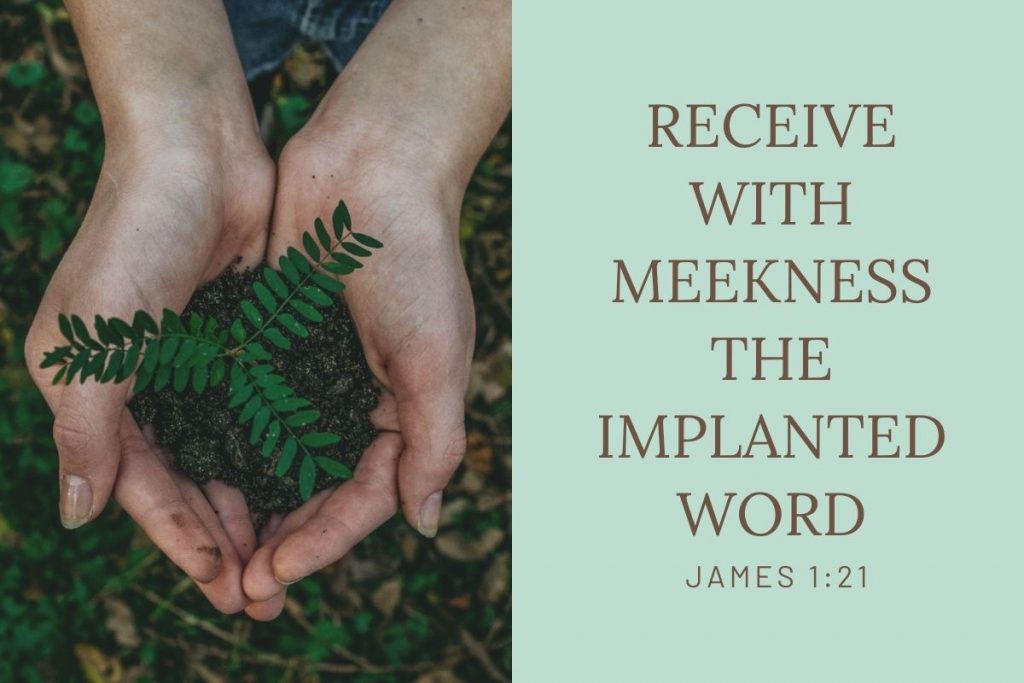
    James Summary

    James is not just about trying to get to heaven when you die. The biblical Gospel is living as people of God’s Kingdom now, not just in the future. Grace release power to live everyday as people of God’s Kingdom.

    James and sermon on Mount is not a call to try to live a better life. It describes God’s Kingdom, not man’s wisdom. It’s not a band-aid for a broken and hurting world. It’s an entirely different way of looking at the world. It requires repentance: to see God, yourself, and the world differently.

    The goal of the book of James is nothing less than our full spiritual maturity as Jesus’ disciples

    The Sermon on the Mount in Matthew 5-7 is not just a good set of morals that you can try to live by. It’s impossible because the Kingdom of God cannot be entered into by man’s efforts.

    Here are some of the ways that James refers to his brother, Jesus’ teaching in the book of James:

    References to the Sermon on the Mount in the Book Of James

    Book of JamesSermon on the MountThemes
    James 1:2Matthew 5:10-12Blessing in facing trials
    James 1:4Matthew 5:48The goal of the Gospel: be perfect, complete
    James 1:6Matthew 7:7Asking in faith
    James 1:20Matthew 5:22The limits of man’s anger
    James 1:22Matthew 7:24-27Doing the word of God
    James 3:18Matthew 5:9Pursuing peace
    James 5:2Matthew 6:19Moth and rust of earthly riches
    James 5:3Matthew 6:21Storing up treasures reveals the heart
    James 5:10Matthew 5:12Example of prophets’ suffering
    James 5:12Matthew 5:34Not taking oaths

    The goal of both the book of James and the Sermon on the Mount is the same: to be perfect and complete as the Father in heaven is perfect. 

    You therefore must be perfect, as your heavenly Father is perfect.

    Matthew 5:48 (ESV)

    And let steadfastness have its full effect, that you may be perfect and complete, lacking in nothing.

    James 1:4 (ESV)

    To be perfect doesn’t mean that you never sin (1 John 1:8-10). It means that you will be complete in Christ. The goal is not to become spiritual child, but to be fully mature in Christ.

    The call of the Gospel is so much higher and the grace of God so much greater than we can ever imagine. The good news is not only that you can go to heaven when you die if you believe in Jesus. The Good News gets even better.

    The Gospel is an invitation into a life in God that is impossible by man’s efforts or works. But God gives us His grace. Grace is not an excuse to live however you want. Grace is the empowerment on your heart to live out the Good News that Jesus preached. It’s a glorious Gospel.

    James describes God’s vision for your life: to go from drifting and being tossed to and fro by the wind and the waves to receiving God’s true wisdom. This is God’s vision for your life and it will bring you into the fullness of Christ.

    James is a call to perfection, or completeness, in Christ. It’s a call to action, to obedience to Christ out of love and to patient endurance unto fruitfulness.

    The Gospel is sometimes understood in its very limited sense of believing in Jesus so your sins can be forgiven and you can go to heaven. The Gospel is much more than that.

    The Gospel is not trying harder to live for Christ. It’s nothing less than a new spiritual birth (John 3:3) until you are transformed into the image of Christ. It can never be entered in through trying to live a better life in your own strength. This can only be received through repentance and faith in Christ. 

    The Gospel of Jesus Christ results in a righteousness that is way beyond the surface of what is often understand as religion. It’s a true relationship with the living God.
    Following Christ is not trying to improve your life or to try to live by a set of moral standards. The Christian life is to count your life as crucified with Christ. It’s to live in the newness of life of who Jesus is.

    The deep things of God are not complex philosophies, doctrines or spiritual experiences but simple acts of obedience to God out of love.

    James doesn’t allow for a Christianity that is lukewarm. It brings a much needed balance and understanding to the Gospel.

    The Benefits of Studying the Book of James in the Bible

    1. The Book of James explains how people get stuck in life and how to move on to spiritual maturity.
    2. James provides pieces that are vital to the Gospel of the Kingdom of God.
    3. James protects us from becoming content with a fruitless form of godliness.

    The key verses in James are James 1:21b-22. These 2 verses summarize the entire teaching of James.

    Therefore put away all filthiness and rampant wickedness and receive with meekness the implanted word, which is able to save your souls. But be doers of the word, and not hearers only, deceiving yourselves.

    James 1:21b-22 (ESV)

    James explains, as Jesus did, that the seed is the Word of God (Luke 8:11). The commands of Christ need to be received with meekness. This means that the Word of God needs to be received as God’s Word and joyful obedience will be the result.

    The book of James is not a random collection of wisdom sayings in the New Testament. Sometimes James is compared to the book of Proverbs in the Old Testament. There are several themes and topics that James focuses on and returns to throughout his epistle.

    The 5 Major Themes of James:

    1. Understanding the place of trials in the Christian life.
    2. Having a proper view of wealth and riches
    3. Receiving God’s Word rightly in order to see fruit.
    4. Emphasizing importance of doing and obeying the word of God out of faith.
    5. Submitting the tongue, our speech, to God.

    We’ll look at some of these themes in the summary of each chapter below. But first, let’s consider: Who is the author of the Book of James? Understanding who James is will give us insight into the letter that James wrote.

  • Who Wrote the Book of James?
  • Book of James Summary
  • Summary of James Chapter 1
  • Summary of James Chapter 2
  • Summary of James Chapter 3
  • Summary of James Chapter 4
  • Summary of James Chapter 5
  • James and Spiritual Warfare

Who Wrote the Book of James?

There are several people named James in the Bible, so which James wrote the book of James?

In general, the early church affirmed that James, the brother of Jesus, wrote the book of James. This is affirmed in the writings of early church historians like Josephus in his Antiquities of the Jews.

The letter of James is written by James, the half-brother of Jesus, to the twelve tribes in the Dispersion (James 1:1). The Jewish people had been scattered throughout the region while living under the rule of the Roman empire. They had move beyond Jerusalem and Israel and James was writing to these Jewish followers of Jesus Christ.

James was one of 4 brothers born to Mary and Joseph (Matt 13:55): James, Joses, Simon, and Judas. They also had sisters . Although James’ name in Greek is actually the name Jacob, which has Hebrew roots, it came to be translated as James in English.

What’s fascinating about James and his brothers is that they did not believe in Jesus during His ministry. It seems like they even mocked Him as recorded in John 7:3-5. It wasn’t until after Jesus’ death, burial and resurrection that they came to believe in Him (Acts 1:14).

At first, James didn’t believe in Jesus’ claims to be the Christ. But after he saw the resurrected Lord, he was willing to lay down his life for His Lord.

To call his half-brother “Master” and “Lord,” James had to be fully convinced.

James does not identify Himself as Jesus’ brother in the book of James. This is one of the reasons that some modern scholars question whether it was actually James, the brother of Jesus, who wrote the book. James simply doesn’t boast that he is Jesus’ brother.

James refers to himself as “a servant of God and of the Lord Jesus Christ” (James 1:1). James actually refers to Jesus Christ as “Lord” several times in the book (James 2:1; 5:7, 8).

If there was anyone who knew Jesus closely, it would have been his brothers. Yet, they came to believe that their brother was the Son of God and to refer to Him as the Lord. What happened? 1 Corinthians 15:7 mentions that Jesus appeared to James after His resurrection.

How did James and Jude come to believe to their half-brother as the Lord? 1 Corinthians 15:7 mentions that Jesus appeared to James after His resurrection.

Brothers might know things that even their mothers don’t. James would have seen Jesus’ life close-up. There would be no secrets. If there were any family secrets, hidden sins, he would have known it all. It was a great testimony for James to acknowledge that Jesus is the Christ, the Son of God.

At one point, Jesus’ family came to visit Him. Great crowds of people came around Him to be healed and to hear Him. Jesus explained that whoever does the will of God is His brother, sister, and mother.

James was not just a biological brother of Jesus but a spiritual brother, one who does the will of God.

James became one who was willing to lay down his life for His Lord and to obey the will of God.

James simply introduces himself as James in the letter, without any other introduction. He must have been well known and expected the readers of his letter to know who he was. James writes with authority and wisdom. He doesn’t explain his credentials and assumes that the readers would know who it is.

James was one of the pillars of the church in Jerusalem (Gal. 2:9; 1:19) so he probably only needed to refer to himself simply as James.

Jude, who is one of James’ brothers, also doesn’t refer to Jesus directly as his brother. Jude, who wrote the New Testament book of Jude, refers to himself in Jude 1:1 as “Jude, a servant of Jesus Christ, and brother of James.” Then in Jude 1:4, 17, and 21, he refers to their brother as the Lord Jesus Christ.

According to Josephus, the historian, James was martyred for his faith in AD 62. James didn’t die out of family loyalty to his older brother, Jesus. Rather, James laid down his life in allegiance to His Lord, Jesus Christ.
James was often referred to as James the Just and some historians consider him to be a Nazarite. That mean he would have taken a vow of devotion and didn’t eat meat,cut his hair, nor drink wine. Such was his devotion to his Lord, Jesus Christ.

Book of James Summary

What is the main message of James? The book of James is an exhortation to live out Jesus’ message of the Gospel of the Kingdom. James shows what it looks like to live out the Sermon on the Mount (Matthew 5-7).

James references the Sermon on the Mount (Matthew 5-7) many times, so without understanding this connection, the teaching of James can be misunderstood and misapplied. (See the table in the introduction section of this article) Some people throughout history have even doubted the usefulness of James in the Bible because this connection was not fully understood.

To apply the book of James is to respond to Jesus’ message of the Gospel. The response that Jesus is looking for is repentance and faith. In Matthew’s Gospel, repent is the first word that Jesus speaks in His public ministry.

From that time Jesus began to preach and to say, “Repent, for the kingdom of heaven is at hand.”

Matt. 4:17 (ESV)

The primary word for repent in the New Testament means “to think differently afterwards.” To repent means to change your mind about God, yourself, and the world around you. To repent is to reconsider, to come to a new way of thinking, see from a new perspective. 

To repent is not just feeling sorry for your sin. Repentance makes you see everything differently, and that includes how you view your sin.

To repent is to change your mind about how you think about God, the world, and yourself.

There is a distinctly Kingdom perspective on life that Jesus brings. It’s a distinctly heavenly wisdom that Jesus declares.

In the Beatitudes, the beginning of the Sermon on the Mount (Matt. 5:3-12),  Jesus presents a view of the world that is radically different from the way people see the world. Jesus presents heaven’s perspective and He calls people to change their mind – to see from this new perspective, and to receive the Good News of this Kingdom coming to earth through the King, Jesus.

Jesus calls people to Himself as one who came from the Father.

Jesus said to him, “I am the way, the truth, and the life. No one comes to the Father except through Me.

John 14:6

The book of James applies this perspective. It’s a life that responds to the Gospel of the Kingdom. 

Let’s now look at how James applies this to several major things in our lives: our speech, how to live in God’s wisdom, how to think about wealth and money.  These themes are related and overlap. The book of James deals with these from different perspectives and brings these topics up at them at different points in the book.
The Book of James

Summary of James Chapter 1

The main point of James chapter 1 is to introduce the major themes that will be explained in more detail in the rest of the letter of James: A perspective on trials in life (James 1:2-8; 12-18), a view of wealth (vs. 9-11), receiving God’s Word (vs. 21), obeying out of faith (vs. 22-25), controlling the tongue (vs. 19-20, 26).

The main theme of the book of James is receiving wisdom from God’s Word. Wisdom from God results in a life that bears fruit. 

Wisdom from God’s Word that affects every area of life and results in a life the is fruitful and thrives even in the face of trials.

James echoes what Jesus taught in the Sermon on the Mount:

You therefore must be perfect, as your heavenly Father is perfect.

Matt. 5:48 (ESV)

James explains how you can live with great joy in being transformed into the image of Christ.

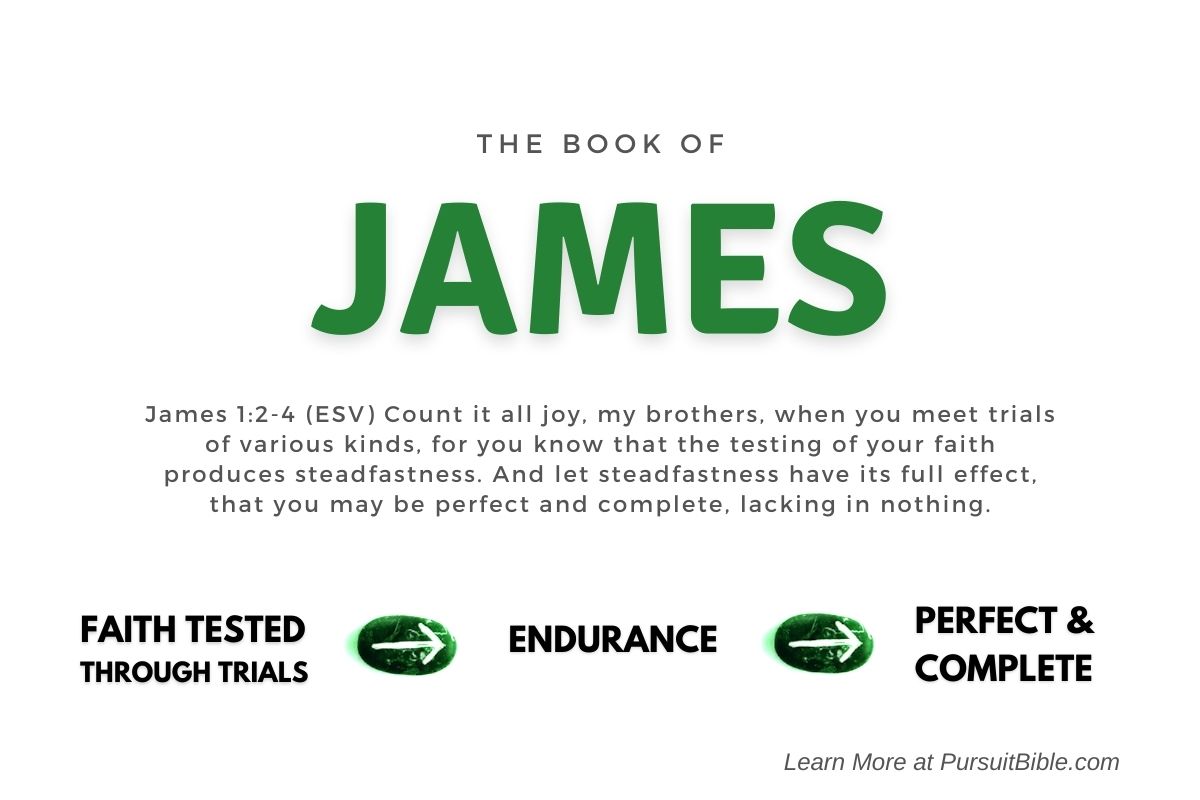
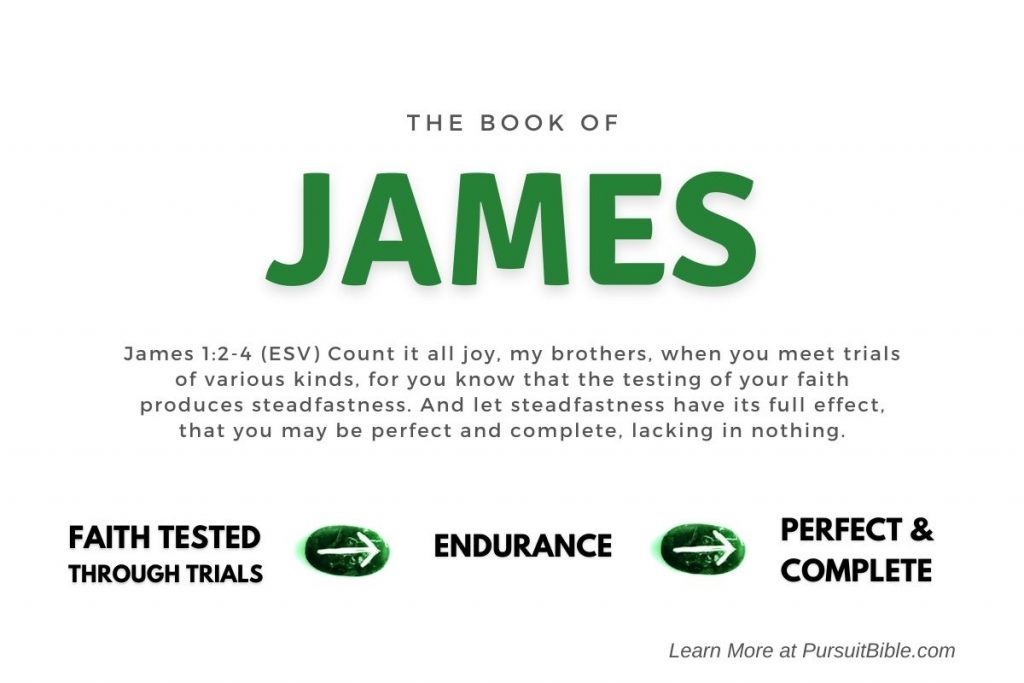
Count it all joy, my brothers, when you meet trials of various kinds, for you know that the testing of your faith produces steadfastness. And let steadfastness have its full effect, that you may be perfect and complete, lacking in nothing.

James 1:2-4 (ESV)

The goal of the Christian life is that you would be complete, and to be transformed into the image of Christ. The goal is that you would be perfect, whole, not lacking anything, and fully mature in Christ. This will take full surrender and receiving God’s Word with meekness.

Much of our energy in life is spent trying to avoid testing trial and temptation. James sees this from a completely different perspective. James is an invitation into the life of Christ in all things. 

The view on life that James presents is very different from religion in the way most people think about it.

Christianity is not trying to get God to bless you, like you, or accept you. It’s an invitation to live a radically different life as a citizen in God’s Kingdom because you have already been blessed in Christ. You can endure anything, even death, with the hope of God’s Kingdom that Jesus proclaimed.

This requires repentance and faith, and seeing God, the world, and yourself differently.

James 1:27 explains that there is pure and undefiled religion that goes way beyond the surface of what is often understood as religion. It’s acknowledging that anything mankind does cannot measure up to God’s standards. It requires surrendering fully to Jesus Christ. As the Word of God is received with meekness, it will result in pure works that care for people in the world.

Religion only makes sense if it is a life that is responding to the Word of God bearing fruit in one’s life. All the major religions in the world require people to live a better life. The Bible calls people to live out of something much deeper.

The Gospel of Jesus Christ results in a righteousness that is way beyond the surface of what is often understand as religion. It’s a true relationship with the living God that results in a transformed life from the inside out.

James is a book that helps when you’re stuck in life. James shows you how you got there and how to get out. Rather than looking for shortcuts when you experience trials in life, James goes to the root of experiencing God’s life-transforming power.

James 1:1-14-15 explains that sin will mature if we don’t bring it to the cross. It starts with being enticed by desire, then desire is conceived, sin is birthed, and when sin is fully growth, death results.

James protects us from a fruitless form of godliness. It calls us to simple obedience to Christ, to be wholly surrender to Him, not being double minded.

Summary of James Chapter 2

The main theme of James 2 is that showing partiality is sin and that faith must be accompanied by works.

James 2 Explains that Partiality is Sin

Favoritism in the Bible is showing partiality or judging people by outward appearances. You are not to judge people by their wealth, influence, social standing, eloquence, education, gender, age, or popularity.

My brothers, show no partiality as you hold the faith in our Lord Jesus Christ, the Lord of glory. 

James 2:1 (ESV)

Showing partiality is a sin in light of the glory of the Lord Jesus (James. 2:9). When you treat people differently based on outward appearances, it is sin.

God does not show partiality (Romans 2:11). God does not judge by the surface. To judge is to make distinction and have discernment. God looks at the heart and the obedience that flows out of faith and love. That’s why God choose David, the  shepherd boy, to be king over Israel (1 Samuel 13:14).

We are to see people through God’s eyes. This does not mean to excuse sin or to accept violence, wickedness, or evil. We are to relate rightly and judge with righteous judgment (John 7:24). 

It takes God to open our eyes to see the riches of His glorious inheritance in the saints (Eph. 1:18).

When we try to achieve justice in this world apart from God, it results in a judgemental and sometimes hateful spirit. Without God, human attempts do not achieve His righteousness. Only the Gospel of Jesus Christ can bring true answers to the root cause of sin in the heart of mankind that leads to partiality.

Many of the problems we face in modern life are the same old things, maybe with new names and labels. The Gospel of Jesus Christ alone answers the issues of the heart at the core.

James 2 Explains that Faith Without Works is Dead

James 2 revisits the theme that was introduced in James 1:22.

But be doers of the word, and not hearers only, deceiving yourselves.

James 1:22 (ESV)

James explains that faith without works is useless, or dead.

So also faith by itself, if it does not have works, is dead.

James 2:17 (ESV)

You believe that God is one; you do well. Even the demons believe—and shudder! Do you want to be shown, you foolish person, that faith apart from works is useless?

James 2:19-20 (ESV)

If the seed of the Word of God is planted in your hearts, it will bear fruit if you have received it with meekness. True faith will always result in fruit.

James is a call to be doers of the Word and not just hearers only. Jesus describes this important connection of the Word of God and obedience in John 15:2.

Whoever has my commandments and keeps them, he it is who loves me. And he who loves me will be loved by my Father, and I will love him and manifest myself to him.

(John 15:21 ESV)

When you encounter God’s love, you will love Him back and obey Jesus.

The book of James in the Bible explains the kind of life that will survive and thrive in the storms that are coming on the horizon. 

The Sermon on the Mount ends with Jesus’ exhortation to not just hear but do the Word of God (Matt. 7:24-27). It’s the true wisdom of God and fruitfulness that will result in a life that stands in the face of the storms that are ahead. James emphasis the same in the book of James.

The Book of James highlights things that are easily missed from the understanding of the Gospel of the Kingdom. These are vital pieces without which we have an incomplete Gospel. James highlights this Spirit of Wisdom when he calls attention to the need to be doers of the Word and not just hearers only.

The Gospel of the Kingdom that Jesus proclaimed is the only foundation upon which the Church can be built into the fullness of Christ. It’s the only message that will empower our hearts with true hope to endure until the end. It’s the call of Jesus for His church to arise to the fullness of Christ.

You can’t know God in a vacuum. It has to be lived out in your everyday life.

If anyone says, “I love God,” and hates his brother, he is a liar; for he who does not love his brother whom he has seen cannot love God whom he has not seen.

1 John 4:20 (ESV)

The letter of James provides an important perspective on the Christian life. It presents several parts that are vital to the full understanding of Gospel of the Kingdom that Jesus proclaimed.

Summary of James Chapter 3

The main them in James 3 is the importance of the tongue, our speech, and receiving wisdom from heaven.

For we all stumble in many ways. And if anyone does not stumble in what he says, he is a perfect man, able also to bridle his whole body. 

James 3:2 (ESV)

James 3 is an expansion of the theme of our speech, that was introduced earlier in James 1.

Know this, my beloved brothers: let every person be quick to hear, slow to speak, slow to anger; for the anger of man does not produce the righteousness of God. Therefore put away all filthiness and rampant wickedness and receive with meekness the implanted word, which is able to save your souls.

James 1:19-21 (ESV)

Words or speech express what is in the heart. James echoes what Jesus taught in Matthew 15:18-20. Words that flow from a heart ruled by the flesh reveal anger and things that do not express or result in the righteousness of God.

When God’s Word is implanted in the heart, it transforms the heart and in turn, the words that flow from it.

God’s implanted Word affects your words.

What do your words say about you?

It can be helpful to ask:

James 3 also contrasts worldly wisdom and the wisdom that comes from heaven. Wisdom from God is expressed in your lifestyle and through “works in the meekness of wisdom” (James 3:13).

Wisdom from heaven is not man’s wisdom. It’s based on resting in God and expresses itself in meekness of a heart fully submitted to Him.

Summary of James Chapter 4

James 4 explains why people fight and quarrel.

What causes quarrels and what causes fights among you? Is it not this, that your passions are at war within you? You desire and do not have, so you murder. You covet and cannot obtain, so you fight and quarrel. You do not have, because you do not ask. You ask and do not receive, because you ask wrongly, to spend it on your passions.

James 4:1-3

Fights and quarrels come from desires for pleasure, or passions, that are at war within the heart. Rage in the heart from passions result in war and conflict in relationships. This can be applied to every level of relationships where 2 or more people are involved: families, friends, churches, nations.

Lust and passions in the heart manifests as fights and quarrels. These things come to be expressed in lust, murder, and wanting what others have.

James 4, in verses 11-12, also revisits the topic of the tongue, or speech. This time, particularly the aspect of judging others, which is related to the previous topic of the reason for  fights and quarrels.

James 4 ends in verses 13-17 with a warning about the evil nature of boasting in arrogance. Boasting in arrogance is evil compared to receiving God’s Word in meekness and allowing it to transform your heart and in turn, your words and actions.

Summary of James Chapter 5

James 5 gives a warning against rich oppressors. It’s a development on the themes of riches and money that were touched on earlier in the Book of James.

James gives a sobering call to the rich who have stored up treasure while oppressing others (James 5:3). James echoes Jesus’ teaching that where you store your treasure reveals the condition of your heart.

For where your treasure is, there your heart will be also.

Matt. 6:21 (ESV)

James 5:7-11 gives a call to patient endurance until the coming of the Lord. The Word of God will bear fruit that will endure. The Kingdom of God operates as a seed, the Word, that will bear fruit with patient endurance. In light of the hope of Jesus’ Second Coming, you can live with confidence and joy regardless of whatever you face in this life.

James 5:13-20 gives a call to the prayer of faith. Prayer involves confessing of sin to one another. The prayer of faith leads to healing and the heavens being opened as in the example of Elijah.

James ends with an exhortation to stay true to God’s wisdom and to restore others who have wandered from it. God’s power is available to save and to overcome sin.

James and Spiritual Warfare

As with all Scripture, the book of James must be approached in full dependence on the Holy Spirit and in view of the full counsels of God, the teaching of all of the Bible. It is a vital book to understanding the Gospel that Jesus preached.

There is tension and spiritual warfare around the book of James. It confronts the enemy’s last stronghold against the Kingdom of God. Many people will have passion, knowledge, spiritual experiences and power. The Enemy will even allow all of these if it will end without simple obedience to Christ. But when a disciple of Jesus begins to obey Christ out of love, the Gospel of the Kingdom advances – one heart at a time. This causes spiritual conflict.

Submit yourselves therefore to God. Resist the devil, and he will flee from you. 

James 4:7 (ESV)

We’re all building something with our lives. Will it endure through the storms of this life? Will it endure at the end of the age, when you stand before Jesus, the King and Judge? Will you bear fruit that God is looking for?

My prayer for you is that you would experience the blessing of the Gospel of the Kingdom of God as expressed in the book of James: May the seed of the Word of God, planted in the soil of a heart fully yielded to God, produces a supernatural harvest of fruitfulness to His glory!

Subscribe to my newsletter for updates and encouraging content.

If you found this Bible Study on the Book of James to be helpful, here are a few others that I’d recommend:

Summary of Ephesians: Meaning, Outline & Application. The book of Ephesians gives another important perspective on the Gospel of the Kingdom. It shows how the raw power of the Gospel transforms individuals and regions as the church comes to the fullness of Christ.

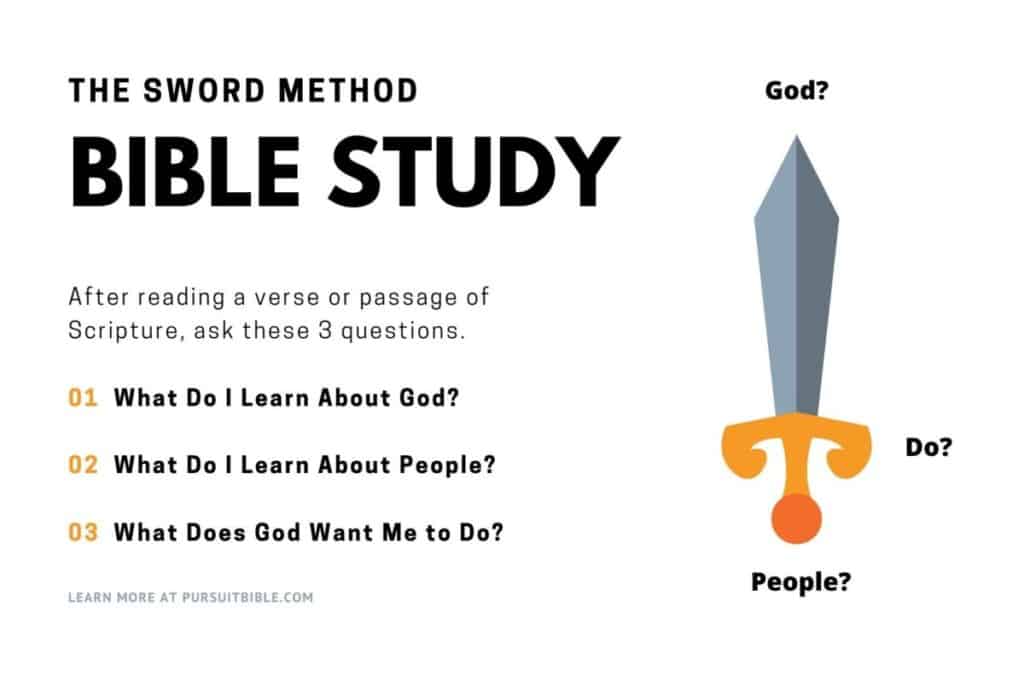
11 Ways to Study the Bible: Methods, Techniques & Tips. In this article, I share different methods of Bible Study, including how to study a book of the Bible. My studies in James combined a few of the methods in the article. Try some of the different methods and see which one works the best for you.

One resource that I highly recommend is: Unlocking the Bible: A Unique Overview of the Whole Bible (You can check out the reviews on this link to Amazon). It has a chapter on every book of the Bible, is very clear, and has great insights. Be sure to get the book and not the one that has just diagrams, charts, and images. The covers look very similar.

Scripture quotations are from the ESV® Bible (The Holy Bible, English Standard Version®), copyright © 2001 by Crossway, a publishing ministry of Good News Publishers. Used by permission. All rights reserved. May not copy or download more than 500 consecutive verses of the ESV Bible or more than one half of any book of the ESV Bible.

Photo by Noah Buscher on Unsplash
  • Summary of Ephesians: Meaning, Outline & Application

    Summary of Ephesians: Meaning, Outline & Application

    Book of Ephesians

    I had the opportunity to study and teach the Book of Ephesians for an entire year. I also got to visit the actual ruins of the city of Ephesus in modern-day Turkey. I want to share with you some of the things that I learned during that year. I hope it’ll be helpful for you in understanding the Letter to the Ephesians.

    The book of Ephesians explains how the Church comes to full spiritual maturity in Christ. The first part describes the Good News of what God has done (Eph. 1-3). The second section gives instructions on how to live in light of those blessings (Eph. 4-5). Ephesians ends with an encouragement to stand firm in the face of any hardships (Eph. 6).

    It is important to study the book of Ephesians because one of the greatest revivals in the history of the early church was based in Ephesus. 

    The Book of Ephesians offers an insider’s view of the faith and mindset that sparked one of the greatest revivals of that time.

    From the city of Ephesus, the Gospel went to the entire region of Asia Minor, with an estimated population of 8-15 million people, in 2 years. All this took place without any church buildings and none of the fancy and flashy things that we have today.

    In the book of Ephesians, we learn about the impact of the Gospel of Jesus Christ and how it can transform our culture. The preaching of the Gospel changed everything from marriages to the economy. Many people choose to follow Jesus and burn their magic scrolls which were common in the region.

    Ephesians presents the Gospel of Jesus Christ as the answer to the brokenness in this world – to a culture that is marred by injustice and oppression.

    Ephesians reveals that the Gospel of Jesus Christ is the only way to see true transformation in the world. The root problem in the world is not racism, oppression, or lack of education. At the core, the problem is sin in the human heart. Fair laws, social justice, and reform are needed, but these cannot change the human heart.

    Ephesians shows that the Gospel is not mainly about trying to force other people or circumstances to change. The Gospel is looking to Jesus and living out in the reality of what He has done.

    The Gospel brings about a true change in the human heart. When we all begin to live this out as the church, it begins to shift the culture of the world. The Gospel brings a true sense of hope into even the most desperate of situations.

    In general, the culture of that day in Ephesus did not see women as equal to men. There was also a form of slavery that was common at that time. Sometimes Christians were persecuted, very severely at times. The Gospel eventually changed all of that from the inside-out. The Gospel conquered the Roman Empire one heart, one marriage, one home at a time. 

    The Gospel transformed the culture of the region without direct political involvement, big budgets, or mass gatherings. It was simply the raw power of the Gospel on display.

    What happened in Ephesus is an example of what can happen when people believe and live out the message of the Gospel of Jesus Christ. It is what happens when the Church comes to maturity in the full stature of Christ. God’s will for His Church is nothing less than this fullness of Christ.

    Until we all attain to the unity of the faith and of the knowledge of the Son of God, to mature manhood, to the measure of the stature of the fullness of Christ.

    Eph. 4:13 (ESV – emphasis added)

    The Apostle Paul wrote the letter to the Ephesians to encourage believers to full spiritual maturity. What did he teach the believers at Ephesus that brought about those results? Let’s take a closer look into this book which many have called the “Alps of the New Testament.”

    Who Is the Book of Ephesians Written To?

    Paul wrote the book of Ephesians as a letter, or epistle, to the Christians who were in the city of Ephesus. He probably wrote it from prison or possibly under house-arrest while awaiting trial (Eph. 3:1; 4:1; 6:20). Although Paul was imprisoned when he wrote the epistle to the Ephesians, the Word of God was prevailing (Acts 19:20).

    It is helpful to understand a little bit of the background of Ephesians: Ephesus was a revival center during the time of the Apostle Paul. Paul stayed in Ephesus for about 3 years (Acts 20:31), preaching the Gospel, the Good News of Jesus Christ. The Gospel went to all of Asia Minor (the region which is now modern day Turkey), which some scholars estimate the population to be around 8-15 million people (Acts 19:10).

    We know more about the Church at Ephesus than any other church in the New Testament. Paul left Priscilla and Aquila to minister there. Apollos, a man who was skilled in expounding Scriptures was also stationed there. The books of 1 and 2 Timothy were both addressed to Timothy in Ephesus and both were about the church in Ephesus.

    The Apostle John was mostly likely in Ephesus when he was arrested during Domitian’s rule. He probably wrote the 3 letters of John and the Gospel of John while he was there with Mary, the mother of Jesus. The church at Ephesus sounds like the Who’s Who of the New Testament!

    Outline of Ephesians

    As with many of Paul’s letters, there’s a clear transition in the middle of the book of Ephesians. The first part is about what God has done. The second part is how to live in light of that as followers of Jesus.

    Here’s the outline that I settled on after seeing many others adopt something similar. I explained earlier that the main theme of Ephesians is how the Church matures to the full stature of Christ to impact the world.

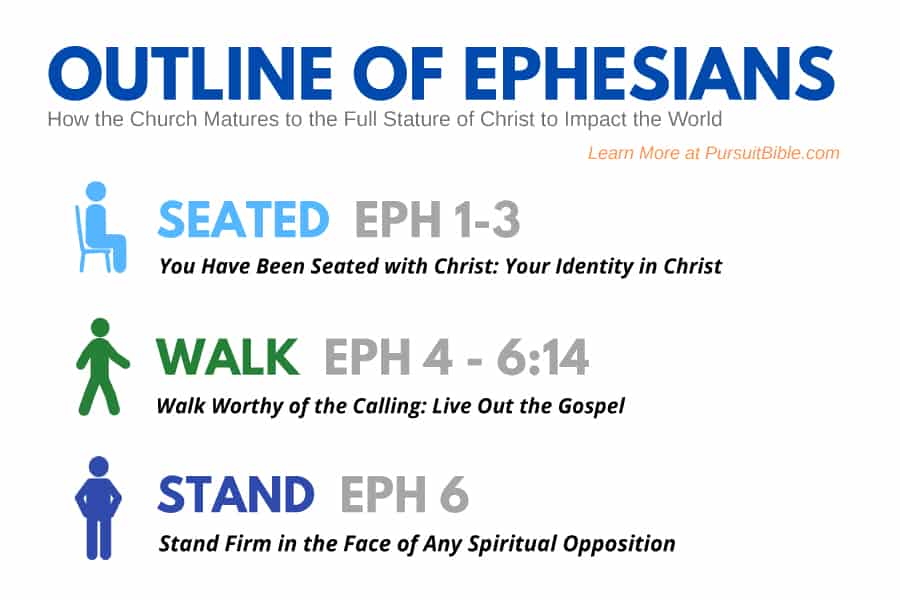
    There are 3 postures that describe how a spiritually mature Church receives and lives out God’s blessings.

    1. SIT (Eph. 1-3)

    And raised us up with him and seated us with him in the heavenly places in Christ Jesus – Eph. 2:6 (ESV)

    • Ephesians reveals our identity “in Christ.” It also speaks of the wealth we have received in Christ (Eph. 1:3).

    2. WALK (Eph. 4:1 – 6:9)

    I therefore, a prisoner for the Lord, urge you to walk in a manner worthy of the calling to which you have been called – Eph. 4:1 (ESV)

    • Followers of Jesus are to walk worthy of their calling. The Gospel is to be lived out in marriage (Eph. 5:22-33), family (6:1-4), and in work and culture (6:5-9).

    3. STAND (Eph. 6:10-23)

    Finally, be strong in the Lord and in the strength of his might. Put on the whole armor of God, that you may be able to stand against the schemes of the devil – Eph. 6:10-11 (ESV)

    • Believers have been resourced by God to stand firm in the face of spiritual warfare (Eph. 6).

    The overview of Ephesians shows that out of the reality of our being seated with Christ flows our walk (how we live this out) and our standing in the face of any spiritual opposition.

    If you’re doing an in-depth study of the book of Ephesians, you might be interested in this article where I share my thoughts on How to Study a Book of the Bible (link opens in a new window). It’s the process that I used in my study of the book of Ephesians.

    Ephesians Summary
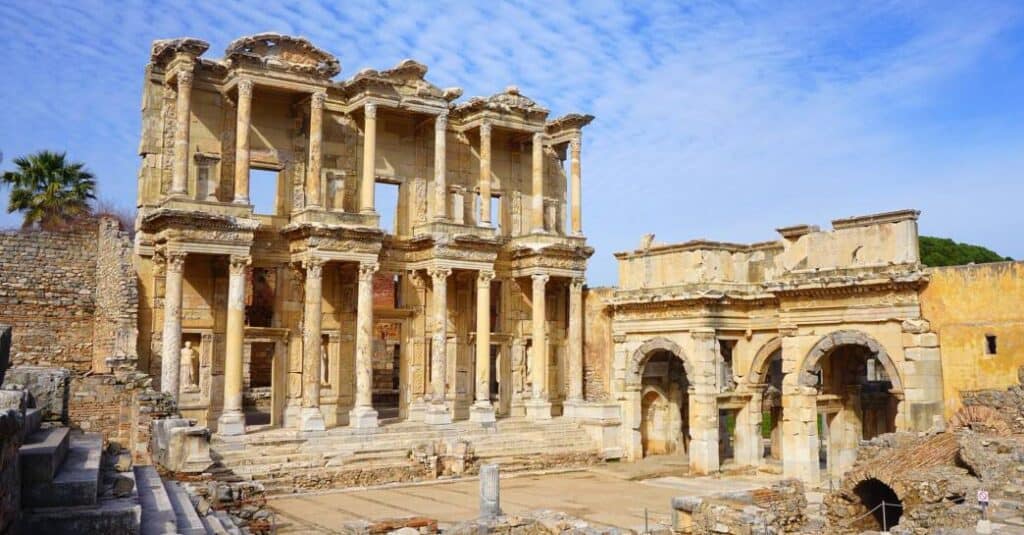
    The Remains and Reconstruction of the Library of Celsus in Ephesus

    What Can We Learn From Ephesians?

    Here are a few insights from the outline and overview of Ephesians.

    Is the order of the outline of Ephesians significant? 

    To sit is to relax and to rest. It’s not to struggle or strain. It’s not work. Our salvation is by grace through faith.

    This first part explains why you can and should live differently. It’s the basis of the whole book. The second part explains what that life looks like. The last section gives assurance to keep living that way even in the face of spiritual opposition.

    Your walk cannot come before understanding your identity and rest in Christ. You need to understand that you’ve been seated with Christ in heavenly places, having been given every spiritual blessing in the heavenly places. Works (how you walk it out) does not come before faith (how you’ve been seated with Christ).

    You are seated in the heavenly realms with Christ but your walk is on Earth. Your walk comes out of your sitting. Your walk, or Christian life, is very practical. Sitting speaks of your position of rest in Christ. You’re not trying to get to God. God has come to us in Jesus Christ and raised us up with Him even when we were dead in our sins.

    Understanding your identity in Christ, how you’re seated with Him, is first in order and first in importance. It’s also the longest section. In other words, you don’t start with DO or don’t do. You start with DONE. Because of what Jesus has already accomplished on the cross, you can BE and BECOME.

    How you stand in the face of any spiritual warfare is based on how you’ve been seated and how you’re walking it out. Spiritual warfare is not about a technique or a special way to pray. To put on the whole armor of God in Eph. 6 means to believe all that Jesus has done for you (Eph. 1-3) and to live it out in your daily life (Eph. 4-5). 

    Ephesians concludes with living in the power of everything that God has done in every area of life even when there are challenges. The real struggle is to stand in the finished work of Jesus. That’s the frontline of the real warfare in your life.

    Ironically, a wrong view of spiritual warfare can become a distraction from accessing God’s true power to stand in the face of opposition. I did a more in-depth study of the armor of God if you’re interested in it: Put on the Whole Armor of God – What it Means & How to Do It (Link opens in a new window).

    Summary of Ephesians

    Here is a brief summary of the book of Ephesians in the Bible. These are some of the highlights and major points in the letter. It’s not meant to be exhaustive but serves as a broad and general commentary of Ephesians.

    Summary of Ephesians 1

    Ephesians 1 shows us that God has spoken and acted in all space and time to bring about His secret plan to redeem us and to bring us gloriously to Himself.

    After the introduction to the letter in the first couple of verses, the rest of the first chapter of Ephesians is only 2 very long sentences.

    Ephesians 1:3-14 is the longest sentence in the Bible. This single sentence in the original Greek language of the Bible spans 12 verses and includes 202 words. The sentence is stretched out by the use of 32 prepositional phrases and other genitive expressions.

    Ephesians 1:3-14 is one long expression of praise to God. To bless means to speak well of or praise. Paul blesses God because God has blessed us with every spiritual blessing.

    Blessed be the God and Father of our Lord Jesus Christ, who has blessed us in Christ with every spiritual blessing in the heavenly places

    Eph. 1:3 (ESV)

    The verses following that descibe all the ways that God has blessed us in Christ.

    In Christ, You Are…

    1. Blessed with every spiritual blessing (v. 3)
    2. Chosen to be holy and without blame (v. 4) 
    3. Predestined (v. 5)
    4. Adopted as sons (v. 5)
    5. Accepted in the Beloved (v. 6)
    6. Redeemed through His blood, according to the riches of His grace (v. 7)
    7. Forgiven of your sins (v. 7) 
    8. Given wisdom and understanding of His will (v. 8-9)
    9. Given an inheritance (v. 11)
    10. To bring praise and glory to God (v. 12)
    11. Sealed with the Holy Spirit (v. 13)
    12. Guaranteed of inheritance until your redemption is fulfilled (v. 14)

    Some people have noted that these blessings can be categorized in several different ways:

    GodheadTruth/ActionTime
    Father (v. 3-6)ChoosesPast
    Son (v. 7-12)RedeemsPresent
    Holy Spirit (v. 13-14)SealsFuture
    The Actions of God to Bless in Ephesians 1

    The next section, Ephesians 1:15-23, is also one long sentence in the original Greek language. It’s not far behind in length to the previous section, with 169 words in Greek. It’s a prayer birthed out of thanksgiving. It’s a prayer to know God more, to know how God feels about us (we are His inheritance), and to experience His power in our lives.

    The first sentence (vs. 4-14) is an expression of praise and describes what God has done. The prayer in vs. 15-23 is that we would know the God who has blessed us in all those ways. 

    Application of Ephesians 1:

    We’re much too quick to look for answers everywhere except in Christ. We go endlessly from one thing to another: one counselor to another, seeking a word that will deliver us or waiting for some spiritual breakthrough. There things are all valid and have their place, but we need the foundation of our identity to be firmly established in Christ. We need the foundational truths of Eph. 1-3.

    The only way we will stand ablaze in love for Jesus in these days is if we will get a hold of every spiritual blessing we have been given in Christ.

    Lastly, there has been a lot of debate throughout history around the understanding of election and predestination. It would take too long to discuss the topic in this article. 

    Regardless of where we find ourselves in that debate, we see in Ephesians 1 that Paul praised God for the revealing of the mystery of God’s will (Eph. 1:9). The one thing everyone is called to do is to be filled with thanksgiving because of this amazing fact: God’s will includes us! The good pleasure of His will (Eph. 1:5) includes you and me and He has called us to be adopted as His children.

    Summary of Ephesians 2

    Ephesians 2 explains how the blessings describe in Ephesians 1 are worked out in a world of brokenness, sin, and death. Though we were dead in our sin, God has made us alive through Christ and has seated us with Christ in the heavenly places.

    All of these astounding blessings and spiritual truths are a gracious gift from God. We can only simply receive it by faith, in believing in Jesus, the One who accomplished redemption for us. It is not something that can be earned through trying to meet God’s standards in the Law or tying to live a good life.

    Eph. 2:11-22 explains another tremendous spiritual blessing: Both Jews and Gentiles (non-Jews) have been reconciled to God through the blood of Christ. We’ve all been given God’s blessings. God’s purpose is that His entire family receive all of His blessings.

    In an environment where there were religious and racial tensions between Jews and Gentiles, the Church was to live and model radical unity. The Church that Jesus shed His blood for does not have any barriers whether they be race, economic standing, or anything else.

    In America, where I live, radical individualism is perhaps one of the biggest reasons that the Gospel is not received and lived out. 

    We as Christians need to love and pray for the Jewish people. We are all called to live in unity in the Body of Christ, all connected to one another.

    Summary of Ephesians 3

    In Ephesians 3, Paul explains the revelation of the mystery of Christ that was given to him. It’s something that was hidden in the past, but God was now revealing.

    God’s redemptive plan was not only to the Jewish people but to all the world. The Gentiles were now being made fellow heirs of the promises of God which were previously only available to the Jewish people. This promise was made available now through what Jesus did. (Eph. 3:6)

    Although Paul is a prisoner, Paul reminds the believers not to lose heart because of his troubles (Eph. 3:1, 13). Through the church, the manifold wisdom of God was being made to the spiritual powers in the heavenly places (Eph 3:10-11). There is no stopping the advance of God’s Kingdom.

    Eph. 3:14-21 is a long, beautiful prayer that God would strengthen the Church to know the love of Christ and for us to be filled with all the fullness of God. The full dimensions of God’s love can only be experienced  together with all the saints.

    Paul ends this prayer with praise to God, “who is able to do exceedingly abundantly above all that we ask or think, according to the power that works in us” (Eph. 3:20 – ESV)

    Summary of Ephesians
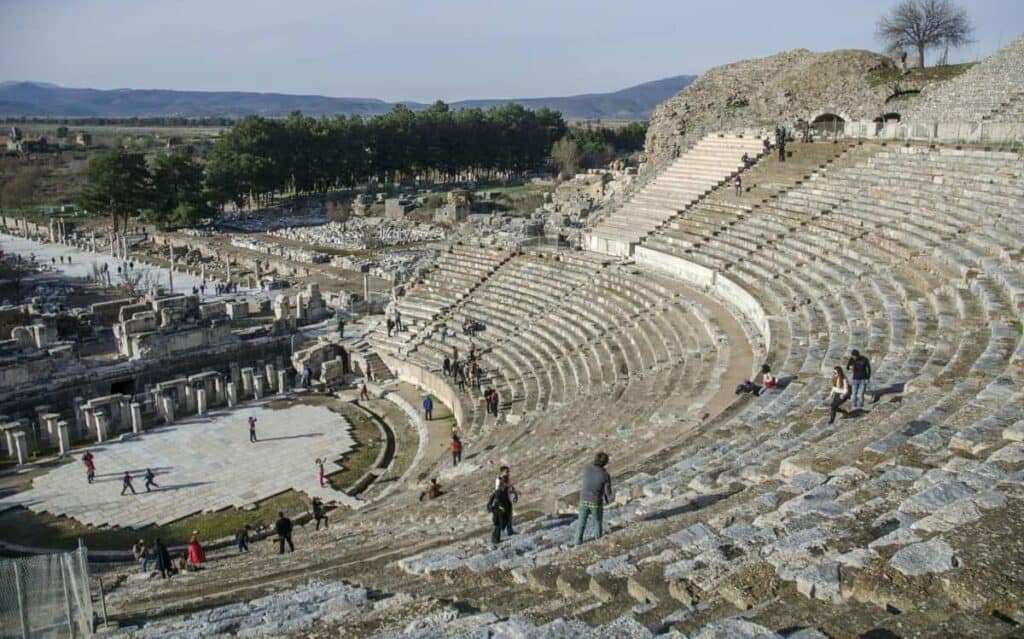
    Ephesus Stadium Where a Riot Took Place Because of the Gospel (Acts 19:23-41)

    Summary of Ephesians 4

    Ephesians 4 is a call for Christians to live worth of God’s calling. It describes how followers of Jesus are to live in light of all that God has done as described in Ephesians 1-3.

    Ephesians 4 also describes what God is building, the church, and why He is building it. The church is called to keep the unity that the Spirit of God has brought us into by living in meekness and gentleness.

    The resurrected and ascended Christ gives gifts to His church. There is a 5-fold manifestation of Christ’s grace through His Church.

    These come in 5 manifestations: apostles, prophets, evangelists, pastors and teachers. It’s easier to just focus on the ones that we identify with most. But in order for the church to come into its fullness to be the expression of Jesus to the world, we need all 5.

    The Apostolic church has a the sense of mission and purpose. Jesus was sent by the Father and now He sends us.

    The Prophetic church emphasizes the sense of God’s presence and seeks His heart and voice. It also seeks the expression of God’s justice. Jesus made known the heart and mind of God.

    The Evangelistic Church seeks to have God’s heart for the lost. Jesus came to proclaim the Good News of the Kingdom.

    The Pastoral Church seeks to build people up and nurture people unto spiritual maturity. 

    The Teaching Church makes known the clarity of God’s will so that there will be long-term growth, health and stability.

    These gifts are given so that the church will come to unity and to the stature of the fullness of Christ.

    Till we all come to the unity of the faith and of the knowledge of the Son of God, to a perfect man, to the measure of the stature of the fullness of Christ.

    Eph. 4:13 (ESV)

    God’s answer to the brokenness in this world is to send His Son, Jesus. Jesus builds His church so that the image of the Son of God, the fullness of Christ would be displayed on the earth. The Church is the Body of Christ. And God’s goal for us is nothing less than the Fullness of Christ.

    Ephesians 4 also gives the blueprint for a changed life. We’re no longer to walk and live as we used to (Eph. 4:17). In light of what God has already done (Eph. 1-3), we are to put off the old self, be renewed in mind, and put on the new self (Eph. 4:22-24).

    It’s not completely biblical to pray something like: “God, please take my impatience.” God will not take it away. He calls you to do to do something in light of what Jesus has done. There’s a subtle line, but it’s the difference between the Gospel vs. self-improvement. I wrote an article which discusses it more: How to Be a Better Person According to the Bible (link opens in a new window).

    Summary of Ephesians 5

    Ephesians 5 instructs believers how to live out the Gospel of Jesus Christ. We are to be imitators of God. It continues from the teaching in Ephesians 4, that our lives are to be different now that we follow Christ. We were once in darkness, but now we are the light in the Lord. We are to walk as children of light (Eph. 5:8).

    Ephesians 5 includes the command to be filled with the Spirit rather than being drunk with wine. Ephesians 5:18-21 is another of Paul’s long sentences in the Greek. The outflow of the fullness of the Spirit involves expressions of praise through singing, thanksgiving, and mutual submission. Mutual submission needs to be understood in context of Ephesians 5 and the entire book of Ephesians.

    Mutual submission out of reverence to Christ is one of the signs that you are filled with the Holy Spirit (Eph. 5:21). Submission literally means to arrange under. The main idea of submission in the Bible is to come under God’s arrangement. We are submitting to God’s plan, coming under Jesus as the head over all things. In light of that, we can submit mutually to one another.

    The highest model of submission is Jesus (Phil 2:6-7). He humbled Himself as a servant, even to the point of going to the cross.

    The idea of submission may seem strange or offensive in some cultures because individualism is emphasized and valued. At the core is a rebellion against God’s order. Christians are called to respond by coming under Jesus as the head over all things.

    Biblical mutual submission is never harsh, assertive or self-promoting.

    It takes the fullness of the Spirit to be able to rightly submit under Christ and to one another. When we are filled with the Holy Spirit, Christ comes to dwell in us by His Spirit, we overflow with a spirit of worship and praise, thanksgiving and mutual submission out of reverence to God and Jesus Christ as the head over all things.

    If you want to begin to see the restoration of God’s plan for your life, find yourself under Christ as the head. Then relate to others in the light of that. In this place, God releases His authority and power in your life.

    Biblical submission is a vital expression of being filled with the Holy Spirit.

    Biblical submission is aligning under God’s order. Submission is not meant to limit someone but to bring the fullness of Christ and God’s restoration to the broken places in life.

    As I submit to Christ as the head, I can rightly practice biblical submission and relate to the brokenness in my life and the brokenness in the world around me. Submission is about the headship of Jesus and alignment in God’s Kingdom. It’s out of reverence to Christ that we submit to one another.

    Ephesians
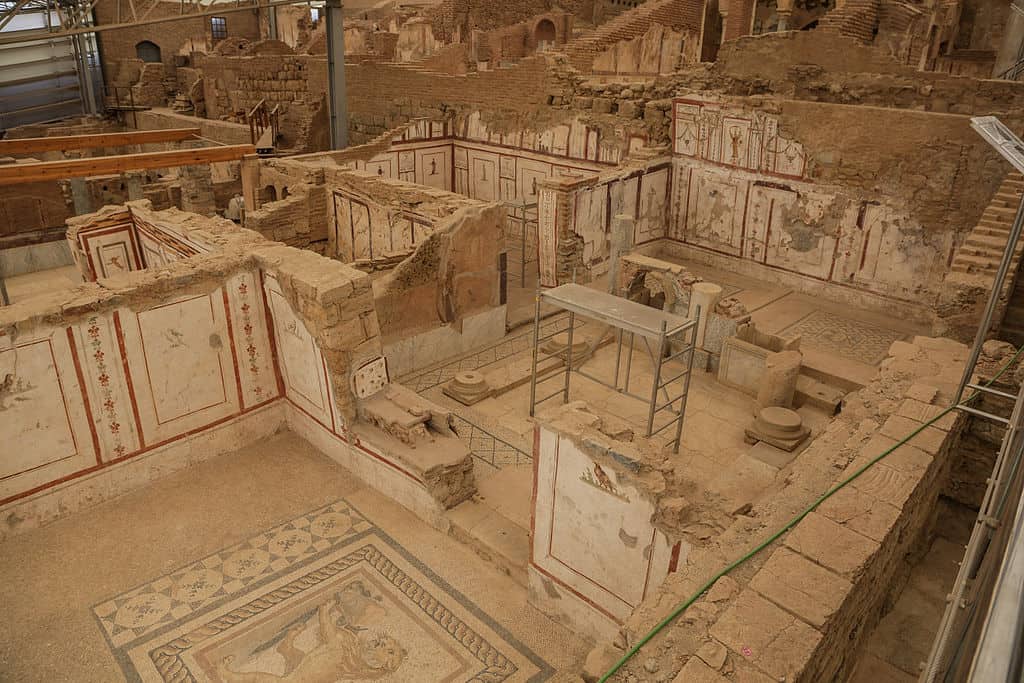
    Terrace Houses in Ephesus

    Ephesians also gives teaching on biblical marriage. How does the Gospel impact marriages? First of all, there is mutual submission which includes husbands submitting to their wives and wives submitting to their husbands (Eph. 5:21). 

    There is also the role and responsibility of the husband as the head. Again, this never includes domineering, belittling, or selfishness on the part of the husband. Rather, it is out of tender and sacrificial love as Christ would display to His Bride, the Church.

    Husbands are to love their wives as Christ loves the Church. This involves how husbands speak to their wives. Husbands are to sanctify and cleanse their wives with the words that they speak (Eph. 5:26). This is what Jesus does for us, His Church. His words affirm, encourage, and bring us to our fullest potential.

    How husbands treat their wives shows the true state of the heart and how they think about their relationship with God. As a husband, if I don’t cherish my wife, I can’t fully know that I am and cherished by God in Christ.

    For a biblical understanding of marriage, I highly recommend Tim Keller’s excellent book: The Meaning of Marriage: Facing the Complexities of Marriage with the Wisdom of God (link to Amazon). 

    We took a year to go through it in our Men’s group at church and found it very helpful. It’s not easy reading, but definitely worth working through. It’s not focused on the typical marriage advice like “improve your communication.” It goes to the root of the issues of the heart and explains that it’s only the Gospel of Jesus Christ that will allow us to have a fulfilling marriage.

    Wives are to respect their husbands. Again, it takes the Gospel of Jesus Christ for a successful marriage. 

    At the end of the day, in my years of counseling married couples, even the most complex marriage problems almost always comes down to this: Wives don’t feel loved by their husbands and husbands don’t feel respect by their wives.

    Ephesians 5 teaches us how we can apply the Gospel to our closest relationships, including marriage. If we do worship services (experiences) well but don’t experience the kingdom of God in our homes, our closest relationships and in our work, we miss the majority of life.

    Ephesians 5 gives us true hope. It takes nothing less than the Good News of Jesus’ death, burial, and resurrection for us to experience God’s true blessing in our marriage and in our home.

    Summary of Ephesians 6

    Ephesians 6 explains how the Gospel applies to families and to work or society in general.

    Ephesians 6:1-4 explains how the Gospel is applied to families. It gives instruction for children to be obedient to their parents because it is right in God’s sight. Commandments don’t need a promise, but this one has one. It’s a two-fold promise. The blessing of following God’s order in families is the promise that things would go well and long life to enjoy those blessings.

    Paul saw transformation in the world because the Gospel touched individuals, marriages, and families.

    This meant a strong and mature church that can impact the world. Strong marriages and strong families are the bedrock of society. These become the building blocks of a mature church and in turn, affects the culture around them. 

    Ephesians 6:4 instructs fathers to not provoke their children to wrath, but to bring them up “in the training and admonition of the Lord” (ESV). It can be a challenge for fathers to either become passive or overly aggressive in raising their children. Either extreme can discourage children and spark a rebellious spirit that leads to wrath. It takes the Gospel of God’s grace to raise children according to God’s way.

    God is a Father and He instructs us to imitate Him because we are His children (Eph. 3:1). No matter how your upbringing or family background was, there is grace in Christ to be a godly parent or nurturing Father. This applies to natural children and spiritual children.

    The Gospel of Jesus Christ is not just for a church service, but to be lived it out in daily life where you live, work and play.

    Ephesians 6:5-9 gives instructions on the relationship between masters and bondservants. It can be applied generally to work or vocation. It can also be applied to the broader concept of how the Gospel impacts culture and how Chrsitains are to seek social justice.

    In Ephesus, at the time that Paul wrote, there was racism, inequality, oppression, and at times persecution of Christians. Sometimes the persecution was very cruel and severe. Change did not come about by protesting for social justice, but by seeking to live as citizens in God’s Kingdom.

    It was common in the Roman empire for many to become bondservants and serve their masters. Of course, this is not in line with the Bible where all people were seen as equal in God’s eyes (Gal. 3:28).

    The Good News of Jesus Christ goes to the very core of the issues of our day and deals with the root cause of sin in the human heart.

    The Gospel is not about confronting the government directly. Rather, Christians are to pray for those in leadership. The Gospel does not directly protest social injustices. Yet, how did Gospel transform the region? It looked to a higher Kingdom.

    Paul presented the Gospel as the answer to the brokenness in this world and to a culture that was marked by injustice and oppression. It transformed the Roman Empire from the inside-out: one marriage, one family, on church at a time. It was the undeniable, raw power of the Gospel of Jesus Christ.

    Ephesians 6:10-20 gives the charge to stand firm in the Gospel in the face of any spiritual opposition. The full armor of God is needed in order to press on through the challenges that will eventually arise. To understand what it means to put on the full armor of God, the context of entire letter to the Ephesians needs to be kept in mind.

    A wrong understanding of the armor of God can lead to confusion about what the Christian life is about. It can also distract from the main and plain teachings of the Bible. Here is an article that goes in-depth into this important topic: Put on the Whole Armor of God – What it Means & How to Do It.

    Just to touch on it briefly here, to put on the whole armor of God is to believe all that God has done (Eph. 1-3) and to live it out in daily life (Eph. 4-6). To put on the full whole armor of God is to apply all of the Gospel to all of your life.

    The whole armor is the expression of your full trust in God and what He has done for you through Jesus Christ. Your victory in spiritual warfare was secured at the cross of Christ and the blood that was shed there (Rev. 12:11).

    Ephesians 6:21-24 concludes the letter with Paul’s personal farewell and blessing to the believers at Ephesus.

    Best Commentaries on Ephesians

    I looked at over a dozen commentaries on Ephesians during my studies. There were two that I kept coming back to more often than others.

    I found Clinton Arnold’s Ephesians in the Zondervan Exegetical Commentary on the New Testament (link to Amazon – opens in a new window) to be the most helpful. It was quite thorough and touched on more of my questions than any of the other commentaries.

    I also recommend Harold W. Hoehner’s Ephesians: An Exegetical Commentary (link to Amazon).


    Subscribe to my newsletter for updates and encouraging content.

    If you found this article to be helpful, here are a few others that I’d recommend:

    Book of James: Summary, Meaning & Application. The book of James has been attacked and misunderstood throughout history. Some people have questioned whether it’s even helpful for Christians to study this book. This study in the book of James looks at the essential pieces that James provides in understanding the Gospel that Jesus proclaimed.

    11 Ways to Study the Bible: Methods, Techniques & Tips. In this article, I share different methods of Bible Study, including how to study a book of the Bible. My studies in Ephesians combined a few of the methods in the article. Try some of the different methods and see which one works the best for you.

    One resource that I highly recommend is: Unlocking the Bible: A Unique Overview of the Whole Bible (You can check out the reviews on this link to Amazon). It has a chapter on every book of the Bible, is very clear, and has great insights. Be sure to get the book and not the one that just has diagrams, charts, and images. The covers look very similar.

    The main theme of the Bible is the Kingdom of God. In this article, I explore what that means and how it can help you grasp a big-picture view of the entire Bible. The Main Message of the Bible: Its Central Theme & Purpose.

    Ephesians Bible Verses

    Lastly, here are some of the most popular Ephesians Verses that touch on some of the theme discussed above. These verses in Ephesians cover a wide range of topics from love, marriage, parenting, faith, to identity in Christ.

    May God stir true revival in our time, to see the Church come to the full stature of Christ, to the glory of His name!

    Ephesians Bible Verses
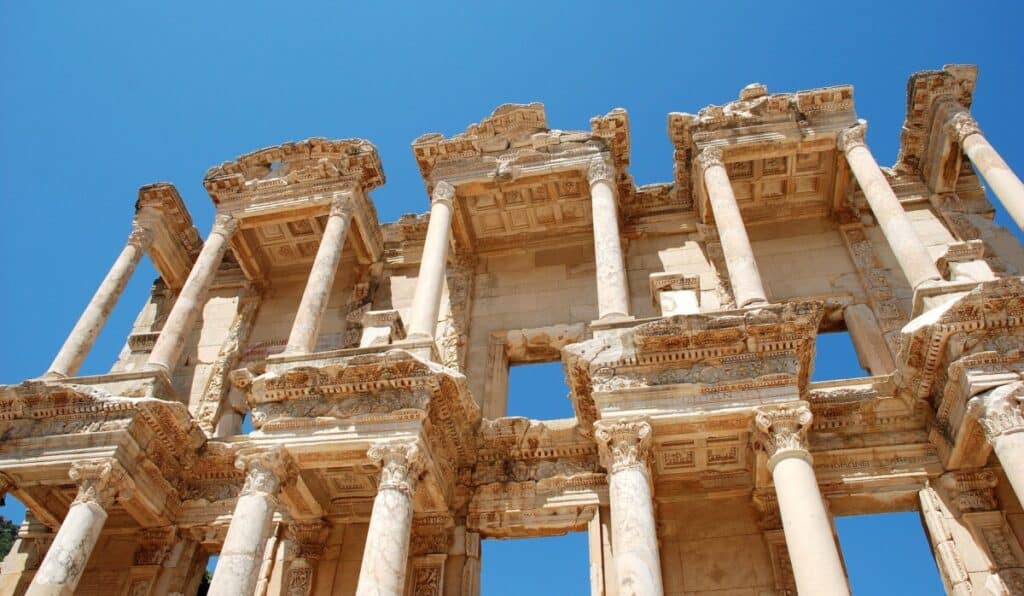
    The Library of Celsus in Ephesus

    Blessed be the God and Father of our Lord Jesus Christ, who has blessed us in Christ with every spiritual blessing in the heavenly places. (Eph. 1:3)

    But God, being rich in mercy, because of the great love with which he loved us, 5 even when we were dead in our trespasses, made us alive together with Christ—by grace you have been saved— 6 and raised us up with him and seated us with him in the heavenly places in Christ Jesus (Eph. 2:4-6)

    For by grace you have been saved through faith. And this is not your own doing; it is the gift of God, 9 not a result of works, so that no one may boast. (Eph. 2:8-9)

    For we are his workmanship, created in Christ Jesus for good works, which God prepared beforehand, that we should walk in them. (Eph. 2:10)

    To me, though I am the very least of all the saints, this grace was given, to preach to the Gentiles the unsearchable riches of Christ (Eph. 3:8)

    That according to the riches of his glory he may grant you to be strengthened with power through his Spirit in your inner being, (Eph. 3:16)

    Now to him who is able to do far more abundantly than all that we ask or think, according to the power at work within us, 21 to him be glory in the church and in Christ Jesus throughout all generations, forever and ever. Amen. (Eph. 3:20-21)

    I therefore, a prisoner for the Lord, urge you to walk in a manner worthy of the calling to which you have been called, 2 with all humility and gentleness, with patience, bearing with one another in love, 3 eager to maintain the unity of the Spirit in the bond of peace. (Eph. 4:1-3)

    There is one body and one Spirit—just as you were called to the one hope that belongs to your call— 5 one Lord, one faith, one baptism, 6 one God and Father of all, who is over all and through all and in all. (Eph. 4:4-6)

    And he gave the apostles, the prophets, the evangelists, the shepherds and teachers, 12 to equip the saints for the work of ministry, for building up the body of Christ, 13 until we all attain to the unity of the faith and of the knowledge of the Son of God, to mature manhood, to the measure of the stature of the fullness of Christ (Eph. 4:11-13)

    Rather, speaking the truth in love, we are to grow up in every way into him who is the head, into Christ, 16 from whom the whole body, joined and held together by every joint with which it is equipped, when each part is working properly, makes the body grow so that it builds itself up in love. (Eph. 4:15-16)

    And do not grieve the Holy Spirit of God, by whom you were sealed for the day of redemption. (Eph. 4:30)

    Be angry and do not sin; do not let the sun go down on your anger, 27 and give no opportunity to the devil. (Eph. 4:26-27)

    Therefore be imitators of God, as beloved children. 2 And walk in love, as Christ loved us and gave himself up for us, a fragrant offering and sacrifice to God. (Eph. 5:1-2)

    Look carefully then how you walk, not as unwise but as wise, 16 making the best use of the time, because the days are evil. (Eph. 5:15-16)

    And do not get drunk with wine, for that is debauchery, but be filled with the Spirit, (Eph. 5:18)

    Submitting to one another out of reverence for Christ. 22 Wives, submit to your own husbands, as to the Lord. (Eph. 5:21-22)

    Husbands, love your wives, as Christ loved the church and gave himself up for her (Eph. 5:25)

    “Therefore a man shall leave his father and mother and hold fast to his wife, and the two shall become one flesh.” 32 This mystery is profound, and I am saying that it refers to Christ and the church. (Eph. 5:31-32)

    Children, obey your parents in the Lord, for this is right. 2 “Honor your father and mother” (this is the first commandment with a promise) (Eph. 6:1-2)

    Put on the whole armor of God, that you may be able to stand against the schemes of the devil. (Eph. 6:11)

    For we do not wrestle against flesh and blood, but against the rulers, against the authorities, against the cosmic powers over this present darkness, against the spiritual forces of evil in the heavenly places. (Eph. 6:12)

    Therefore take up the whole armor of God, that you may be able to withstand in the evil day, and having done all, to stand firm. 14 Stand therefore, having fastened on the belt of truth, and having put on the breastplate of righteousness, 15 and, as shoes for your feet, having put on the readiness given by the gospel of peace. 16 In all circumstances take up the shield of faith, with which you can extinguish all the flaming darts of the evil one; 17 and take the helmet of salvation, and the sword of the Spirit, which is the word of God (Eph. 6:13-17)

    Scripture quotations are from the ESV® Bible (The Holy Bible, English Standard Version®), copyright © 2001 by Crossway, a publishing ministry of Good News Publishers. Used by permission. All rights reserved. May not copy or download more than 500 consecutive verses of the ESV Bible or more than one half of any book of the ESV Bible.


    Image by Salih Altuntaş from Pixabay

    Image by laomi lv from Pixabay 

    Image by Ronan Reinart / CC BY-SA

    Image by Zigor Agirrezabala Vitoria from Pixabay

  • Difference Between Old and New Testament: With Simple Charts

    Difference Between Old and New Testament: With Simple Charts

    Difference Between Old and New Testament

    Have you ever wondered why the Christian Bible has two sections?  How are the Old and New Testaments related? The Bible is a big book, so finding the answer might not be obvious at first and can take some time to discover.

    Knowing how the Old and New Testaments relate to each other can help you understand the Bible better. So, let’s take a look at the main similarities and differences.

    The simplest way to understand it is that the Old Testament was written first and tells the first part of the story. The New Testament was written later and finishes the story.

    Here’s a more detailed explanation.

    What is the difference between the Old Testament and the New Testament? The entire Bible, both the Old and New Testaments point to Jesus. The Old Testament looks forward to Jesus. The New Testament explains the finished work of Jesus. The Old Testament starts with the people of Israel, through whom Jesus would come into the world. The New Testament explains how the Good News of Jesus will go to the ends of the earth.

    Hebrews 1:1-2 explains the relationship between the Old and the New Testaments well. God spoke through the prophets in the Old Testament. In the New, He has spoken through Jesus, His Son.

    Long ago, at many times and in many ways, God spoke to our fathers by the prophets, but in these last days he has spoken to us by his Son, whom he appointed the heir of all things, through whom also he created the world.

    Hebrews 1:1-2 (ESV)

    The Old Testament sets up the story, beginning with the Creation of the world. The New Testament is the conclusion, with the revealing of Jesus, the Son of God. All creation was made through Him.

    That’s the summary, but a bit more explanation can make things clearer. So let’s dig in a little deeper. Here’s a chart that shows some of the differences.

    Differences Between the Old Testament and the New Testament (Chart)

    OLD TESTAMENTNEW TESTAMENT
    SIZEThe first 2/3 of the BibleThe last 1/3 of the Bible
    NUMBER OF BOOKS3927
    TIMEFRAMECreation to ~400 B.C.1st Century (0 – 100 A.D.)
    WRITTEN BYJewish Prophets: Moses and othersJewish and non-Jewish writers
    ORIGINAL LANGUAGEHebrewGreek
    MAIN THEMEGod promises to redeem the world through a SaviorJesus’ death, burial, and resurrection
    MAIN PEOPLEAdam
    Abraham (2,000 B.C.)
    Moses (1,500 B.C.)
    David (1,000 B.C.)
    Isaiah (500 B.C.)
    Jesus
    Peter
    James
    John
    Paul

    The Old Testament was written before the New Testament. The books of the Bible are not written in chronological order, but all of the Old Testament was written before the New Testament.

    Since they were written at different times in history, they are written in different languages (with a little bit of Aramaic here and there), by different people. And each part emphasizes different parts of the story.

    The Old Testament is the first part of the story. It starts with how the world began and how it got to be in a state of brokenness. The New Testament explains the fulfillment through Jesus Christ. It shows how God’s perfect, original design for the world is being restored through what Jesus did.

    The entire Bible, both the Old and New Testaments point to Jesus. The Bible is one continuous story of how God is restoring the world to His perfect, original design.

    After His resurrection, Jesus has a Bible Study with 2 disciples on the road to Emmaus. Jesus teaches about Himself from the Old Testament, the writings of Moses and all of the Prophets.

    And beginning with Moses and all the Prophets, he interpreted to them in all the Scriptures the things concerning himself.

    Luke 24:27 (ESV)

    The difference is what part of that story is being told and what is being emphasized.

    A simple way to explain it is that the Old Testament looks forward to Jesus. The New Testament explains the finished work of Jesus.

    A resource that I recommend is: Unlocking the Bible: A Unique Overview of the Whole Bible (You can check out the reviews on this link to Amazon – opens in a new window). It has a chapter on every book of the Bible and how every book fits into the big story of what God is doing. Be sure to get the book and not the companion volume that only has charts, diagrams, and images. The covers look very similar.

    Main Difference Between Old and New Testament

    The main difference between the Old and New Testaments is that they focus on different parts of one big story. The Old Testament sets up the story and the New Testament continues and finishes it.

    Overview of the BIble
    Diagram of the Big-Picture Storyline of the Bible, both the Old and New Testaments

    The diagram is from an article where I give a big-picture overview of the Bible. I think it’ll be helpful as a good complement to this article. You can find it here: The Bible Explained for Beginners (link opens in a new window).

    The Old Testament explains the beginning of everything. It starts in the book of Genesis with the creation of the world. It explains the Fall, how the world came to be in a state of brokenness as mankind chose to go away from God.

    Genesis, after the third chapter, and the rest of the Old Testament focus on God’s plan to restore the broken world to Himself. He does it by choosing one nation, the people of Israel, to be His people. He gives them the Law through Moses, to show them the way to live so that they will be God’s instrument to reveal Himself to all the nations of the world.

    The Old Testament is the first part of the unfolding story of God’s will on the earth. He wants His Kingdom, His perfect design for the earth restored on the earth. Mankind departed from that through sin. God sets in motion the plan to redeem and restore His people.

    How will God roll out this plan for all the earth without violating people’s free will? How will He do this without leaving evil unpunished at the end? The New Testament shows the fulfillment of how this happens.

    The Old Testament shows that the people of Israel were not able to live according to God’s Law. It’s why the nation was destroyed and taken into foreign lands.

    The Old Testament ends with a portion of the people of Israel back in their land. This is where it picks up in the New Testament.

    The New Testament explains the Good News that Jesus Christ, the Son of God, came into a broken world, lived a perfect, sinless life, and gave His life on the cross to pay for the sins of the world. It calls people to turn from their ways and believe in Jesus and follow Him.

    The New Testament then goes on to show the beginnings of the Church. Jesus is gathering a people to live and welcome God’s Kingdom and will on the earth.

    Relationship Between Old and New Testament

    Romans 11:25-36 is helpful in understanding the relationship between the Old and New Testament.

    It says that God’s plan was to start with the people of Israel. Israel departed from God’s Law and it resulted in their fall.

    The good news, for the world, is that because the people of Israel hardened their hearts against God, the Good News went to the Gentiles. Gentiles simply means nations. To the Jewish people who understood that God had chosen them to be His people, the nations meant non-Jewish people.

    The better news is that once the fullness of the Gentiles has turned to God, all of Israel will be saved (Rom. 11:25-26). We’re still in the middle of this happening. God’s end goal is that all the people on earth will open to His love and truth.

    Simply put, this means that God has had a plan all along to bless all the nations of the world. The Old Testament shows God’s choosing of Israel and their fall. The New Testament reveals God’s ultimate mercy through Jesus Christ. Once the Gospel goes to the ends of the earth, all of Israel will return to God.

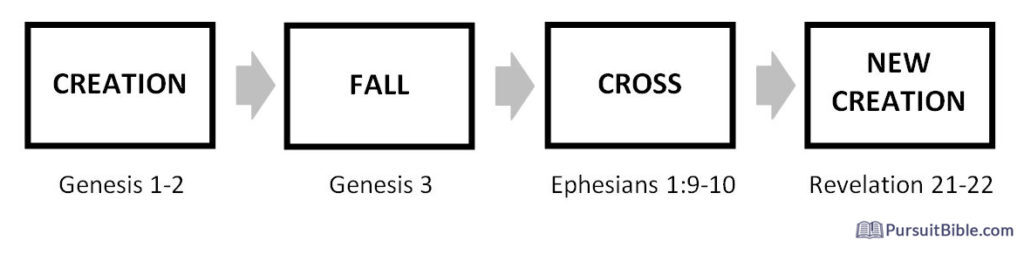
    Another way to think about the Old and New Testament is to look at the first chapter of the Bible and the last 2 chapters. The Bible begins in the book of Genesis with the creation of the world. The Bible ends in the book of Revelation with a New Heaven and a New Earth. In between those two is the unfolding of God’s plan to get us from the Fall to God’s original, perfect design through Jesus’ work on the Cross.

    A third way to think about it is that the Old Testament has many prophecies about the coming Messiah. The Old Testament looks forward to Jesus, the Christ, or Messiah. The New Testament shows how these prophecies were fulfilled in Jesus. It looks back to His finished work and beyond.

    One of many examples of this is the Old Testament prophecy in Isa. 7:14 which explains the circumstances around Jesus’ birth.

    Therefore the Lord himself will give you a sign. Behold, the virgin shall conceive and bear a son, and shall call his name Immanuel.

    Isaiah 7:14 (ESV)

    This prophecy is fulfilled in the New Testament with Jesus’ birth.

    All this took place to fulfill what the Lord had spoken by the prophet:
    “Behold, the virgin shall conceive and bear a son,
    and they shall call his name Immanuel”

    Matt. 1:22-23 (ESV)

    Old Testament Vs New Testament God

    People sometimes ask if the God of the Old Testament is different from the God of the New Testament. Is God mean and angry in the Old Testament? Is God loving and forgiving in the New?

    According to the Bible, God is the same and doesn’t change (Mal. 3:6). God is love in the Old Testament as He is in the New. God is completely just and punishes evil in both the Old and New Testaments as well.

    Heb. 1:3 (ESV) explains that Jesus is the “radiance of the glory of God and the exact imprint of his nature.” In other words, Jesus in the New Testament is a perfect reflection of God in the Old Testament.

    Sometimes the confusion comes because it looks like God punishes sin in the Old Testament but is lenient in the New. People read verses that sound terrifying in the Old Testament. But this is no different in the New Testament. God will ultimately punish sin in the New Testament when Jesus returns.

    In the Old Testament, God sent the flood. The New Testament says that God will not send a flood to cover the entire earth again, but He will send a judgment of fire at the end of this age. The main difference is that in the New Testament, we have the full picture of God’s mercy and love through Jesus’ death, burial and resurrection.

    God cannot be considered good if He does not deal rightly with evil, even if it’s in our own hearts. That’s the reason Jesus died on the cross to pay for our sins.

    In the end, God will remove all that hinders love. Right now is a time of God’s mercy so that more people will turn to Jesus. (2 Pet. 3:6-7)

    The Lord is not slow to fulfill his promise as some count slowness, but is patient toward you, not wishing that any should perish, but that all should reach repentance.

    2 Pet. 3:9 (ESV)

    No matter what happens, we can live with hope and trust God’s character, because He is good.

    Should You Read the Old or New Testament First?

    Should You Read the Old or New Testament First? For those new to the Bible, it is recommended to start reading in the New Testament. For those from another spiritual background, or who have some knowledge of the Bible, the Old Testament is a good place to start.

    The Bible is a big story, a long epic, so it’s okay to start in the middle of it and then work your way back. For example, some movies and books have trilogies that start in the middle of the story and then go back to explain how it started with a prequel. So it’s okay to start reading the New Testament first.

    Reading the New Testament first is recommended for new Christians and those who don’t have a spiritual background. The New Testament books are relatively shorter than the books of the Old Testament. The New Testament requires less knowledge of the cultural and historical background, so it can be easier to understand.

    For those who are familiar with other religious beliefs, reading the Old Testament first can be a better place to start. It explains the Creation of the world and the unfolding of God’s redemptive plan from the beginning.

    If you read the New Testament first, will you miss a few of the Old Testament references? Yes, you might, but you can always go back and read the Old Testament after and it will make more sense and you can appreciate both.

    The Old Testament sets up the background story. The New Testament brings the climax to what God did about it. 

    There is no right place to start reading. If you’re not sure where to start, I suggest starting with the Gospel of Mark in the New Testament as it is the shortest of the Gospels.

    If you want to get an effective overview of the Bible, both the Old and New Testaments, I share the 15 books of the Bible to read in this article: What Is the Best Order to Read the Bible for Beginners? (link opens in a new window). Focusing on those 15 books first will give you a great overview of the entire Bible.

    Wherever you’re reading, I hope this article has helped you get a better understanding of how the Old and New Testaments are related. 

    Leave a comment below or let me know through the Contact page if you have other questions that I can help with as you read the Bible.

    Subscribe to my newsletter for updates and encouraging content.

    A Study Bible is an all-in-one-volume of the most commonly used Bible study resources. I highly recommend the CSB Tony Evans Study Bible (link to Amazon opens in a new window) for those who are starting out. Here’s an article I wrote about how to use one so you can see how it can be helpful: How to Use a Study Bible: Helpful Illustrated Guide.

    Unlocking the Bible (link to Amazon). This is the book I mentioned earlier. I’ve found it to be more helpful than other introduction to the Bible that I have used. I recommend it because it’s also accessible to those who are starting out, but also full of insights for people who’ve been studying the Bible for years.

  • 11 Ways to Study the Bible: Methods, Techniques & Tips

    11 Ways to Study the Bible: Methods, Techniques & Tips

    Ways to Study the Bible: Methods, Techniques & Tips

    How to Study the Bible: Choose One of These Methods

    Are you ready to start studying the Bible for yourself? Are you looking for different methods to study the Bible and enrich your reading of Scripture? Here are 11 different ways to effectively study God’s Word.

    You can choose the one that fits your season of spiritual growth, the passage of the Bible you’re interested in, and the time that you have available. Explore different methods and let them spark ideas you can pursue in your study of the Bible.

    The different types of Bible Study methods are given a rating of 1 to 3 Clipboard icons depending on the level of difficulty. The amount of time that’s required for each is also given a rating of 1 to 3 Clock icons.

    Level (of difficulty):

    1 of 3 Clipboards. Level: Basic Bible Study
    Basic
    2 of 3 Clipboards. Level: Intermediate Bible Study
    Intermediate
    3 of 3 Clipboards. Level: Advanced Bible Study
    Advanced

    Time (Needed to complete):

    1 of 3 Clocks. Level: Basic Bible Study
    Minutes
    2 of 3 Clocks. Time required for Bible Study Method: Hours
    Hours
    3 of 3 Clocks. Time required for Bible Study Method: Days
    Days

    11 Bible Study Methods (With Examples & Tips)

    Sword Method Bible Study - The Easiest Way to Study the Bible

    1. THE SWORD METHOD OF BIBLE STUDY

    Level:

    1 of 3 Clipboards. Level: Basic Bible Study

    Time:

    1 of 3 Clocks. Level: Basic Bible Study

    The Sword Method of Bible Study is a simple, but powerful way to study the Bible. You simply ask 3 questions that cover the 3 most important points. It can be applied to a single verse or multiple verses (for example, the story of Jesus and Zacchaeus in Luke 19:1-10).

    The blade of the sword points upward toward heaven, so you ask “what do I learn about God in this passage?” Next, the handle of the sword points down toward man, so ask “what do I learn about people in this passage?” The 3rd question asks how we apply what we learned: “What does God want me to do?”

    There are many variations of this type of devotional or observation Bible study. You might have seen different graphics or charts for Bible Study methods that emphasize different aspects of learning and applying the Bible.

    The important thing is to not get distracted by the tools. Highlighters, charts, acronyms are helpful if they help you engage with the Bible and apply it to your life. Usually, it’s best to go with a simple, reproducible method like the Sword Method.

    It’s simple and reproducible, so it can be used and taught by adults and children. It can be used to lead a small group Bible Study or discussion.

    Here are a few related questions you can branch off into. You can get an idea of how useful the 3 main questions are.

    1. What does this passage teach me about God, Jesus or the Holy Spirit?
    2. What do I learn about mankind in general – How and why do people act, think, and feel the way they do? What do I learn about myself personally and why I act, think, and feel the way I do? Do I identify with anyone in the story and why?
    3. Is there anything that God wants me to do according to this passage? Is there a Sin to avoid? Is there a Promise to claim? Is there an Example to follow? Is there a Command to obey? (You can use the acronym: S.P.E.C. to remember the 4 questions related to what God wants you to do).

    If you want to try out this method, you can find more details and a few examples in this article: The Easiest Way to Study the Bible. In it, I share a simple infographic that explains how to use the method.


    2. CHARACTER STUDY

    Level:

    2 of 3 Clipboards. Level: Intermediate Bible Study

    Time:

    2 of 3 Clocks. Time required for Bible Study Method: Hours

    In a Character Study or Biographical Study, you look at one character in the Bible and draw out lessons from their life. 

    There are many to choose from – major characters like Abraham, Joseph, Deborah, Moses, Ruth, David, Solomon, Esther, Paul, and Peter. There are hundreds of other characters in the Bible that you can learn from.

    In a character study, you are looking at how God relates to people and how people respond to God. You can observe and learn from the dealings of God in a person’s life.

    You can learn from both the positive and negative experiences in a person’s life. Are there any interesting life lessons? Were there any challenges that the person faced? What were his or her biggest faults? Did they overcome them? How?

    For example, the life of King David, the second King of Israel, is a fascinating study. He starts out as a shepherd boy who is faithful in the mundane things of this life, like taking care of a few sheep. God sees him as a man after His heart and chooses him to be king over all of Israel. Yet, it takes many decades before the full promise is fulfilled. Along the way, David has many triumphs and some really big stumblings.

    Now these things happened to them as an example, but they were written down for our instruction, on whom the end of the ages has come.

    1 Cor. 10:11 (ESV)

    The Bible is a combination of biographies, poems, songs, visions and dreams, letters, and history. The Bible is not written like a theological textbook. It’s about how God relates to people in everyday life.

    When you do a character study, you can delve into the life of one person in the Bible and learn valuable lessons to apply to your own life. You can find yourself in the story.

    How to do a Character or Biographical Bible Study

    1. Pick a character in the Bible.

    2. Find out all the passages of the Bible where the person is mentioned.

    Be careful of different people with the same name. A quick internet search or a Bible dictionary will be helpful. Study Bibles may have a concordance or index that can be helpful.

    A Study Bible is a great resource for in-depth Bible Study. I’ve found the CSB Tony Evans Study Bible (link to Amazon opens in a new window) to be a good balance of good scholarship with helpful applications to daily life. For Study Bibles, I highly recommend getting the print version and not the digital/eBook version.

    3. Make a timeline of their life if it’s helpful. 

    What are the major events in that person’s life? What kind of trials or temptations did they face?

    E.g. For King David, it might be nice to map out the different seasons of his life and the different cities where those seasons took place: Bethlehem, Gibeah, Adullam, Hebron, and Jerusalem. These can be found in the books of Samuel and Chronicles.

    4. What character traits do you notice?

    What strengths or weaknesses of the person are highlighted in the Bible? Do they struggle with the same issue throughout their life? Do you notice any patterns? How did they overcome those trials or temptations?

    5. What lessons can you glean from their life?

    Can you find yourself in this story? How can you identify with the character? What can you apply to your own life? What does God want you to do? Commit to obey. Ask God to empower your heart to obey.

    Before we look at the next Bible study method, I want to share with you what I’ve found to have the most impact in the long-run when studying the Bible. It’s not mainly about tools and techniques but the posture of the heart. I hope you’ll find these helpful: 7 Guidelines: How to Start Studying the Bible for Yourself (Link opens in a new window).

    Write Out Verses from the Bible


    3. WRITE OUT VERSES FROM THE BIBLE

    Level:

    1 of 3 Clipboards. Level: Basic Bible Study

    Time:

    1 of 3 Clocks. Level: Basic Bible Study

    Writing out a verse or several verses makes you slow down and think about the Scripture. It can give you a different perspective on the verse than just reading it alone.

    Write it in your own handwriting. It can be on a lined sheet of paper. You can also get creative and write it in a different pattern. You can get colorful if you want to. You can doodle a little bit and draw small pictures if it helps you process the verse.

    As you write the verse, ask yourself: 

    1. What words are my eyes drawn to?
    2. What is the main subject?
    3. What is the main verb?

    Read the passage out loud several times. Try reading it slowly. Try reading it quickly to get a sense of the structure. Read it again as many times as you’d like.

    I didn’t include journaling as a separate way to study the Bible because that can apply to any of these different ways to study the Bible. But, a journal would be a great place to keep these.

    Take the journal or paper you wrote the Scripture on and look at it throughout the day. You can take a photo with your phone and set a reminder during your lunch break to look at it. Think about the verse and how you can apply it to your life.

    To take it a step further, you can paraphrase or summarize the verse or passage in your own words. This makes you process and ask what the verse means even further.

    You can also come up with a title for the verse or passage and write it at the top. It can be a phrase that summarizes what the verse is about, what you learned, or how you can apply it to your life.


    4. STUDY A BOOK OF THE BIBLE

    Level:

    3 of 3 Clipboards. Level: Advanced Bible Study

    Time:

    3 of 3 Clocks. Time required for Bible Study Method: Days

    Have you tried other ways to study the Bible and want to go deeper? Do you like to be challenged? Studying a book of the Bible, or doing a book-by-book study, is a great way to go.

    Studying a book of the Bible is one of the more challenging ways to study the Bible because it involves a little bit of every method of Bible Study. It can involve studying themes, topics, characters, individual words, and cross-references. 

    A book study takes time and commitment, but it can also be the most rewarding! It’s my favorite way to study the Bible because it takes me deeper and helps me wrestle with the text over an extended period of time.

    You might see many Bible verses in a whole new light when you read them in their context. You might even find that some of your favorite verses mean something different than what you might have heard in the past.

    If you take a verse out of its context, it can seem to mean something different than what the author intended. The advantage of a book study is that it helps you keep Bible verses in their context. You want to know what God is saying and not change its meaning.

    What I love about doing a book study of the Bible is that I usually end up where I didn’t expect. I start out with a general idea of what I think the book means. Then I end up in a surprisingly different place at the end. Also, whatever book I studied last becomes my new favorite!

    Studying the Bible one book at a time requires some time commitment. It can take anywhere from a few weeks to many months to study one book of the Bible, depending on the length and complexity of the book.

    One resource that I highly recommend is: Unlocking the Bible: A Unique Overview of the Whole Bible (You can check out the reviews on this link to Amazon). It has a chapter on every book of the Bible, is very clear, and has great insights. Be sure to get the book and not the one that has just diagrams, charts, and images. The covers look very similar.

    If you want to try this type of study, take a look at this article where I go into more detail and provide several examples: How to Study a Book of the Bible: 5 Step Guide With Examples (link opens in a new window).

    Here are the 5 steps from that article:

    How to Study Books of the Bible

    1. Make an outline of the book.
    2. Look for keywords or phrases.
    3. Identify the main themes, ideas, and key verses.
    4. Look for the main applications.
    5. Study the background of the book.

    These steps don’t have to be followed in the exact order. You can go back to any of the steps as your understanding of the book develops. As with any of the methods to study the Bible, enjoy the journey and the learning process. 

    The lessons you learn in Bible Study, and in life too, often come at unexpected times and in unexpected ways.  Stay consistent and stay on track and you’ll discover many jewels in God’s Word along the way.

    If you’d like an example of a book study, I’d like to share what I learned during my studies in the book of  Ephesians: Summary of Ephesians: Meaning, Outline & Application (link opens in a new window). I also did a study of the Book of James.

    If it’s your first time doing a book study, my recommendation would be to pick a book from the New Testament that’s not too long, like the book of Philippians.


    Read through the Bible

    5. READ THROUGH THE BIBLE

    Level:

    2 of 3 Clipboards. Level: Intermediate Bible Study

    Time:

    3 of 3 Clocks. Time required for Bible Study Method: Days

    Reading through the Bible is a great way to study it. Every page of the Bible reveals God’s character, emotions, thoughts, and actions.

    All Scripture is breathed out by God and profitable for teaching, for reproof, for correction, and for training in righteousness, that the man of God may be complete, equipped for every good work.

    2 Timothy 3:16-17 (ESV)

    When you read the entire Bible or large portions of it, you can get a big-picture overview of the Bible. Anytime you read the Bible, you’ll know what part of the big picture it is in.

    How to Read through the Bible

    Option 1: Read through the entire Bible from cover to cover.

    Option 2: Read specific books first to get an effective overview of the Bible

    Books of the Bible to Read for an Effective Overview

    These 15 books of the Bible will help you cover all the major themes and the main storyline of the Bible.

    1. Genesis
    2. Exodus
    3. Joshua
    4. 1 Samuel
    5. 2 Samuel
    6. 1 Kings
    7. 2 Kings
    8. Ezra
    9. Nehemiah
    10. Habakkuk
    11. Proverbs
    12. Luke
    13. Acts
    14. Ephesians
    15. Revelation

    If you want more details on why these books are suggested and how they fit into the big-picture overview of the Bible, you can find it in this article: What Is the Best Order to Read the Bible for Beginners?

    The books of the Bible are arranged by category, not chronologically. That’s one of the reasons that reading the Bible from cover-to-cover is challenging for many people.

    For example, there are 4 records of the Gospels, the life of Jesus, in the New Testament. You can read one of the Gospels the first time through and then read the others after you have an overview of the Bible.

    If you’re reading through the entire Bible from cover-to-cover, you can use a bookmark that motivates you. I simply use a small sticky note. No reading charts needed! It’s not elegant, but it works. That way, my bookmark never falls out and lose its place.

    There are also One-Year-Bible (link to Amazon opens in a new window) type of books that have the daily portions conveniently divided. These are helpful in developing a daily Bible-reading habit.

    There are also many different types of Bible reading plans that you can find online. Some Bible apps and programs also have reading plans with reminders. A reading plan with check-marks can be motivating to keep reading. This is especially true when life gets busy and you fall behind schedule.

    Another way to cover the Bible is to listen to an audio Bible. Audio Bibles can give you a new perspective on the flow of a book. You can listen when you’re not able to read.

    Many Bible apps offer audio along with the text. Also, some apps offer a choice of dramatized or non-dramatized versions of the audio. The dramatized ones might include background music, sound effects, and different actors reading different portions of the Bible.

    Some Bible websites like ESV.org also let you listen to the Bible online as well.

    If you get stuck in your Bible reading plan, feel free to skip any books along the way and come back to them later. Remember, the goal is to encounter God and His heart for you. If you keep the main thing as the main thing, you’ll find great benefit and encouragement from God’s Word.


    6. TOPICAL/THEMATIC BIBLE STUDY

    Level:

    2 of 3 Clipboards. Level: Intermediate Bible Study

    Time:

    2 of 3 Clocks. Time required for Bible Study Method: Hours

    As you read the Bible, there might be some topics or themes that you’re interested in going more in-depth into. A Topical or Thematic Bible Study is a type of study that explores a theme or topic through the entire Bible.

    How to do a Topical Bible Study

    1. Choose a topic.
    2. Look up every instance of that topic in the Bible.
    3. Categorize and summarize your findings. Explore the differences, nuances, and connections in the verses.

    There are many theological or doctrinal themes in the Bible. For example, how is Jesus both fully God and fully man. Theologians would call this the doctrine of the Incarnation. There are also topics like salvation, angels, or the nature of the church.

    The topic can also be application-oriented. What are the fruit of the Spirit? How do you develop passion for God? How can I forgive people who have hurt me and let go of the past? What does the Bible say about baptism in water? What is the purpose of prayer and fasting?

    There are countless numbers of topics and themes in the Bible that you can pursue. How is the color purple used in the Bible? What does the number “12” often signify?

    Depending on the topic, it might be a study that takes an hour, or if it’s a major theme like the End Times, it could take months.

    The idea of a Topical or Thematic Study is to study what the Bible says about a topic or theme throughout the entire Bible and not just from one verse. 

    To do this, you can use tools like a Bible Concordance. Many Bibles, especially Study Bibles have at least a short index in the back.

    How do you look up every instance of a topic or word? A concordance is a great tool for this. A Concordance is like an index at the back of a book. For example, you can look up all the verses where the word “heaven” occurs in the Bible. Some Bibles have a concordance in the back, but they’re usually very limited.

    Some concordances are organized by topics, which would be perfect for a topical or thematic study. Here’s one that’s online that I would recommend: Torrey’s Topical Textbook Online Resource.

    TIP: Navigate using the alphabet at the bottom, not with the search bar at the top. If you wanted to study the topic of “heaven,” click on the letter “H” then scroll down and choose the word “heaven.”

    It should take you to a screen that shows you the verses for the topic and subtopics: Torrey’s Topical Textbook Entry on “Heaven.”

    You can look up each verse to study and compare (cross-reference) with other verses.

    If the topical concordance doesn’t have many results, or you want to study the verses on your own before you look it up in a topical concordance, you can use a standard concordance that looks up words, not topics.

    The most widely used concordance is some variation of Strong’s Exhaustive Concordance, but most Bible apps or websites can do this easily using the search feature. Here’s an example at esv.org (you might have to create a free account to use the tool). ESV.org search results on “heaven.”


    7. PRACTICAL STUDY

    Level:

    2 of 3 Clipboards. Level: Intermediate Bible Study

    Time:

    2 of 3 Clocks. Time required for Bible Study Method: Hours

    A Practical Study is like a topical study of the Bible, but with a broader focus on applying it to your life. These are topics that entire books can be written on. For example, practical studies can dive into topics like prayer, discipleship, raising children, relationships, how to live out your faith in the workplace, and how to share your faith with others.

    All the tips and tools like concordance resources that we looked at in Topical Studies would also be useful for a devotional/practical study.

    The uniqueness of a practical study is the application of the truth from the Bible to our modern life. It’s mind-boggling to see how much of the Bible written about 2000+ years ago could apply to our modern-day life. Countless numbers of people have received God’s wisdom and applied the truths of the Bible to their lives.


    8. MEMORIZE SCRIPTURE

    Level:

    1 of 3 Clipboards. Level: Basic Bible Study

    Time:

    1 of 3 Clocks. Level: Basic Bible Study

    I have stored up your word in my heart,

        that I might not sin against you.

    Psalm 119:11 (ESV)

    Memorizing scripture is a great way to hide God’s Word in your heart. Memorizing portions of the bible lets you think about the Bible verse any time of the day or night. You can start out with verses that are especially meaningful to you.

    You can combine Scripture memorization with many of the different Bible Study Methods like writing out verses in your own writing and meditating on the Word. These methods flow together well.

    You can also memorize several verses or even chapters of the bible. This would be a more challenging goal, but also very rewarding. 

    There’s great value in having the Bible always on your mind and ready to think about for yourself or to share with others (John 14:26).


    Study Bible Cross-references Bible Study Method

    9. STUDY SCRIPTURE CROSS-REFERENCES

    Level:

    2 of 3 Clipboards. Level: Intermediate Bible Study

    Time:

    1 of 3 Clocks. Level: Basic Bible Study

    Studying cross-references is looking up other places in the Bible that mention the same or similar ideas. This doesn’t require as much time commitment as some of the methods we’ve looked at so far, but you can apply it to any verse or passage of Scripture you’re interested in.

    For example, there are four accounts of the Gospel, or Good News of the life, death, and resurrection of Jesus Christ. The writers of the Gospels cover a lot of the same events. Each reference might reveal a different detail or says it in a slightly different way that helps you understand the passage you’re studying.

    These cross-references will point you to the word, phrase, or idea in different parts of the Bible. You’ll find that the Bible often interprets itself. For example, if you’re reading a verse in Ephesians, you will find a lot of parallel passages in the book of Colossians. If you’re in the book of Revelation, you’ll find a lot of references to the book of Genesis.

    These cross-references are often in the center column.  Some Bibles have titles for sections added in and could list parallel passages. Reference Bibles, some reading Bibles and almost all Study Bibles will have cross-references next to the text of the Scripture.

    If you’d like to see some examples, I explain how to look up cross-references using a Study Bible in this article: How to Use a Study Bible: A Helpful Illustrated Guide. (Link opens in a new window).

    If a Bible verse doesn’t make sense, looking at the immediate context around the verse or looking up cross-references can often bring a lot of clarity. If you don’t understand the verse right away, put it “on the shelf” and use one of the other ways to study the Bible. Memorize the Scripture so you can think about it. You can try meditating on God’s Word and let the insight arise slowly.

    Write your questions in a journal, not just the insights and applications. Ask God to open His Word to you. You’ll find that many of these questions get answered eventually.


    10. MEDITATE ON THE WORD

    Level:

    2 of 3 Clipboards. Level: Intermediate Bible Study

    Time:

    2 of 3 Clocks. Time required for Bible Study Method: Hours

    To Meditate on God’s Word is to ponder and dwell on the Scripture. It’s a way to have the Word of God “dwell in you richly” (Col. 3:16).

    Let the word of Christ dwell in you richly, teaching and admonishing one another in all wisdom, singing psalms and hymns and spiritual songs, with thankfulness in your hearts to God.

    Colossians 3:16 (ESV)

    The Bible speaks more about meditating on the Word than studying it (Gen. 24:63; Josh. 1:8; Psalm 1:2; 119:23, 97). To study is to observe and gather facts, analyze them, and come to conclusions. 

    To meditate is to purposely stay narrowly focused on a short phrase or verse and ponder it deeply. Meditating on the Word is more like cooking a stew for many hours than a quick saute in a pan.

    Meditating on the Word is not to get more information from the Bible, but to let even one word or phrase from the bible take hold of your heart and mind.

    There are many ways to meditate on the Word. We’ve looked at several of these earlier as these different ways overlap and are related to each other.

    Ways to Meditate on the Word of God

    1. Read the Word

    Slowly read the Bible verse several times. Discover key phrases or words.

    2. Write the Word

    Write the entire verse at least once.

    3. Memorize the Word

    Having the verse in your mind and heart frees you up to not have to look for your place on the page.

    4. Speak the Word

    Gently speak it out loud several times. It can help you focus and process the verse.

    5. Sing the Word

    Sing the Bible? Yes! (Col. 3:16) Singing can unlock the heart and emotions. This has been an important part of many traditions in monasteries throughout history. It adds another dimension to meditating on God’s Word.

    6. Pray the Bible

    Turn the Bible into a dialogue with God. Thank God for the truth that the verse is pointing to. Commit to obey and ask God to empower your heart to follow-through.

    7. Picture the Bible

    For example, when Jesus says that the Kingdom of God is like a Sower going out to the field to sow seed, picture the scene in your mind. What is God thinking, feeling, and saying?

    All of these are ways to meditate on God’s Word and be still in God’s presence. Be sure to write down any insights and thoughts you had and ask God to give you more.


    11. WORD STUDY

    Level:

    3 of 3 Clipboards. Level: Advanced Bible Study

    Time:

    3 of 3 Clocks. Time required for Bible Study Method: Days

    A Word Study looks at the individual words and translations of the Bible text.

    For example, there are several different words in the original languages of the Bible that are usually just translated into one word, love, in the English translations. Another example is that there are more than 7 different Hebrew words for praise in the Old Testament. There are lots of opportunities for fruitful study if you know where to look.

    To learn to do a Word Study properly takes a lot of time in learning at least the basics of the original languages that the Bible was written in. Fortunately, many translations of the Bible and Word Study tools are available, so you can gain many of the insights of Word Studies from these resources. Unless you’re doing original research in theology or Biblical studies, these resources will serve you well.

    3 Ways That You Can Benefit From Word Studies

    1. Compare 2 or 3 different translations of the Bible. E.g. ESV, NKJV, and NLT
    2. Use a Word Study resource like Vine’s Concise Dictionary of Old and New Testament Words to look up particular words. Some of this info is available on the websites like the ones the video below mentions.
    3. Learn to use Bible software or online tools. Here’s a video introduction to 3 helpful websites that you can use to do Word Studies.


    Take the Next Steps

    Has something in this article sparked your interest and given you any ideas to pursue? Take the first step today to engage with God and His Word. Don’t let the many options here overwhelm you. Just pick one and be a doer of the Word today.

    Let me know in the comments below which of the methods of Bible Study you’re going to try. Also, you can let me know if you get stuck and need encouragement or direction.

    What’s important is that you engage your heart to meet Jesus, the Word, through the eternal written Word of God (John 1:1-3). God delights to reveal Himself through His Word. Come with a teachable heart and enjoy the journey!


    Subscribe to my newsletter for updates and encouraging content.


    If you enjoyed this article, here are some others I think you’ll love:

    How to Use a Study Bible: Helpful Illustrated Guide. A Study Bible is an all-in-one-volume resource of the most commonly used Bible Study resources. In the article, I show how you can use it to enhance your study of the Bible.

    A Study Bible I recommend is the CSB Tony Evans Study Bible (link to Amazon). I would highly recommend getting the print version and not the eBook, as I explain in the article above.

    After studying and teaching the Bible for many years, I’ve found what really matters in the long-run is not tools and techniques but the posture of the heart. I hope you’ll find these helpful: 7 Guidelines: How to Start Studying the Bible for Yourself

    If you need an additional boost of motivation and encouragement to study the Bible, here are 21 Valuable Benefits of Studying God’s Word.


    Photo Credits:

    Photo by JD Mason on Unsplash

    Photo by Priscilla Du Preez on Unsplash

    Photo by chuttersnap on Unsplash

  • The Main Message of the Bible: Its Central Theme & Purpose

    The Main Message of the Bible: Its Central Theme & Purpose

    An open Bible with pages flipping

    The Bible is a big book, a collection of 66 books written by around 40 different authors over a period of 1600 years. Is there a unifying theme in the Bible? In this article, I’ll share an overview of the Bible so that the main message of the Bible will be easier to see.

    What is the main message of the Bible? The main message of the Bible is that God is restoring the world to His original design through Jesus Christ. The world is in a state of brokenness because of mankind’s rejection of God and His plan. Jesus entered into a broken and hurting world to die on the cross to restore mankind to God.

    There are lots of different opinions when it comes to interpreting the Bible’s main message. How do we know which one to go with? The best way to interpret the Bible is to start with the big-picture themes and ideas. What does the Bible say that its main message is?

    The Main Theme of the Bible Is the Kingdom of God

    Kingdom Revealed - Kingdom Forfeited - Restoration Introduced - Kingdom Reclaimed - Kingdom Fulfilled

    The entire Bible can be summed up in the theme of the Kingdom of God. The different parts of the Bible can be explained in terms of the Kingdom of God. The Kingdom of God is the reason God created the world, the reason Jesus came to die on the cross so that people can enter into the Kingdom of God. God has a good plan for the world and the people He created to rule over the earth.

    To understand the main message of the Bible, you have to understand the theme of the Kingdom of God. It will help you get an overview of the Bible.

    The Kingdom of God means His rule and reign. God’s Kingdom is His original plan as the Creator of the world and as the King who establishes what is good and right.

    KINGDOM REVEALED: In the beginning, God created the world and placed mankind as His representatives in charge of caring for it (Gen. 1:28). God is the Creator and the King and He delegates His authority to mankind. Words like “subdue it” and “have dominion” in Genesis 1:28 describe how man is to use God’s authority to bring the earth to its fullness.

    KINGDOM FORFEITED: Man rejected God’s will and plan and went his own way (Gen. 3:6-7). This is what the Bible calls sin. Sin is when we depart from God’s plan and go our own way. Sin is what leads us to brokenness (Rom. 3:23). This results in death entering into the world (Rom. 6:23). God created a perfect world without brokenness (Gen. 1:31). Man opened the door to sin and death, leading into brokenness.

    RESTORATION INTRODUCED: The Old Testament after Genesis 3 is the introduction and working out of God’s restoration process. God chose Israel, one nation, out of all the nations of the earth to call His own. The people of Israel were to learn God’s way and become a blessing to all the nations (Gen. 12:1-3). Israel as a literal kingdom on earth becomes a history lesson to prepare the world for the Cross.

    Now these things happened to them as an example, but they were written down for our instruction, on whom the end of the ages has come.

    1 Cor. 10:11 (ESV)

    KINGDOM RECLAIMED: The Kingdom was reclaimed when God Himself entered into the brokenness of this world. Jesus, as the Son of God, was born as a man. Jesus’ main message was the Gospel, or the Good News, of the Kingdom of God. 

    The Good News is that God is doing something about the brokenness of man and the world. Israel was not able to uphold the Law and live as God intended. God Himself would have to redeem mankind from sin and death. The Kingdom of God, His rule and reign would be reclaimed on the earth.

    Jesus accomplished this through His death on the Cross. Jesus’ death on the Cross pays for the penalty of sin (1 Pet. 3:18). Jesus says after His resurrection from the dead that all authority in heaven and earth had been given to Him (Matt. 28:18).

    KINGDOM FULFILLED: The Bible ends with the Kingdom of God fully established on earth (Rev. 21-22). Jesus comes to replace the kingdoms of this world with God’s Kingdom. He will remove all evil from the earth. Until then, God is patient to give people time to turn to Him (2 Pet. 3:9).

    All of the Bible Points to Jesus

    Why is Jesus Christ important? Jesus is the central figure and theme of the Bible. Jesus is important to Christianity because of the Good News that He came to make known and His work of redemption through His death on the cross.

    The Kingdom of God was forfeited by man as we went our own way away from God’s design, so it required God to redeem the world.

    The name Jesus comes from the Hebrew name Joshua. Joshua means “the Lord saves.” Jesus is the Son of God who saves the world from its sin and brokenness. Jesus did this by entering into a broken world, being born as a man.

    All of the Bible points to Jesus. All of Scripture points to some aspect of who Jesus is or what He would come to do.

    And beginning with Moses and all the Prophets, he interpreted to them in all the Scriptures the things concerning himself.

    Luke 24:27 (ESV)
    The main theme of the Bible is the Kingdom of God. And Jesus, as the Son of God, and as the King, is the center of its message.

    Jesus’ Main Message Was the Kingdom of God

    Jesus’ main message was the Good News of the Kingdom of God.

    But he said to them, “I must preach the good news of the kingdom of God to the other towns as well; for I was sent for this purpose.”

    Luke 4:43 (ESV)

    Jesus’ mission statement is that He came to tell people the Good News of the Kingdom of God (Luke 4:43). Why is it good news? The bad news is that we live in a world of brokenness, separated from God. What is the Gospel, or the Good News?

    The main message of the Gospel, or Good News, is that we can be restored to God and live as people of His Kingdom, under God’s rule and reign through Jesus Christ.

    This is great news to people who admit that they’re living in brokenness and not in God’s design for the world. This is good news to people who are experiencing brokenness in this world: sickness, broken relationships, war, famine, injustice, etc…

    Jesus not only told people about the Kingdom of God, He showed people that God’s Kingdom is here and that God cares. The Gospels record the many miracles of healing that Jesus displayed to show that God’s Kingdom was here to restore the world.

    Jesus came to show people that there’s a different way to live and a way to be restored, or saved, from the brokenness of this world. We can enter the Kingdom of God and live as God’s people.

    Jesus’ life and ministry is summed up in the cross. The cross is where Jesus died to pay for the penalty of sin and to reconcile man to God. Jesus laid down His life as a sacrifice. The death on the cross and the blood that was shed for sin is what brings forgiveness of sin and pays the price so that we are redeemed by God and restored to Him.

    Through His death on the cross, Jesus reclaimed the Kingdom of God on man’s behalf. It’s reclaimed for people who forfeited it by going out of God’s Kingdom through sin. Through the cross, Jesus makes a way for people to enter into the Kingdom of God.

    Jesus said to him, “I am the way, and the truth, and the life. No one comes to the Father except through me.

    John 14:6-7 (ESV)

    The Bible Calls People to Repentance and Faith

    The message of the Kingdom of God requires something of us. What does God want us to do? Jesus sums it up in Mark 1:15 when He began His ministry: repent and believe the Good News.

    And saying, “The time is fulfilled, and the kingdom of God is at hand; repent and believe in the gospel.”

    Mark 1:15 (ESV)

    The Bible calls people to repentance. What does repentance mean? In the Bible, to repent means to think differently after. It means to change your mind. It’s what the hymn Amazing Grace describes when it says “I once was lost, but now am found.”

    Jesus presents a way to look at the world. We could not see clearly before. We are not victims of a broken world anymore. There is good news. After we hear the good news, we have to think differently about God, the world, and ourselves.

    After we hear the Good News, we have to think differently about God, the world, and ourselves.

    What is the purpose of the Bible? The Bible is God’s Word to man so that mankind can align with God’s rule and reign, His Kingdom.

    The Bible calls people to faith. Faith means to believe and trust. To have faith means to receive Jesus, to believe in His name, that He came to save us. He came to restore us to God, to become children of God.

    But to all who did receive him, who believed in his name, he gave the right to become children of God.

    John 1:12 (ESV)

    Jesus gathers people who believe into a community called church (Matt. 16:18). The church is not a building, but a group of people who live with Jesus as their King, under His life-giving and joy-filled authority. 

    The mission of the church is to show others the Kingdom of God and to invite people to follow Jesus. The church points people to follow Jesus and to live out God’s plan for their lives. God’s people are called to love God and love others as Jesus commanded.

    And Jesus came and said to them, “All authority in heaven and on earth has been given to me. Go therefore and make disciples of all nations, baptizing them in the name of the Father and of the Son and of the Holy Spirit, teaching them to observe all that I have commanded you. And behold, I am with you always, to the end of the age.”

    Matt. 28:18-20 (ESV)

    Jesus’ message was that the Kingdom of God is near. God wants people to repent and believe in Him and follow His ways. Jesus builds His church to extend God’s rule over hearts, individuals, marriages, families, work, and overall society.

    Jesus Fulfills the Kingdom of God on Earth

    The final part of the main message of the Bible is that Jesus is coming to fulfill the Kingdom of God on earth.

    Jesus’ first coming was to preach the Kingdom of God and make a way for people to enter it. Jesus’ Second Coming will be as King and Judge to fully establish God’s Kingdom on earth. He does this by removing all evil from the earth. Jesus will sit as the righteous Judge on His throne.

    God’s original plan was forfeited by man. Jesus made a way for it to be restored. God will once again live with man on earth.

    And I heard a loud voice from the throne saying, “Behold, the dwelling place of God is with man. He will dwell with them, and they will be his people, and God himself will be with them as their God. He will wipe away every tear from their eyes, and death shall be no more, neither shall there be mourning, nor crying, nor pain anymore, for the former things have passed away.”

    Rev. 21:3-4 (ESV)

    What separated man from God will be fully removed. All evil will ultimately be removed from the earth by Jesus, the King, and Judge. He will return to finish what He started in His first coming.

    Hope is an eager expectation of what is to come. The message of the Bible is that there is hope in this world where we experience pain and brokenness. The hope of the Bible is that Jesus is returning to restore God’s plan for the world. The Bible calls people to see from God’s perspective and to believe in Jesus, the Son of God, who died for their sin.

    What is the message of the Bible in one sentence? God calls people to believe in Jesus Christ, the Son of God, who died to restore mankind to God and fulfill His original plan and purpose for a broken and hurting world.


    Subscribe to my newsletter for updates and encouraging content.

    If you enjoyed this article and want to learn more about understanding the Bible, you might be interested in this article: The Essential Guide to Understanding the Bible for Beginners. In it, I share some tips and guidelines to help you get the most out of your study of the Bible.

    Thy Kingdom Come – What It Means & How to Pray It. It’s from the prayer that taught His disciples. It explores the powerful prayer which summarizes the entire Bible.

    There are some misconceptions about what the Bible says about going to heaven. In this article, we explore this all-important question: How to get to Heaven According to the Bible: It’s NOT By Being Good.
    Photo by Priscilla Du Preez on Unsplash

  • How Does the Bible End?

    How Does the Bible End?

    Many people are familiar with how the Bible begins, with the creation of the world. But how does it end? Does the Bible predict the end of the world? Is there hope for the world or is it all “doom-and-gloom?” There are many different approaches and interpretations of how the Bible ends. From many years of study and teaching classes on this fascinating topic, here’s what I’ve found to be the highlights which are the most clear and evident from the Bible.

    The Bible ends in the book of Revelation with Jesus returning as the King and Judge who cleanses the earth from all evil. Jesus’ leadership at the end of this age results in the restoration of God’s original plan for mankind, with a new heaven and a new earth.

    The story that the Bible presents is quite the epic tale that offers some unique explanations for the brokenness we experience in this world and what God is doing about it. Let’s look in more detail at this epic strategy of God and His opposition that the Bible presents about the end of this age.

    Buildings and Clouds

    The Bible Ends How It Begins

    The Bible begins and ends in a garden. The garden is where God placed man after He created everything. He says it’s “good” (Gen. 1:31). The imagery that’s found in the first part of the Bible is also at the end of the Bible. Genesis, the first book of the Bible, describes how God created the world. The last book of the Bible, Revelation, reveals how God will restore His original plan.

    The First Book of the Bible: GenesisThe Last Book of the Bible: Revelation
    The Garden of Eden (Gen. 2:8)Garden & the Tree of Life (Rev. 22:2)
    The Tree of Life (Gen. 2:9)The Tree of Life (Rev. 22:2)
    The River (Gen. 2:10)The River of Life (Rev. 22:1)
    Creation of Heaven & Earth (Gen. 1:1)New Heaven & New Earth (Rev. 21:1)
    The First Marriage (Gen. 2:24-25)The Final Marriage (Rev. 19:7, 9)

    How does the Bible begin and end? The Bible begins with God’s original plan for mankind to rule as His representatives on the earth (Gen. 1-2). Mankind chooses not to follow God’s plan, resulting in the Fall (Gen. 3). As a result, mankind and the world we live in end up in a state of brokenness – sin and death enter the world. There is sickness, war, poverty, injustice and all sorts of things that cause pain and sadness in the world.

    The rest of the Bible is the plan that God sets in motion to restore mankind and the earth to His original plan. God’s plan is to ultimately join heaven and earth together (Eph. 1:9-10). This plan is fulfilled at the end of the Bible when heaven, the spiritual unseen (to us) realm and the earth are joined. The city called New Jerusalem comes down to earth and there is a New Heaven and a New Earth (Rev. 21). There will no longer be any brokenness or death in the world.

    The way God makes this is possible is through what happens at the cross where Jesus Christ, the Son of God, dies as a substitute for the sins of mankind (Luke 23). What happened at the cross is the payment for our sin (Rom. 6:23). The cross makes it possible for mankind and for the world we live in to be restored to God’s original design. The Bible now calls people to believe in Jesus Christ who God has sent (John 3:16).

    For God so loved the world, that he gave his only Son, that whoever believes in him should not perish but have eternal life.

    John 3:16

    Here’s a diagram of the main flow of the Biblical narrative that we’ve looked at so far.

    Diagram of the Big-Picture Overview of the Entire Bible

    The diagram is from an article where I share a simple overview of the Bible, which I think will be a good compliment to this article. You can find it here: Bible Explained for Beginners (link opens in a new window).

    The Bible Ends with the Second Coming of Jesus

    Most of the events in the book of Revelation focuses on Jesus’ second coming. Jesus’ first coming is recorded in the Gospels, which are the books of Matthew, Mark, Luke, and John. Jesus’ first coming was as the Lamb of God to die on the cross for the sins of the world. These events took place around 30 or 33 A.D.

    Jesus’ second coming is explained in various places, but with the most detail in the book of Revelation. Jesus’ Second Coming as explained in the book of Revelation has yet to take place. Jesus Himself gave us signs that will accompany His return.

    These signs are recorded in Matthew 24 and Luke 21. This is how the Bible predicts the world will end. It’s actually not the end of the world. It’s just the end of this age and the beginning of the next age. The signs in Matthew 24 will come about before Jesus returns to cleanse the earth of evil, and heaven and earth will be joined together and renewed.

    The Signs of the End of the Age in Matthew 24

    1. False Messiahs claiming to be the Christ (Matt. 24:4)
    2. False prophets (Matt. 24:11) with false miracles that are not from God (Matt. 24:24). Even people who believe in Jesus will be deceived (Matt. 24:24-25). 
    3. The abomination of desolation (Matt. 24:15). An idol will be set up in the temple in Jerusalem (the temple is currently not rebuilt yet).
    4. Political upheaval: wars and rumors of wars (Matt. 24:6)
    5. Convulsions of nature: famines, pestilences, earthquakes (Matt. 24:7)
    6. Persecution of Christians, leading to apostasy, the great falling away: The love of many will grow cold. Many will be offended, leading to betrayal and hatred (Matt. 24:9-13).
    7. The Good News of the Kingdom of God that Jesus preached will be preached in all the nations (Matt. 24:14).
    8. Lawlessness and lovelessness (betrayal and cruelty) will abound in society (Mt. 24:12)
    9. The emergence of the Antichrist’s worldwide worship and economic system related to the abomination of desolation (Mt. 24:15)
    10. There will be an unprecedented number of deaths (Mt. 24:40-41)
    11. The great pressures in Jerusalem (Mt. 24:16-20)

    The Bible Ends with Jesus’ Leadership as the King & Judge to Cleanse the Earth from All Evil

    One of the most common questions is “Why does God allow evil?” Is God able to do anything about it? Does He care? The Bible ends with God finally removing everything that’s evil from the earth. He is able and He cares. The answer is a bit more complicated that – but it is a very satisfactory answer that upholds His justice but also does not violate mankind’s will to choose.

    Why did it take God so long before He removes evil from the earth? One reason is that if God were to remove evil from the earth right now, no one would be good enough to earn a place in the new heaven and earth (Rom. 3:23).

    In the last book in the Bible, the book of Revelation, there is a person who is referred to as the Beast because of his character and actions. He is referred to as the Antichrist in other places in the Bible. He is empowered by Satan, whose name means Adversary.

    This Antichrist will be a world leader who will bring about a one-world government, called Babylon, with one economic system, and set up a one-world religion that requires everyone to comply (Rev. 17-18). It will look like peace and safety is finally achieved for the world, but this Antichrist will turn out to be the embodiment of evil and oppose God and His plan.

    When God finally removes evil from the earth, it will be a takeover of all the nations and kingdoms on the earth. For the first time in all of history, the full wrath of God will be displayed on the Antichrist and his armies (Rev. 11:15).

    The Bible Ends with the Book of Revelation

    The Bible is a collection of 66 books divided into Old and New Testaments.

    The Book of Revelation is at the end of the Bible. Revelation brings together all the major themes of the entire Bible and comes to a fitting conclusion. The word revelation means revealing or unveiling.

    The book of Revelation is the unveiling of the leadership of Jesus Christ at the end of this age to restore God’s original plan for mankind and the earth.

    The central scene in the book of Revelation is the throne room of God in chapters 4 and 5. God is seated on His throne with a scroll in His hand, but no one is worthy to open the scroll or look inside (Rev. 5:4-10). God has His plans for the world in this scroll but no one is able to open it and act on it.

    Jesus walks into this throne room scene, portrayed as the Lamb that was slain.  He is the substitutionary sacrifice for the sins of mankind. He takes the scroll and opens it. He is the only person in history who is worthy because He lived a sinless life as the Son of God and laid down His life and can bring people into God’s Kingdom (Rev. 5:9-10).

    The rest of the book of Revelation is what happens as Jesus opens the scroll. There are 7 seals that keep the scroll closed securely. These are opened one by one. These are followed by 7 trumpet blasts. Lastly, there are 7 bowls of wrath. Each one gets more severe and serves as a warning for people on the earth to prepare for Jesus’ return.

    These judgments are released as warnings to the city of Babylon and the Antichrist. Each judgment brings devastation to the Antichrist and his infrastructure. The judgments conclude with the bowls of wrath that are poured out on the Antichrist and his armies who will gather to attack Jesus one last time.

    People are given many opportunities over and over again in the book of Revelation to turn to God. Many turn and believe in God. Those who follow the Antichrist grow more hardened and declare war on God (Rev. 17:14).

    Mankind has tried for centuries to bring about peace on the earth. Every effort ultimately falls short. We have more education, technology, social networking, and resources available to us than ever before in history, but we’re not able to bring about world peace and return to God’s original plan for mankind and the world.

    People try to bring about what they want in their own way. World leaders will go to the extent of forcing others through government and economic policies to get peace on the earth. It will result in a false peace that can only be maintained through severe manipulation by the strictest dictator in the history of the world, the Antichrist.

    The best that man is able to produce is summarized as the city of Babylon in the book of Revelation (Rev. 18:10). The only way to sustain this false unity is through the controlling leadership of the Antichrist. Jesus comes to ultimately judge the city of Babylon, the Antichrist and all who follow him.

    The Bible Ends with Jesus as the Bridegroom Coming for His Bride

    One recurring theme in the Bible is that of God as a Bridegroom. An epic would not be complete without romance. At first, it can seem somewhat foreign to think in terms of romance and marriage when thinking about God. Yet, the Biblical view of marriage is that human marriage reflects Jesus and His church (Eph. 5:31-33).

    God who created mankind also created marriage (Gen. 2:24). Marriage points to the ultimate reality of Jesus pursuing His church. Marriage on earth is a gift from God to know Him better.

    The book of Revelation portrays Jesus as this Bridegroom who is coming for His Bride – His people, and His city (Rev. 19:6-10; Rev. 21:2). Jesus has been betrothed to His Bride, but the marriage has not been consummated yet. Now, the Bridegroom is coming for His Bride and He will remove all evil that gets in the way. The Bible ends in Revelation 21-22 with the joining of heaven and earth.

    The book of Revelation ends in the last chapter with these 2 final verses (Rev. 22:20-21).

    He who testifies to these things says, “Surely I am coming soon.” Amen. Come, Lord Jesus! The grace of the Lord Jesus be with all. Amen.

    Rev. 22:20-21

    Jesus reassures His people that He will return. The response of His Bride, His people, is “Come, Lord Jesus!” (Rev. 22:20). There is a Bride, the people of God, who are longing for Jesus’ return to cleanse the world of evil, to replace the evil kingdoms of the world with His Kingdom, and to restore God’s original design for mankind and the earth.

    The final verse (Rev. 22:21) concludes with a blessing that the grace of Jesus would be with everyone. With all that will take place on the earth before His return, we will need God’s help, mercy, and wisdom to navigate and thrive.

    The Bible Ends with Hope & an Invitation

    According to the Book of Revelation, there will be two groups of people at the end of this age. There will be the Bride that is looking to Jesus’ return as the only solution to the brokenness of this world. There will be others who will mourn when Jesus returns. They will not like Him and what He represents. Many will declare war on Jesus. Eventually, they will mourn when they see Jesus returning with the clouds. The events at the end of the Bible are meant to be an invitation to believe in Jesus Christ as the Son of God, the Lamb of God who takes away the sin of the world.

    Behold, he is coming with the clouds, and every eye will see him, even those who pierced him, and all tribes of the earth will wail on account of him. Even so. Amen.

    Rev. 1:7

    To those who have put their faith in Jesus, the book of Revelation gives hope and courage. God is in total control and will not desert His people. The period right before Jesus returns will be very turbulent (Matt. 24:21), but God is preparing His people so that they will long for His return and partner with Him rather than be offended at Him.

    In the end, it will be worth it to have trusted in Him. He will wipe away every tear and make all things new (Rev. 21:4-5).

    He will wipe away every tear from their eyes, and death shall be no more, neither shall there be mourning, nor crying, nor pain anymore, for the former things have passed away.” And he who was seated on the throne said, “Behold, I am making all things new.” Also he said, “Write this down, for these words are trustworthy and true.”

    Rev. 21:4-5


    Subscribe to my newsletter for updates and encouraging content.

    If you found this article to be helpful, here are a few that I think you’ll enjoy.
    Thy Kingdom Come – What It Means & How to Pray It. It’s from the prayer that taught His disciples. It explores the powerful prayer which summarizes the entire Bible.

    Difference Between Old and New Testament: With Simple Charts (link opens in a new window). In it, I share another chart that gives an overview of the Bible. It’ll be a good compliment to this article.

    If you want to read the Bible for an effective overview, I’d recommend focusing on just 15 books first. I share those in What Is the Best Order to Read the Bible for Beginners? It gets to the essence of the Bible’s main message.

    Photo by Stefan Widua on Unsplash

  • How to Study a Book of the Bible: 5 Step Guide With Examples

    How to Study a Book of the Bible: 5 Step Guide With Examples

    A person studying the Bible with a pen in hand

    Studying a book of the Bible, rather than a topic, is a great way to go deeper in studying the Scriptures. The default way for most people is to read random parts of the Bible or to study only certain popular topics. But if you’re ready to go much deeper in God’s Word, I’m so excited to introduce my favorite way of studying the Bible: one book at a time.

    Many people find it a bit intimidating at first because it takes a bit of a commitment, but the rewards are very much worth it! Here are the 5 steps to studying a book of the Bible with tips and examples so you can have a fruitful time in going deeper in God’s Word.

    How to Study a Book of the Bible

    1. Make an outline of the book (Don’t skip this step – it’s simple but really helpful)
    2. Look for keywords or phrases
    3. Identify the main themes, ideas, and key verses
    4. Look for the main applications
    5. Study the background of the book

    1. Make an Outline of the Book

    The first step to study the Bible book by book is to read the book several times. Each time you read it, you’ll find yourself focusing on different aspects of the book. Some of the best insights might come to you after re-reading the book over many weeks.

    As you read the book several times, a general outline might begin to take shape in your mind. Sometimes the outline might be obvious. At other times, the structure will be less clear.

    The advantage of studying a book of the Bible vs. a single topic from anywhere in the Bible is that you get a sense of the immediate context. We’re not picking out verses that talk about a single topic, for example, joy, but reading an entire book of the Bible, for example, the entire book of Philippians that talks about what true joy really means.

    One way to take advantage of studying the Bible in context is by jotting down an outline of the book. Rather than taking a microscope and trying to understand a single verse, look at the big-picture panorama of the book. That way, we can understand individual verses in the book better.

    5 Helpful Questions as You Outline a Book of the Bible:

    • Are there any keywords or ideas that are repeated?
    • Are there any changes in the flow of thought in the book?
    • Are there any literary markers, for example, words like “therefore?”
    • Are there any shifts in the setting like geographic location or time?
    • Are there any shifts in the main characters?

    For the book of Ephesians, there’s a big shift starting in Eph. 4:1 with the word “therefore.” This is very common in Paul’s letters. He’ll start out with the truth of what God has done, then he’ll transition to the second section of the application and how to live in light of the truth.

    The keyword also changes from seated to walk. Eph 6:10 starts with the word “finally,” signaling another transition. Here’s an example of a simple outline of the book of Ephesians.

    Book of Ephesians

    You can find an example of how I studied the book of Ephesians in this article: Summary of Ephesians: Meaning, Outline & Application (article opens in a new window). In it, I share the outline above and what I learned in that book study.

    Example: Outline of the Book of Ephesians
    1. Eph. 1-3 Seated: Our Position in Christ – We’ve been blessed with every spiritual blessing in Christ.
    2. Eph. 4-6:9 Walk. How we live out our Christian lives in light of who we are in Christ
    3. Eph. 6:10-24 Stand. How we press on through spiritual warfare

    For the book of Genesis, there are shifts in time, themes, and main characters.

    Example: Outline of Genesis

    Example: Outline of Genesis
    I. Genesis 1-11 Creation, Fall, Flood, and Babel
    A. Creation of Heaven and Earth. Everything is described as good (Chapters 1-2)
    B. Origin and results of sin as man drifts spiritually and physically away from Eden (Chapters 3-11)
    II. Genesis 12-36 The Origins of Israel: The Three Patriarchs and Joseph
    A. Abram (Abraham) and God’s Covenant (Chapters 12-23) contrasted with Lot
    B. Isaac (Chapters 24-26) contrasted with Ishmael
    C. Jacob (Chapters 27-36) contrasted with Esau
    D. Joseph (Chapters 37-50)

    Here are a few things to keep in mind while making an outline of the book:

    • There’s more than one way to outline the structure of a book and sometimes the structure is not obvious. Just choose the one that seems the most natural or interesting to you for now.
    • It’s okay to change your outline as you study the book. Don’t feel pressured to “get it right” the first time. I find that my outlines develop or change the more I study the book. 
    • The outline can be as basic or as detailed as you want, but try not to get so detailed that you lose focus on the main flow of the book.

    TIP: Read or listen to the book of the Bible through from beginning to end as often as you can.

    Read the entire book through from beginning to end regularly – whether that’s weekly or some other time-frame depending on how long the book is.

    I like listening to audio recordings of the book. Audio Bibles gives me a new perspective on the flow of a book and I’ll notice different things than when I’m reading.

    1. Many Bible apps offer audio along with the text. I use Bible.is because it lets me download the audio onto my phone.
    2. You can also read and listen to the Bible on many websites like esv.org

    2. Look for Keywords or Phrases

    • What words or phrases are repeated the most often?

    Many books will have words or that are repeated often. These keywords or phrases can help identify the major themes or ideas in the book. At the least, these are ideas that are being emphasized in the book.

    For example, the book of Philippians uses the word joy or rejoice 16 times. Combined with the fact that Paul, the author of that book, is writing from prison (Phil. 1:13-14), the keyword draws attention to one of the main ideas in that book.

    The book of 1 John is also another book that focuses on joy. A phrase like “these things we write you” occurs 4 times in the book (1 John 1:4; 2:1; 2:26; 5:13).  Each time John uses that phrase, he touches on different aspects of what brings true joy and happiness into our lives: God as the source of our joy, how we deal with sin in our lives, having a personal relationship with Jesus Christ, and having the assurance that we have eternal life in Christ.

    It’s worthwhile to do a word study on these keywords. (It’s on my list to write a guide on how to do a word study on this website, so stay tuned).

    Keywords or phrases that are repeated will be helpful as we go to the next step in our study.

    3. Identify the Main Theme, Ideas & Key-Verses

    • What is the main theme of the book? 
    • What are the major ideas?
    • What are the key verses?

    In the book of James, a form of the word “works” is repeated 16 times. Knowing this can help us identify the main theme of the book of James, that true faith is always followed by action.

    James also uses the word “wisdom” four times. James is full of practical, action-oriented topics. That’s why people have called James the New Testament book of Proverbs because of the similar ideas of practical wisdom.

    It’s helpful to pick a key-verse that summarizes the main theme of the book. In the book of James, it could be a verse like James 2:17, So also faith by itself, if it does not have works, is dead. Another verse could be James 3:13, Who is wise and understanding among you? By his good conduct let him show his works in the meekness of wisdom. This one combines both the themes of wisdom and works.

    Here is an example of my studies in the book of James. It looks at the how James echoes the Sermon on the Mount (Matthew 5-7) and how that shapes our understanding and application of the Gospel that Jesus proclaimed.

    Sometimes, the author tells you why the book was written. John says in 1 John 5:13, I write these things to you who believe in the name of the Son of God so that you may know that you have eternal life. This would make a great key-verse for the book.

    4. Look for the Main Applications

    • What was the application to the original hearers or readers?
    • What is my personal application now? What does God want me to do?

    Most books have commands, instructions, or corrections that we are to apply to our lives. Paying attention to these will be good because we don’t want to just gain head knowledge without having our lives impacted as we study God’s Word.

    Focusing on the application is also helpful because it often helps us to understand the book more clearly. As you begin to apply the truths of the book to your life, the meaning of the book will begin to make more sense.

    There might be certain verses or paragraphs that might not make sense yet, but focusing on applying the Bible to your life will help keep the big picture of the book in view.

    Try memorizing consecutive verses – It can be challenging but very worthwhile. You can think about the Scripture anytime you want to. It also helps you to slow down and savor the Word of God. Many people find that the greatest insights come at unexpected times by meditating on the Word throughout the day.

    How sweet are your words to my taste, sweeter than honey to my mouth!

    (Psalm 119:103)

    5. Study the Background of the Book

    • Who wrote the book? Who is the book written to? Who are the main characters in the book?
    • What is the historical background of the book?
    • When was the book written?
    • Where is the setting of the book?
    • Why was the book written?

    There are many Bible study resources and tools that can help answer some of those questions. I recommend staying within the Bible itself at first. After you’ve had a chance to read or listen to it several times, check out other resources to see what other people have learned.

    There are many resources out there, but here are a few to get you started:

    • There is a genre of books such as Introduction to the Old Testament or Introduction to the Old Testament. There are several good ones out there, but my personal favorite is a bit easier to use: Unlocking the Bible: Unlocking the Bible: A Unique Overview of the Whole Bible (You can check out the reviews on this link to Amazon). Be sure to check out the book and not the companion volume with charts, diagrams, and images. The covers look very similar.
    • Most Study Bibles will cover all of the basic info and have other study tools like basic commentary. A Study Bible combines the most-used Bible Study resources in one volume. If you don’t have one, a great choice is the ESV Study Bible (link to Amazon) Another one I’ve started to recommend, especially for beginners, is the CSB Tony Evans Study Bible (link to Amazon).
    • Commentaries. Most Commentaries are written by Bible Scholars and go in-depth into every aspect of the book, including the original language. Choose two commentaries and keep a study journal covering every few verses. There will be an endless variety of opinions. If it’s helpful, use it. If it’s not, just move on.

    Remember, it’s more important to learn how to study the Bible than to learn how to use resources. Do your own study of the Bible first. I put this step last because there are many good resources out there, but you can still understand and apply the Bible for yourself without these extra tools.

    But the anointing that you received from him abides in you, and you have no need that anyone should teach you. But as his anointing teaches you about everything, and is true, and is no lie—just as it has taught you, abide in him.

    (1 John 2:27)

    Enjoy the Learning Process

    So these are the 5 steps to study a book of the Bible. If you follow these steps, I’m sure you’ll find many other things in the book that you’ll want to study more.

    It usually takes me a few weeks or months before I get a good handle on what the book is about. Sometimes, I set aside an entire year to just stay in one book. The longer I study a book, the more insights and clearer perspective I get. So, take your time and enjoy the learning process of going deeper into God’s Word. It’ll be worth it!

    I’d love to hear in the comments below what book you are thinking of studying. Also, let me know if you have any other comments or questions as well.


    Subscribe to my newsletter for updates and encouraging content.

    Studying a book of the Bible is just one of the great ways to study God’s Word. I cover 10 other ways in this article (opens in a new window): 11 Ways to Study the Bible: Methods, Techniques & Tips. See which one works best for you.

    One resource that I highly recommend is: Unlocking the Bible: A Unique Overview of the Whole Bible (You can check out the reviews on this link to Amazon). It has a chapter on every book of the Bible, is very clear, and has great insights. Be sure to get the book and not the one that has just diagrams, charts, and images. The covers look very similar.

    Photo Credit:

    Photo by Amy Velazquez on Unsplash